Yamata no Orochi — the eight-headed serpent whose tail yielded a sword
Yamata no Orochi is the eight-headed, eight-tailed serpent from the Kojiki and Nihon Shoki, who was plied with sake and cut down by the god Susanoo to save the maiden Kushinada-hime in the Izumo region. In the monster's tail was found the sword Kusanagi no Tsurugi — one of the three regalia of the Japanese emperors, not the weapon that killed the serpent.
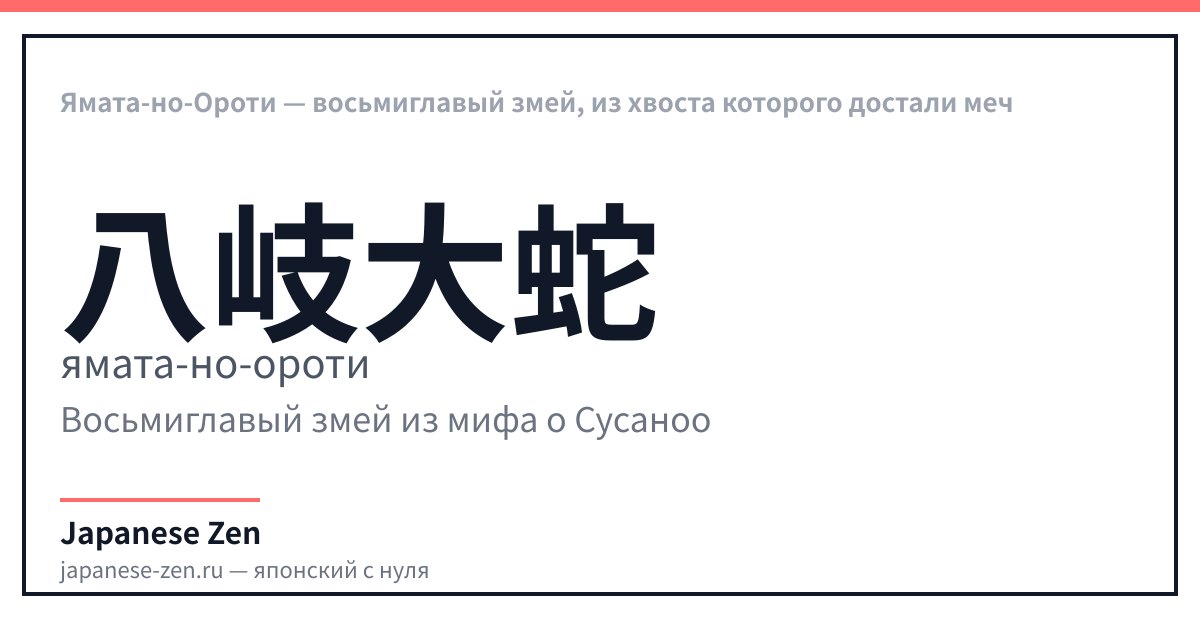
The myth is older than the writing system that recorded it: eight heads, a body eight valleys long, and a clever plan involving sake instead of a sword. For such a monster, the story has surprisingly little bloodshed — and surprisingly many consequences for Japanese statehood: the sword found in the tail became one of the three imperial regalia.
What "Yamata no Orochi" means
八岐大蛇 (Yamata no Orochi) is made up of 八岐 "eight forks" and 大蛇 "great serpent": orochi is not the ordinary word for a snake (that would be the simple 蛇, hebi), but a separate archaic term specifically for a mythical serpent-monster.
| Japanese | Reading | Translation |
|---|---|---|
| 八岐大蛇 | Yamata no Orochi · Yamata no Orochi | The eight-headed serpent from the myth of Susanoo |
| 須佐之男 | Susanoo · Susanoo | The god who slew the serpent |
| 出雲 | Izumo · Izumo | The region where the myth takes place |
| 草薙剣 | Kusanagi no Tsurugi · Kusanagi no Tsurugi | The sword found in the serpent's tail — an imperial regalia |
Why "eight" can mean "many"
In archaic Japanese, the numeral "eight" often means not an exact count but "very many" — just as in the expression 八百万 (yaoyorozu) "eight million gods," meaning simply "countless." In this sense, the eight heads and eight tails of Orochi are closer to "too many to count," though the Kojiki text itself gives that exact number, and in retellings it has long been taken literally.
The myth in full: how Susanoo killed it
The story is recorded in the Kojiki (712) and with variations in the Nihon Shoki (720). The god Susanoo, banished by the gods from the heavenly plain of Takamagahara, descends to the Hi River in the Izumo region and meets the weeping old couple Ashinazuchi and Tenazuchi with their daughter Kushinada-hime. The serpent Yamata no Orochi has already devoured her seven elder sisters and is due to come for her. The monster has eight heads and eight tails, its back overgrown with moss and trees, eyes red as winter cherry berries, and its body stretches across eight valleys and eight hills. Susanoo orders strong sake to be brewed and set out in eight vats; the serpent dips all eight heads into them at once, becomes drunk, and falls asleep. While the monster sleeps, Susanoo hacks it to pieces with his own sword.
What the Kusanagi sword has to do with it
Here it is worth separating two things: it was not Kusanagi that killed Orochi, but Susanoo's own sword — Totsuka no Tsurugi (十拳剣, "the ten-fist sword"). When the blade stuck on something hard in one of the tails, there Kusanagi no Tsurugi (also known as Ame no Murakumo no Tsurugi) was discovered. Susanoo presented the find to his sister, the goddess Amaterasu, and the sword eventually became one of the three imperial regalia of Japan.
蛇 — the serpent sign in the monster's name
The word "orochi" itself is not written with the modern character 蛇 — it is written with 大蛇. But 蛇 is the character used in Japanese for a snake in general. On the left is the radical 虫, historically a collective for small crawling creatures; on the right is the phonetic 它. This element in deep antiquity itself meant "snake," but later was taken over as a pronoun — and for "snake" a clarifying radical had to be added.
蛇 — значение: snake, serpent — онъёми: ジャ、ダ、イ、ヤ — кунъёми: へび — 11 штрих(ов). 蛇 — "snake": 11 strokes, radical 虫 on the left, phonetic 它 on the right. N1 level.
What parts make up the character
The pictograph 它 once really did depict a snake — with a curved body and a head. When this character was "taken away" to serve as a pronoun, a new character was formed for the meaning "snake": the same phonetic plus the radical 虫. This logic is clearly visible in the writing and explains why many "animal" kanji have a paired hint radical.
Write 蛇 along the guides and break down the stroke order.
What people get wrong about it
What is most often confused
- Orochi does not regrow severed heads — the Kojiki says nothing about regeneration, though it is often compared to the Greek Hydra purely on the basis of the number of heads.
- It was not Kusanagi that killed the serpent — Susanoo cut nothing with that sword: the sword, on the contrary, was found inside the carcass when Susanoo's blade stuck on something hard.
- "Eight heads" is probably not an exact count but an archaic way of saying "very many," as in the expression about eight million gods.
- Yamata no Orochi is not a "composite" monster like the nue: it has no parts from different animals, it is simply one serpent with eight heads and tails.
FAQ
- Who is Yamata no Orochi?
- An eight-headed, eight-tailed serpent from the Japanese myths the Kojiki and Nihon Shoki: its body overgrown with moss and trees, eyes red as winter cherry berries, and eight valleys and eight hills long. According to legend, it was about to devour yet another daughter of the local old couple when the god Susanoo stopped it.
- How did Susanoo defeat the serpent?
- He ordered strong sake to be brewed and set out in eight vats; the serpent dipped all eight heads into them at once, became drunk, and fell asleep. While the monster slept, Susanoo hacked it to pieces with his own sword — no magic, just ordinary cunning.
- Where did the Kusanagi sword come from?
- It was discovered inside one of the serpent's tails when Susanoo's sword stuck on something hard during the killing. Susanoo did not fight with this sword — he found it and presented it to the goddess Amaterasu; later the blade became one of the three imperial regalia of Japan.
- Why does Yamata no Orochi have exactly eight heads?
- That is the number given in the Kojiki text, but in archaic Japanese the numeral "eight" often simply means "very many" — as in the expression about eight million gods. The number most likely should not be taken literally, though in retellings it has long been fixed as an exact count.
- Where did the serpent live, according to the myth?
- By the Hi River in the ancient Izumo region — the territory of modern Shimane Prefecture. There Susanoo also meets the old couple Ashinazuchi and Tenazuchi with their daughter Kushinada-hime, whom the serpent was to receive.
- Are Yamata no Orochi and the nue the same thing?
- No, they are different monsters from different layers of mythology. Orochi is simply a serpent, albeit with eight heads, while the nue is a chimera assembled from parts of four different animals and appearing in a much later legend about the Heian court.
Sources
Updated: 2026-09-10