Ginkaku-ji — the Silver Pavilion that contains no silver
Ginkaku-ji (also written Ginkakuji) is the "Silver Pavilion," a Buddhist temple in Kyoto officially called Jishō-ji. It was never covered in silver: a 2007 study confirmed this, and the nickname "silver" first appears only in a 1658 guidebook — nearly a century and a half after the death of its builder, the retired shogun Ashikaga Yoshimasa.
Ginkaku-ji looks like the modest younger brother of the Golden Pavilion, but the difference between them is not in the metal — it is in the intent. If Kinkaku-ji is the brilliance of Kitayama culture, Ginkaku-ji is the restraint of Higashiyama culture, from which the aesthetic of wabi-sabi later grew. Let's look at where the "silver" name came from, what in the garden appeared only after the builder's death, and what the beginning of the tea room has to do with it.
Jishō-ji: the villa of Ashikaga Yoshimasa in the Higashiyama district
Ginkaku-ji (銀閣寺) is the common name of a Buddhist temple in the Higashiyama district of Kyoto, officially called Jishō-ji (慈照寺) and belonging to the Rinzai school. In 1482, the retired shogun Ashikaga Yoshimasa began building his own country villa here, modeled on the villa of his grandfather Yoshimitsu, which later became the Golden Pavilion. For the two-story pavilion itself, which is now called the "Silver Pavilion," the ceremony of raising the pillars and rafters was held in March 1489.
Yoshimasa never saw the pavilion completed
In October 1489, Yoshimasa fell seriously ill and died in early 1490, never seeing the building in its finished form — construction continued after his death. As with the Golden Pavilion, the villa became a Buddhist temple only after the owner's death: the estate was turned into a Rinzai school temple under the name Jishō-ji.
Why "silver": a nickname without a single gram of silver
The pavilion was never covered in silver — this was confirmed by a 2007 study that found no traces of silver in any period of the building's history. The upper tier was originally finished with black lacquer. The widespread versions "silver was planned but never applied" and "there was silver, but it flaked off over time" are nothing more than later folk interpretations with no support in historical sources.
The name appeared nearly a century and a half later
The nickname "Ginkaku," "Silver Pavilion," is first recorded in the 1658 guidebook "Rakuyō Meishōshū" — it was given already in the Edo period, as a counterpart to the "Golden Pavilion" Kinkaku-ji, not by Yoshimasa's contemporaries. The difference between the two pavilions is not in the metal: Kinkaku-ji embodies the brilliance of Kitayama culture in Yoshimitsu's time, while Ginkaku-ji embodies the restraint of Higashiyama culture in his grandson's time, from which the aesthetic of wabi-sabi later grew.
Ginshadan and Kogetsudai — the sand garden Yoshimasa never saw
In the garden by the pavilion, two sand mounds stand out: Ginshadan (銀沙灘), the "silver sand sea" — a flat platform with a wavy pattern, and Kogetsudai (向月台) — a cone-shaped hill, the "moon-viewing platform." Both elements look striking, but their current form owes nothing to Yoshimasa's time — they were rebuilt at the end of the Edo period, that is, they appeared more than two centuries after the pavilion itself.
Tōgu-dō: the hall where the tea room began
In the Tōgu-dō hall (東求堂), which survives from Yoshimasa's time, there is a small room called Dōjinsai (同仁斎) with an area of four and a half tatami mats. According to tradition passed down in tea ceremony history since the Edo period, this room is considered the prototype of the classic tea room of that size. The tea ceremony itself as a separate ritual took shape only later, in the following century.
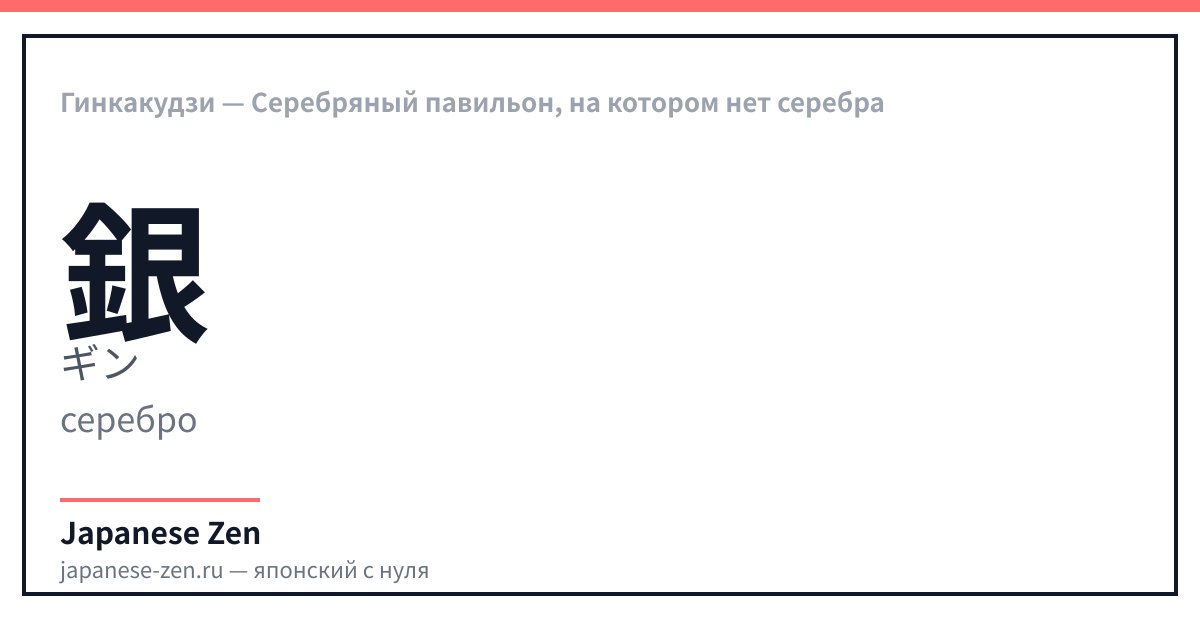
銀 — silver: the character that appears only in the nickname
銀 — значение: silver — онъёми: ギン — кунъёми: しろがね — 14 штрих(ов). 銀 — "silver": a character not found on the pavilion itself, but present in its nickname. The same character appears in 銀行, "bank," literally "silver row," and in 銀色, "silver color."
銀 is read gin in compound words and shirogane — rarely, as a standalone word. 銀行 (ginkō), "bank," historically goes back to the exchange of silver ingots; 銀色 (gin'iro) — "silver color," any shade of metallic gray. In the word 銀閣寺 itself, the character 銀 does not describe the building material — it is part of a nickname given a century and a half after Yoshimasa's death.
閣 — not just any building, but a tall pavilion
The second character of the nickname, 閣, means not a building in general, but a tall multi-tiered pavilion or superstructure — the same character appears in the name of the Golden Pavilion, Kinkaku-ji. The temple's official name, Jishō-ji (慈照寺), is structured differently: 慈 "mercy," 照 "to illuminate with light" — the posthumous honorary name of Yoshimasa himself, not a description of the building.
| Japanese | Reading | Translation |
|---|---|---|
| 銀閣寺 | Ginkaku-ji · Ginkaku-ji | Ginkaku-ji, the Silver Pavilion |
| 慈照寺 | Jishō-ji · Jishō-ji | Official name of the temple |
| 銀行 | ginkō · ginkō | Bank |
| 銀色 | gin'iro · gin'iro | Silver color |
| 水銀 | suigin · suigin | Mercury, literally "liquid silver" |
Write 銀 along the guides — the character for "silver" from the nickname of Ginkaku-ji.
FAQ
- What is Ginkaku-ji?
- A Buddhist temple in Kyoto officially called Jishō-ji, which the retired shogun Ashikaga Yoshimasa began building as a country villa in 1482. It is known as the "Silver Pavilion," although the building never had any silver.
- Why is Ginkaku-ji called "silver" if there is no silver there?
- A 2007 study found no traces of silver in any period of the building's history — the upper tier was originally covered with black lacquer. The versions that silver was planned or that it flaked off over time are later folk interpretations without support in sources.
- When did the pavilion start being called "silver"?
- The nickname "Ginkaku" is first recorded in the 1658 guidebook "Rakuyō Meishōshū" — already in the Edo period, nearly a century and a half after the builder's death. The name was given as a counterpart to the "Golden Pavilion" Kinkaku-ji, not by Yoshimasa's contemporaries.
- How does Ginkaku-ji differ from Kinkaku-ji in intent?
- Not by metal, but by aesthetics: Kinkaku-ji expresses the brilliance of Kitayama culture in the time of shogun Yoshimitsu, while Ginkaku-ji expresses the restraint of Higashiyama culture in the time of his grandson Yoshimasa. It was from this restraint that the aesthetic of wabi-sabi later grew.
- Were Ginshadan and Kogetsudai in the garden already in Yoshimasa's time?
- No: both sand mounds — Ginshadan and Kogetsudai — took their current form only at the end of the Edo period, more than two centuries after the pavilion itself. The garden seen today is very different from what surrounded the villa during Yoshimasa's lifetime.
- How is "Ginkaku-ji" written in Japanese?
- 銀閣寺, read ぎんかくじ. 銀 means "silver," 閣 means "tall pavilion," 寺 means "temple." The official name of the whole temple is Jishō-ji (慈照寺), "temple of the illumination of mercy" — the posthumous honorary name of Yoshimasa himself, not a description of the building.
Sources
Updated: 2026-09-15