Silence in Japanese: 静けさ (shizukesa) and 沈黙 (chinmoku)
Silence in Japanese is not one word but at least three. 静けさ (shizukesa) is the silence of a place: a garden, a forest, a room early in the morning. 沈黙 (chinmoku) is a person's silence, an act rather than the absence of sound around you. 無音 (muon) is the technical absence of sound, a term for recording and equipment. Confusing shizukesa with chinmoku is a common mistake: the first is about space, the second about the one who does not speak.
In English, "silence in the room" and "he kept silence" use the same word. In Japanese these are two different kanji combinations, because the silence of a place and a person's silence are different phenomena for the Japanese language.
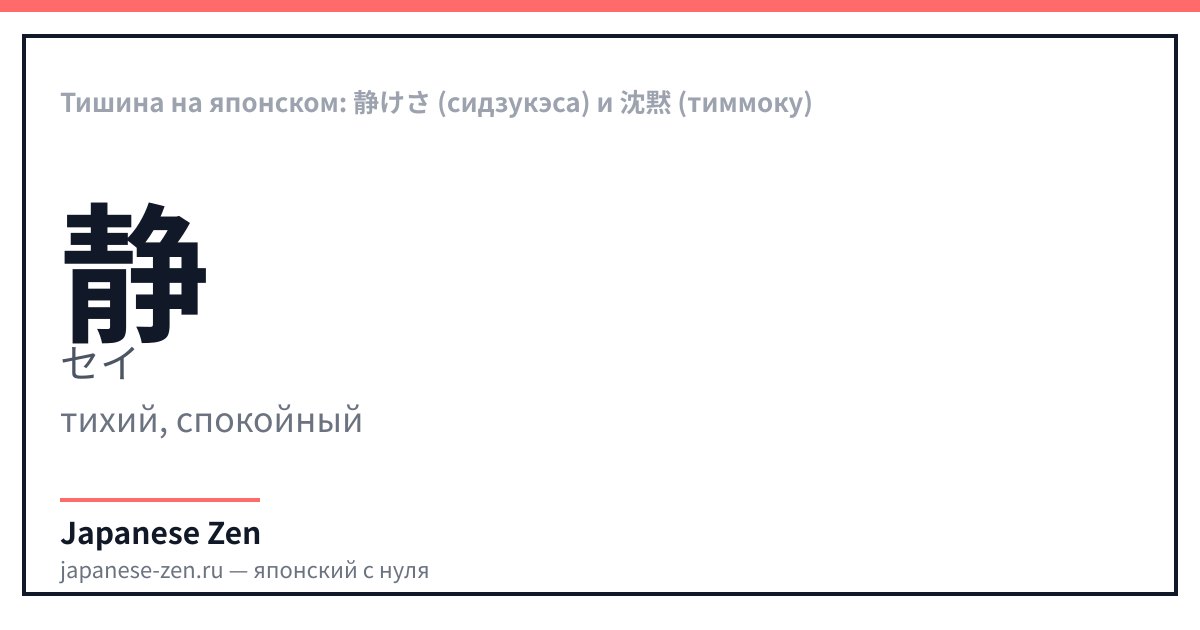
How "quiet" is written: the character 静
静 — значение: quiet, calm — онъёми: セイ、ジョウ — кунъёми: しず-、しず.か、しず.まる、しず.める — 14 штрих(ов).
What the parts of the character 静 mean
On the left of 静 is an element meaning "blue, pure" — historically it is also linked to freshness and clarity. The right part added the sense of "dispute, struggle," and together it read roughly as "calm after the agitation has settled." 静 itself is an adjective; 静か (shizuka) means "quiet, calm" and describes both a place and a person's character. From it comes the noun 静けさ — "silence" as a state that can be heard in a garden or a forest.
The silence of a place, a person's silence, the absence of sound
| Japanese | Reading | Translation |
|---|---|---|
| 静けさ | shizukesa · shizukesa | Silence of a place (the calm of a garden, a forest, early morning) |
| 静か | shizuka · shizuka | Quiet, calm (the adjective from which shizukesa is formed) |
| 沈黙 | chinmoku · chinmoku | Silence (an act of a person, not a property of a place) |
| 無音 | muon · muon | Absence of sound (technical silence: recording, equipment) |
| 静まり返る | shizumarikaeru · shizumarikaeru | To fall completely silent (an intensified form, about a sudden change) |
| 沈黙を守る | chinmoku o mamoru · chinmoku o mamoru | To keep silence (a set phrase with 沈黙) |
When to choose which word
静けさ describes a space: the silence of a temple, a snowy street, a room after the guests have left. It has a shade of beauty — it is not emptiness but a quality of the moment. 沈黙 applies only to people: someone holds a pause in a conversation, refuses to answer, keeps silent on principle. 無音 carries no emotion at all — it is a term used by a sound engineer or technician, "zero signal," not the atmosphere of a place.
Write 静 yourself
14 strokes: on the left the element "blue," on the right "dispute" — trace along the guides.
FAQ
- How do you say "silence" in Japanese?
- It depends on what kind of silence. The silence of a place is 静けさ (shizukesa), a person's silence is 沈黙 (chinmoku), and the technical absence of sound is 無音 (muon). There is no single universal word as in English.
- How does 静けさ differ from 沈黙?
- 静けさ is a property of a place: the silence of a garden or a room that anyone entering hears. 沈黙 is an action of a specific person: they are silent, do not answer, hold a pause. Confusing them means attributing to a space what a person is actually doing.
- How is the character 静 read?
- The kun reading is "shizu" in words like 静か and 静けさ; the on reading is "sei," found in terms like 静止 (seishi, "stillness"). On its own, without endings, the character is not read.
- What does 無音 mean and how does it differ from 静けさ?
- 無音 literally means "without sound" — a dry technical term for the complete absence of an audio signal, used in recording or when adjusting equipment. It has none of the shade of calm or beauty that 静けさ has: it is simply zero on the volume scale.
- Is Japanese silence connected with Zen Buddhism?
- The word 静けさ itself is ordinary everyday vocabulary, not a philosophical term. The practice of seated meditation, in which silence plays a special role, is called zazen, and that is a separate topic.
Sources
Updated: 2026-09-09