Shamisen — the Japanese three-stringed lute: how it sounds and where it came from
The shamisen (三味線) is a Japanese plucked instrument with three strings, a long fretless neck, and a square body covered in skin. It is played with a plectrum called a bachi, and its distinctive buzzing overtone, the sawari, sets it apart from a guitar or a banjo. The instrument came to Japan in the 16th century from Ryukyu via the port of Sakai, and ever since it has carried the part in kabuki, bunraku, and on the concert stage.
The shamisen's shape is simple — three strings, a neck, a body. But there is plenty of confusion around it: the instrument gets compared to a banjo, and its history is traced back to the Okinawan sanshin, even though the shamisen has traveled a very long way from the sanshin. Let's break down how it is built, the different types of shamisen, and what film and TV most often invent about this instrument.
How the shamisen is built and where it came from
The shamisen consists of three parts: a flat rectangular body covered in skin on both sides, a long neck without a single fret, and three silk strings stretched from the tuning pegs to the lower edge of the body. It is played with a plectrum called a bachi (撥) — a flat paddle, usually made of wood or tortoiseshell. The skin of the body was historically made from cat or dog skin; today, because of cost and animal protection, synthetic materials are increasingly used, while the Tsugaru shamisen traditionally holds on to dog skin longer than other types.
The shamisen owes its construction to the Ryukyuan sanshin (三線) — a three-stringed instrument with a body covered in snake skin, which came from Okinawa to mainland Japan in the 16th century, presumably through the trading port of Sakai near Osaka. On the mainland, the snake skin was replaced with cat or dog skin — no suitable snake was found in Japan — and within a few decades the instrument became a distinct one, with its own repertoire and technique.
How the shamisen sounds
The first, thickest string of the shamisen has a special device called sawari (さわり): at the upper nut it does not rest on it, but touches a small protrusion on the neck. Therefore, the string does not produce a pure tone, but a buzzing, slightly noisy overtone with rich harmonics. Without this overtone, the shamisen would sound drier, closer to a banjo: the sawari is not a defect of the instrument, but part of its characteristic timbre.
Hosozao, chūzao, futozao: three necks for different music
| Type | Neck | Where it is used |
|---|---|---|
| Hosozao (細棹) | thin | nagauta — music of the kabuki theater |
| Chūzao (中棹) | medium | jiuta, tokiwazu, kiyomoto, folk songs |
| Futozao (太棹) | thick | gidayū in bunraku theater, Tsugaru shamisen |
Tsugaru shamisen — a virtuoso style from the north
The Tsugaru shamisen is a variety with the thick futozao neck, which developed in the northern Tsugaru region of Honshu as an accompaniment to folk songs, and by the 20th century turned into an independent virtuoso genre with fast percussive plectrum techniques. Because of its sharp, percussive sound, it is sometimes compared to a rock guitar — the comparison is loose, but it conveys the energy of the performance.
三味線 — not 'three tastes', but an ateji with a Ryukyuan sound
三味線, if you read the characters literally, is 'three', 'taste', and 'thread, line': it gives the impression that the name means 'three tastes of the string'. That is not the case.
Three tastes or three strings
三味線 is an ateji: the characters were chosen to match the already existing sound of the word, not the other way around, and the character 味 'taste' here tells nothing about the instrument. The name was formed from the pronunciation of the Chinese 三弦 (sanxian, 'three strings') — the same word from which the Okinawan sanshin (三線), the direct ancestor of the shamisen, got its name.
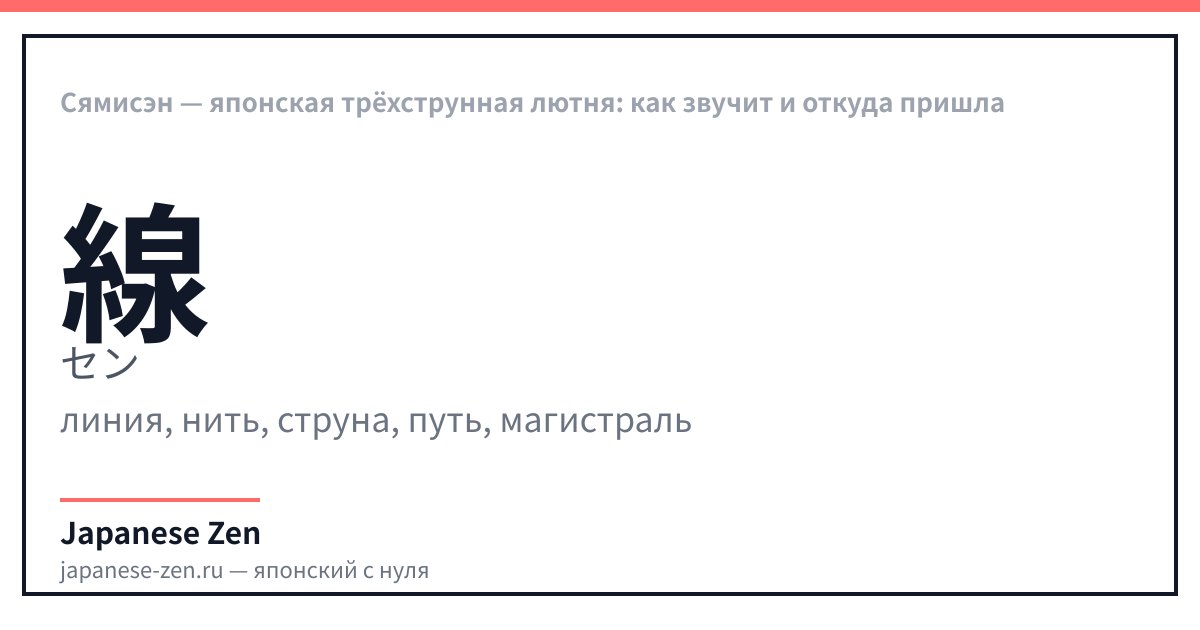
線 — значение: line, thread, string, route, trunk line — онъёми: セン — кунъёми: すじ — 15 штрих(ов). 線 — 'line, thread': in 三味線 this character names the string, a stretched line of sound. The same character appears in 光線 (kōsen) 'ray of light' and in 新幹線 (shinkansen), literally 'new trunk line', but in fact a high-speed train.
| Japanese | Reading | Translation |
|---|---|---|
| 三味線 | shamisen · shamisen | Shamisen |
| 三線 | sanshin · sanshin | Okinawan ancestor of the shamisen |
| 撥 | bachi · bachi | Plectrum for playing |
| 津軽三味線 | Tsugaru-jamisen · Tsugaru-jamisen | Virtuoso northern playing style |
| 線 | sen · sen | Line, thread, string |
| 弦 | gen · gen | String (general word) |
Write 線 along the guides — the character for 'line, thread', which forms the third part of the word 三味線.
The shamisen on screen: 'Kubo', 'Mashiro no Oto', and Ghost of Yōtei
The shamisen is a rare instrument in Western pop culture, but when it appears, it is usually not an accidental detail but part of the plot.
- 'Kubo and the Two Strings' (Laika studio, 2016) — the puppet hero brings origami to life by playing a magical shamisen that holds the whole story together.
- 'Mashiro no Oto' (ましろのおと, manga since 2010 by Ragawa Marimo; anime in spring 2021) — the plot is entirely about the Tsugaru shamisen: a young performer searches for her own sound after the death of her grandfather-teacher.
- 'Ghost of Yōtei' (Sucker Punch Productions, 2025) — the heroine Atsu wields the shamisen alongside weapons: playing the instrument is part of the gameplay.
- The band Wagakki Band, which began performing in 2013, uses the Tsugaru shamisen — it is played by Ninagawa Beni.
What film and TV simplify
In film and anime, the shamisen almost always sounds perfect from the first frames, and characters master it in just a few scenes. In reality, mastering a technique like the sawari takes many years of practice, and professional performers — for example, the Yoshida Brothers duo — hone their technique for years to reach concert level.
FAQ
- What is a shamisen?
- The shamisen is a three-stringed plucked instrument with a long fretless neck and a square body covered in skin. It is played with a plectrum called a bachi, and its special buzzing overtone, the sawari, makes its sound recognizable from the first notes. It has carried the part in kabuki, bunraku, and on the concert stage for several centuries.
- How many strings does a shamisen have?
- Three strings, stretched from the tuning pegs to the lower edge of the body: they are distinguished by thickness and called the first, second, and third. Originally they were made of silk dyed yellow with turmeric; today modern materials are more often used, especially for the Tsugaru shamisen.
- How does the shamisen differ from the sanshin?
- The sanshin (三線) is the Okinawan ancestor of the shamisen, with a body covered in snake skin and a shorter neck. The shamisen appeared on the mainland in the 16th century, when snake skin was replaced with cat or dog skin, the neck was lengthened, and the instrument's sound and repertoire went their own way.
- What is a shamisen made of?
- The neck is carved from hard wood — rosewood, sandalwood, less often oak or mulberry — and the body is covered in skin: historically cat or dog skin, today increasingly synthetic because of cost and animal protection. The strings are silk, and the bachi plectrum is made of wood or tortoiseshell.
- In which anime is the shamisen played?
- The shamisen is the main theme of the anime 'Mashiro no Oto' (2021) about the Tsugaru shamisen. In film, it is played by the puppet hero of the animated movie 'Kubo and the Two Strings' (Laika, 2016), and in the game 'Ghost of Yōtei' (2025) shamisen playing is part of the heroine's arsenal alongside weapons.
- How is 'shamisen' written in kanji?
- 三味線, read as しゃみせん. Literally the characters combine 'three', 'taste', and 'thread', but this is ateji: the characters were chosen for the sound of the word, not its meaning. The name goes back to the Chinese 三弦 (sanxian, 'three strings') via the Okinawan sanshin.
Sources
Updated: 2026-09-14