Koto — the Japanese 13-string zither: how it is played
The koto is a Japanese stringed zither: thirteen silk or nylon strings, movable ji bridges that set the pitch of each note, and tsume picks worn on the fingers of the right hand. The body is traditionally carved from paulownia wood. There is also a larger, seventeen-string version — created in the 20th century by Miyagi Michio, composer of the famous melody "Haru no Umi" (The Sea in Spring).
Over its fifteen-hundred-year history, the koto has accumulated some confusion: the instrument is written sometimes as 箏 and sometimes as 琴, though these are two different characters. And the zither itself is constantly compared either to the Chinese guzheng or to the Western harp. Let's look at where the koto came from, how it is played, and why no Japanese New Year is complete without it.
Thirteen strings, ji bridges, and a sound from the Nara period
The koto came to Japan from China in the Nara period, in the 8th century, as one of the instruments of the gagaku court orchestra, and for its first centuries it was heard exclusively there. The body, about 1.8 meters long, is carved from paulownia wood (kiri, 桐) — light and soft, and it resonates well; thirteen strings are stretched along the entire body.
The pitch of each string is set not with a tuning peg, as on a guitar, but with a movable bridge called ji (柱), which is shifted along the body before playing. The instrument is played with tsume (爪) picks worn on the thumb, index, and middle fingers of the right hand — while the left hand presses the strings behind the bridges, slightly changing the pitch.
Why the koto is played to welcome the New Year
In 1929, the composer and performer Miyagi Michio wrote a duet for koto and shakuhachi called "Haru no Umi" (春の海, The Sea in Spring). Since then, this melody has been played every year on Japanese television and in shopping malls at New Year, and for many Japanese it has become as much a symbol of the holiday as the chime of bells. Miyagi himself later also created a seventeen-string version of the koto for a lower, orchestral sound.
Back in the 17th century, the blind musician Yatsuhashi Kengyō retuned the koto to a new style that was then coming into fashion in urban music. He also wrote the piece "Rokudan" (六段) — today perhaps the most famous standalone composition for this instrument.
箏 or 琴: a thousand years of confusion
The word "koto" has confusion around two different characters. 箏 (sō, in everyday reading — koto) is an instrument with movable bridges and usually thirteen strings. 琴 (kin, also sometimes read koto) is an old Chinese seven-string instrument without bridges, where the pitch is changed by pressing the string with a finger directly against the body. These are two different instruments, not variants of one.
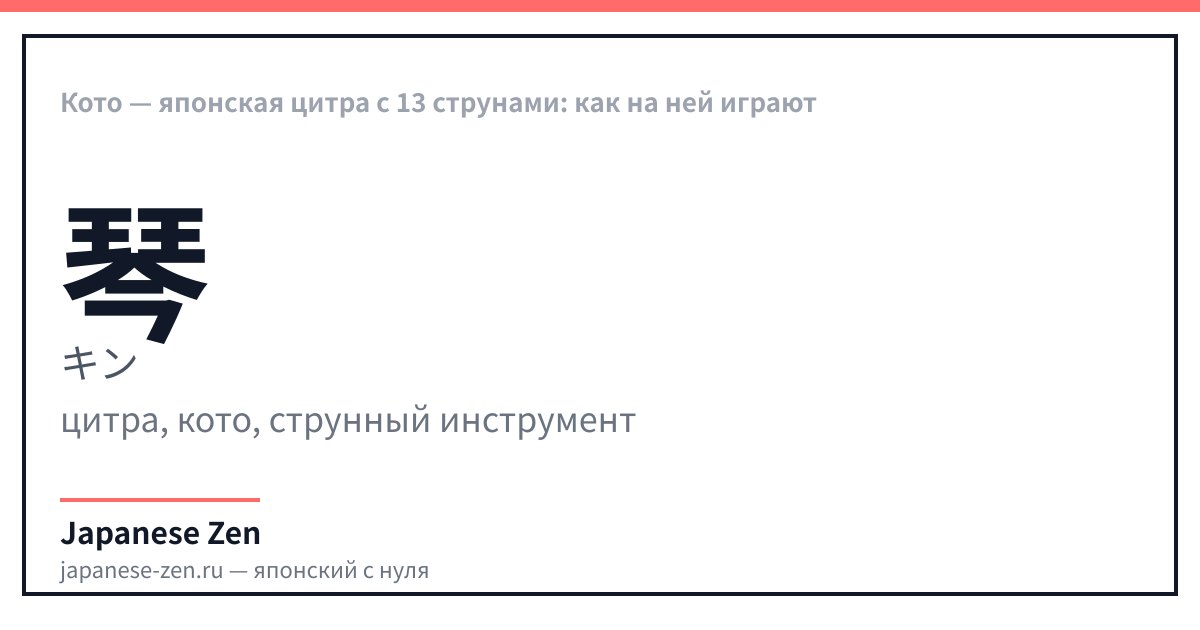
琴 — значение: zither, koto, stringed instrument — онъёми: キン、ゴン — кунъёми: こと — 12 штрих(ов). 琴 — "zither, koto": in 木琴 (mokkin) the same character denotes not a stringed but a percussion instrument — a xylophone, literally "wooden koto". In modern writing, 琴 everywhere replaces the more precise but complex character 箏 — so often that for most readers they mean the same thing.
Which of the two characters is correct
Formally, the correct character for the instrument with bridges is 箏, and dictionaries distinguish 箏 and 琴 as two different words. But in everyday texts, signs, and even the names of koto clubs, the simpler 琴 is almost always written — this is how it has historically developed, not because someone once made a mistake.
| Japanese | Reading | Translation |
|---|---|---|
| 箏 | koto · koto | Koto (strict spelling) |
| 琴 | koto · koto | Koto (common spelling) |
| 柱 | ji · ji | Movable bridge under the string |
| 爪 | tsume · tsume | Plectrum pick worn on the finger |
| 春の海 | Haru no Umi · Haru no Umi | "The Sea in Spring", a New Year melody |
| 十七絃 | jūshichigen · jūshichigen | Seventeen-string koto |
Write 琴 along the guides — the most common everyday character for koto, though the strict variant for this instrument is 箏.
The koto today: ryū schools, weddings, and New Year
Today the koto is taught in private ryū schools — for example, the largest traditions, Ikuta-ryū and Yamada-ryū, date back to the 17th–18th centuries — as well as in music lessons at some schools. The koto is heard at wedding ceremonies, in contemporary ensembles where it is combined with electric guitar or orchestra, and in the soundtracks of films and games with historical settings.
Koto and gusli: are they similar
The koto and the Western harp have an outward resemblance: both instruments have many strings stretched along a resonating body. But this is a similarity of instrumental type, not of kinship — plucked zithers with a similar construction appeared independently in different parts of the world, from China to Scandinavia. There is no direct historical connection between the koto and the harp.
FAQ
- What kind of instrument is the koto?
- The koto is a Japanese stringed zither with a long body made of paulownia wood: the sound is produced by plucking the strings with tsume picks on the fingers of the right hand, and the pitch of each note is set by a movable ji bridge. The instrument came from China in the Nara period, in the 8th century.
- How many strings does a koto have?
- A classical koto has thirteen strings. In the 20th century, the composer Miyagi Michio also created a larger, seventeen-string version — it sounds lower and is more often used in ensemble rather than solo concert music.
- How is "koto" written in Japanese?
- The strict spelling is 箏, but in everyday use the simpler character 琴 is written almost everywhere — formally it means a different instrument, without bridges, but it has long been used as a substitute. Both variants are read the same — こと.
- What music is played on the koto?
- From gagaku court music and old pieces like Yatsuhashi Kengyō's "Rokudan" to Miyagi Michio's New Year melody "Haru no Umi" and modern pop arrangements. The koto is taught in private ryū schools, the most famous of which are Ikuta-ryū and Yamada-ryū.
- Is the koto similar to the Western harp?
- Outwardly, yes: both zithers lie horizontally and are played by plucking strings stretched along the body. But this is a similarity of construction type, not of kinship: similar instruments appeared independently in different cultures, from Japan to Scandinavia.
Sources
Updated: 2026-09-14