Japanese hope kanji: 希望 — what it consists of
The Japanese hope kanji is a combination of 希 (rare, to desire) and 望 (to look into the distance, to hope). Together 希望 (kibō) means “hope.” The first character 希 carries the nuance of “rare, desired,” the second 望 literally means “to gaze into the distance,” hence the meaning: hope as a gaze beyond the horizon.
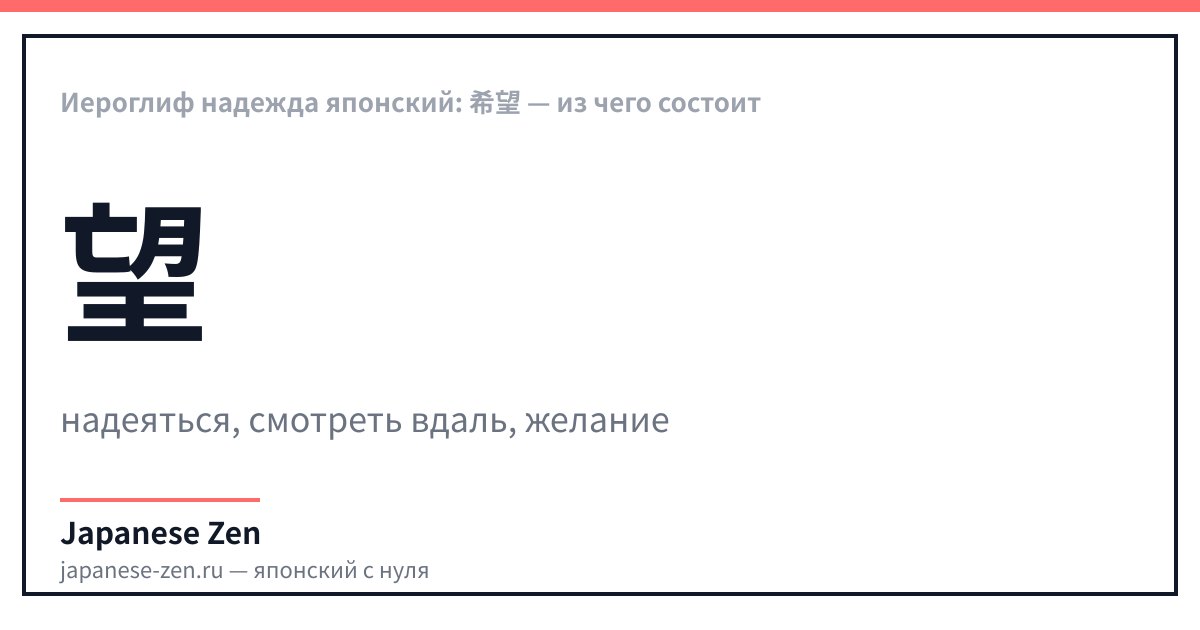
Japanese hope is assembled from rarity and a distant gaze: 希 — that which is encountered rarely, 望 — to look where nothing is yet visible. Together it is not “belief that everything will be fine,” but “desire for what is still far away.”
How the hope kanji is written in Japanese
望 — значение: to hope, to look into the distance, desire — онъёми: ボウ、モウ — кунъёми: のぞ.む、もち — 11 штрих(ов). The second character of the word 希望. Click “Show stroke order” — 亡 and 月 on top, 王 below.
The first character — 希
希 means “rare, desired”: the same character in 希少 (kishō) “rare” and in 希 as an element of names. In the pair 希望 it adds the nuance of “something you want and that rarely happens” — hope here is about exceptionality, not certainty.
Words about hope and desire
| Japanese | Reading | Translation |
|---|---|---|
| 希望 | kibō · kibō | Hope |
| 願い | negai · negai | Wish, request, prayer |
| 夢 | yume · yume | Dream, sleep |
| 望む | nozomu · nozomu | To wish, to hope |
| 絶望 | zetsubō · zetsubō | Despair (the same 望 with “to cut off” 絶) |
| 希望を持つ | kibō o motsu · kibō o motsu | To keep hope |
Hope, dream, and wish — three different words
希望 (kibō) — hope as expectation of something specific: it is “held” and “lost.” 夢 (yume) — a dream, often distant and big. 願い (negai) — a wish that is expressed: it is what is written on temple plaques. One does not replace the other.
Write 望 yourself
Trace 望 along the guides: the character is built in three tiers, and the bottom one is the widest.
FAQ
- What signs does 希望 consist of?
- The word “hope” is written with two characters — 希望 (kibō): 希 “rare, desired” and 望 “to look into the distance, to hope.”
- How do you say “hope” in Japanese?
- 希望 (kibō). “To keep hope” — 希望を持つ, “to lose hope” — 希望を失う, and “despair” — 絶望 (zetsubō).
- How is hope different from a dream?
- 希望 — expectation of something concrete, 夢 (yume) — a dream, usually big and distant, 願い (negai) — an expressed wish that is written on temple plaques.
- Is 希望 suitable for an inscription?
- Yes, it is an existing word. You need to write both characters: a single 望 is read as the root of the verb “to wish,” not as “hope.”
Updated: 2026-07-25