Amae — the right to lean on another: Takeo Doi's concept
Amae (甘え) is a concept in Japanese psychology: the need and unspoken right to rely on another person's goodwill, as a child relies on a parent. The word derives from the verb 甘える — "to act sweetly, to count on indulgence" — the same root as 甘い "sweet." Psychiatrist Takeo Doi described amae in a 1971 book and showed that it lives far beyond parent-child relationships.
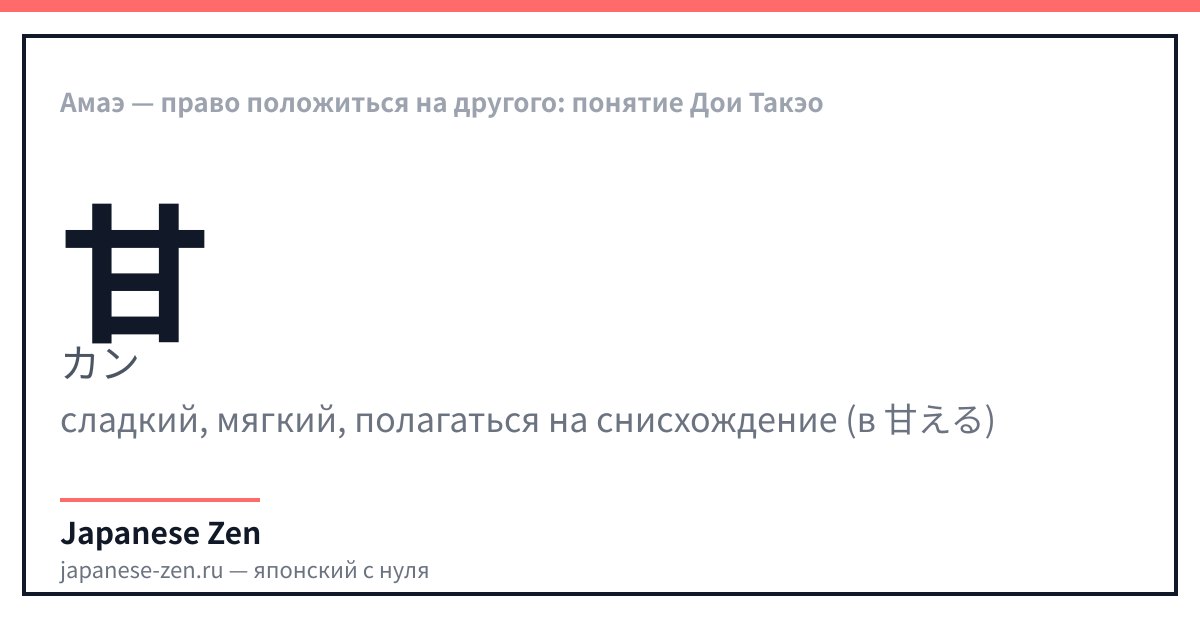
Amae is often called an "untranslatable" and "purely Japanese" feeling, though the author of the concept himself did not think so. Let's look at the exact meaning of the word, Takeo Doi's book that made amae known outside Japan, and where this need to lean on another shows up in everyday life — without labels like "infantility" or national exceptionalism.
Sweet indulgence: what the word "amae" means
甘え (amae) is a noun from the verb 甘える (amaeru): "to act sweetly, to count on another's indulgence, to expect to be pampered." The same root as in 甘い "sweet": amae is literally about the feeling that you are allowed to be weaker and more dependent than the formal rules of the relationship require, and to count on that being accepted.
From infant to adult — the same model
Takeo Doi saw the prototype of amae in the infant's relationship with its mother: the child does not yet perceive itself as separate from her and counts on care without asking for it directly. According to his theory, the same need to rely on another's goodwill continues to operate in adult life too — in the family, at work, between teacher and student — just in different forms.
The 1971 book that made amae noticed worldwide
Takeo Doi, a psychiatrist and psychoanalyst, set out the concept of amae in the book 甘えの構造 (1971) — it became a bestseller in Japan and one of the most famous books on the Japanese national character. In 1973, John Bester's English translation "The Anatomy of Dependence" was published by Kodansha, after which the word amae entered the vocabulary of Western Japanologists as well.
Is amae really a purely Japanese feeling?
Critics of the "nihonjinron" genre — theories about the uniqueness of the Japanese — reproached Doi for exaggerating the exceptionality of amae, though a similar need to rely on others exists in other cultures too. Doi himself later clarified his position: according to him, it is not the need itself that is unique, but the fact that the Japanese language found a separate, frequently used word for it.
Family and dojo: where amae shows up most clearly
Researchers most often notice amae where relationships are unequal but kind. The first example is parents and adult children who continue to count on the family's support. The second example is mentor and student in traditional arts, where the student is entitled to count on the master's patience.
Amae is not a diagnosis or a weakness
The word is easily confused with a reproach for adult dependency, but for Doi it is not a pathology but an ordinary human need that simply manifests differently in different relationships. Healthy amae presupposes that the other side is also ready to accept it — if they are not, the need turns into disappointment rather than connection.
甘: one character for "sweet" and for "to lean on"
甘 — значение: sweet, mild, to rely on indulgence (in 甘える) — онъёми: カン — кунъёми: あま.い、あま.える、あま.やかす、うま.い — 5 штрих(ов). 甘 — "sweet": the basic meaning is visible in 甘い (amai) "sweet, mild," and the figurative meaning, about relationships between people, in 甘える (amaeru) "to rely on another's goodwill" and in the word 甘え itself.
Four ways to read one character
The on'yomi of 甘 is カン (kan); the kun'yomi are あまい (amai) "sweet," あまえる (amaeru) "to act sweetly, to rely on indulgence," and あまやかす (amayakasu) "to spoil, to indulge." The last word is no longer about the one who counts on amae, but about the one who gives in to it: 甘やかす — "to spoil a child," a view from the adult's perspective, not the child's.
| Japanese | Reading | Translation |
|---|---|---|
| 甘え | amae · amae | The need to rely on another's goodwill |
| 甘える | amaeru · amaeru | To act sweetly, to count on indulgence |
| 甘やかす | amayakasu · amayakasu | To spoil, to indulge — from the adult's side |
| 甘えん坊 | amaenbō · amaenbō | A clingy, attention-dependent person |
Trace 甘 along the guides — the character for "sweet," from which the word "amae" is formed.
FAQ
- What does the Japanese word "amae" mean?
- Amae (甘え) is the need and unspoken right to rely on another person's goodwill, as a child relies on a parent. The word derives from the verb 甘える "to act sweetly, to count on indulgence" and is related to 甘い "sweet" — they share a common root.
- Who introduced the concept of "amae" into psychology?
- Psychiatrist and psychoanalyst Takeo Doi described amae in the 1971 book 甘えの構造 — it became a bestseller and one of the most famous books on the Japanese national character. In 1973, the English translation "The Anatomy of Dependence" was published, translated by John Bester.
- How is "amae" written in kanji?
- 甘え, read あまえ — a noun from the verb 甘える (amaeru). Both words begin with the same character, 甘, which in other combinations simply means "sweet": for example, 甘い (amai) — "sweet, mild in taste."
- Is it true that amae is a uniquely Japanese feeling?
- Not exactly. Critics reproached Takeo Doi for exaggerating the uniqueness of amae, though a similar need to rely on others exists in other cultures too. Doi himself later clarified: it is not the phenomenon itself that is unique, but the fact that the Japanese language found a separate, frequently used word for it.
- In which relationships does amae manifest most strongly?
- It is most often noticed where relationships are unequal but benevolent. These are parents and adult children who continue to count on the family's help, and also mentor and student in traditional arts, where the student is entitled to count on the master's patience.
- Is amae the same as being spoiled?
- No. Being spoiled is the result of someone giving in too easily to another's amae (甘やかす, "to spoil"). Amae itself is an ordinary human need to rely on another's goodwill, which, according to Doi, everyone has, just to varying degrees and in different forms.
Sources
Updated: 2026-09-15