Ryokan — a Japanese inn: tatami, futon and dinner in your room
Ryokan (旅館) is an inn in the Japanese style: a room with tatami, a futon laid out on the floor at night instead of a bed, a yukata instead of loungewear, and dinner and breakfast that come with the stay. What sets a ryokan apart from an ordinary hotel is not just the furnishings but the rhythm of the evening itself: you don't just stop by for the night — you stay for the whole way of things, from the hot bath to a leisurely dinner and breakfast before you leave.
It's easy to mistake a ryokan for just a hotel with tatami, but the difference goes deeper than the interior: it's in the way of things, in the hotel business law, and in the word itself, which for centuries didn't mean quite the same thing. Let's look at how a ryokan differs from a minshuku and a business hotel, where the word came from, and what a certain inn listed in the Guinness Book of Records has to do with it.
Tatami, futon and dinner on the bill: what makes up a ryokan
Ryokan (旅館) is an inn in the Japanese style: the room is covered with tatami rather than carpet, you sleep on a futon that is spread out on the floor at night and put away in a cupboard during the day, and instead of loungewear guests are given a yukata. Dinner and breakfast are almost always included in the price of the night and are served either in your room or in a shared dining room — the set of dishes is often called kaiseki.
A ryokan is not about a quick overnight stay
In an ordinary hotel, a guest usually just sleeps and leaves, but in a ryokan the night is built around the way of things itself: a hot bath before dinner, a leisurely dinner, breakfast before departure. In a traditional ryokan, this routine is looked after by a maid called a nakai — she also greets the guest, serves the food and lays out the futon.
Ryokan, minshuku and business hotel: one category in law, different ways of doing things
The Hotel Business Act (旅館業法) divides the hotel business by type of accommodation, not by the name of the establishment. Until 2018, hotels and ryokan were officially listed as separate categories with different minimum numbers of rooms, but an amendment that same year merged them into one — 'ryokan and hotel' (旅館・ホテル営業). Today the difference between a ryokan and a business hotel is not in the law but in the way of things chosen by the owner.
| Feature | Ryokan | Minshuku | Business hotel |
|---|---|---|---|
| Room | Tatami, futon | Tatami or a simple room, often in the owners' house | Western-style bed |
| Meals | Dinner and breakfast almost always included | By arrangement, often home cooking | Usually not included |
| Service | Nakai maid, a special evening routine | The owners themselves, family-style | Minimal personal contact |
| Scale | From a few rooms to large resort complexes | Small, often a single building | From small to chain hotels |
Minshuku — a ryokan in miniature
A minshuku (民宿) is simpler than a ryokan: it is often part of the owners' home, and running the inn is not their only occupation. In terms of the way of things, a minshuku is closer to a ryokan than to a business hotel, but without professional staff and usually without a separate building just for guests.
From Edo-era roadside hatago to the inn that made it into Guinness
旅館 literally means 'house for the traveller': 旅 'journey' plus 館 'building, house'. The predecessors of modern ryokan are considered to be the roadside hatago — inns on the five main routes of the Edo period — and separate inns at onsen. It is difficult to draw a direct, documented line from the hatago to today's ryokan: it is more a general tradition of Japanese hospitality on the road than an exact institutional inheritance.
The oldest hotel in the world — in the Guinness Book of Records
Keiunkan in the village of Hayakawa, Yamanashi Prefecture, is a ryokan at an onsen spring that was entered into the Guinness Book of Records in 2011 as the oldest operating hotel in the world. According to legend, it was founded in 705: Fujiwara Masato, while hunting in the mountains, found a spring gushing among the rocks and built a bathing house next to it. No one has ever verified the legend with documents, but the status in the Guinness Book of Records is a fact, not a legend.
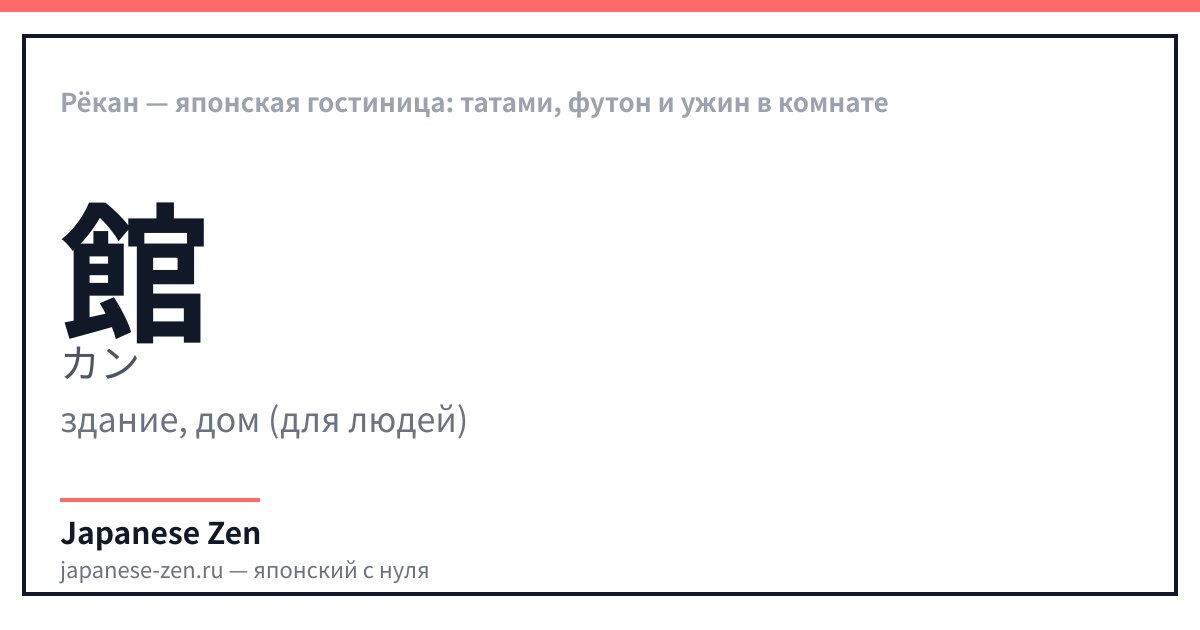
館 — a building for people: the character from the word 'ryokan'
館 — значение: building, house (for people) — онъёми: カン — кунъёми: やかた、たて — 16 штрих(ов). 館 — 'building, house for people': the second character in 旅館. The same character appears in 図書館, 'library', and 美術館, 'museum': it is used to form the names of buildings where people come for a purpose.
館 is read kan in compound words, and as a standalone word it is yakata, meaning a large traditional house. 図書館 (toshokan) is made up of 図書 'books' and 館; 映画館 (eigakan) is made up of 映画 'film' and the same 館. The logic is the same: add 館 to what people do in the building, and you get its name.
旅 — travel itself
The first character of the word 旅館, 旅, means 'journey' and is read ryo in compound words, tabi on its own. 旅行 (ryokō), 'trip, journey', is the most common word with this character in everyday speech, far more common than 旅館 itself.
| Japanese | Reading | Translation |
|---|---|---|
| 旅館 | ryokan · ryokan | Ryokan |
| 民宿 | minshuku · minshuku | Minshuku, a family-run inn |
| 図書館 | toshokan · toshokan | Library |
| 映画館 | eigakan · eigakan | Cinema |
| 旅行 | ryokō · ryokō | Trip, journey |
Write 館 along the guides — the 'building for people' character from the word 'ryokan'.
FAQ
- What is a ryokan?
- An inn in the Japanese style: a room with tatami, a futon instead of a bed, a yukata instead of loungewear, and dinner and breakfast that are almost always included in the price of the night. The evening routine here is just as important as the room itself.
- How does a ryokan differ from an ordinary hotel?
- Not only in the tatami and futon instead of a bed, but also in the routine: in a hotel you usually just sleep, while in a ryokan the evening is built around a hot bath, a shared dinner and the care of a nakai maid. Since 2018, ryokan and hotel are legally one category — the difference is in the way of things, not in the law.
- How does a ryokan differ from a minshuku?
- A minshuku is simpler: it is often part of the owners' home, and the inn is not their only occupation. In terms of the way of things, a minshuku is closer to a ryokan than to a business hotel, but without professional staff and without a separate building just for guests.
- Where does the word 'ryokan' come from?
- 旅館 literally means 'house for the traveller': 旅 'journey' plus 館 'building'. Its predecessors are considered to be the roadside hatago of the Edo period and inns at onsen, although it is difficult to trace a direct documented line from them to today's ryokan.
- Which inn in Japan is the oldest in the world?
- Keiunkan in Yamanashi Prefecture, a ryokan at an onsen spring: in 2011 it was entered into the Guinness Book of Records as the oldest operating hotel in the world. According to legend, it was founded in 705, although no one has ever verified the legend with documents.
Sources
Updated: 2026-09-15