Kamakura: the city of shoguns, the Great Buddha, and the sea an hour from Tokyo
Kamakura is a coastal city near Tokyo that became the seat of Japan's first shogunate at the end of the 12th century. The name 鎌倉 is read "Kamakura": the first character means "sickle," the second "storehouse, granary," but the place name itself is older than any explanation through the meanings of the characters, and there are several theories about its origin. Today the city is known for its open-air Great Buddha, its Zen temples, and the little train that runs along the sea.
We'll look at where the city's many interpretations of its name come from — from the local terrain to the legend of a buried sickle — and why none of them can be called proven. We'll find out why Minamoto no Yoritomo chose this very place as his seat, why the Kamakura period has two possible starting years, and what happened to the hall that once covered the Great Buddha. And at the end — the character 倉 from the city's name and a snow hut with the same name that has nothing to do with it.
"Sickle" and "storehouse": two characters, seven theories of origin
The name 鎌倉 is made up of the characters 鎌 "sickle" and 倉 "storehouse, granary," but as a place name it is most likely not directly connected to either sickles or storehouses. The most common theory among historians is topographical: "kama" here means "a curved cliff, a slope," and "kura" is an old word for "valley, ravine" — together, something like "valley beneath the cliff." A close variant of the same reading also exists: "kama" as "cave," "kura" as "rock."
Legends that are also seriously discussed
There are theories of a completely different kind: one tradition links the name to the general Fujiwara no Kamatari, who is said to have buried a sickle here after a prophetic dream — hence "sickle" and "storehouse," where it was hidden. Another legend traces the name to "kabane-kura," "storehouse of bodies," supposedly left after the campaign of the legendary Emperor Jimmu. Among the rarer versions is an origin from an Ainu word meaning "mountain pass." None of the theories has exact proof: the place under this name is already mentioned in the Kojiki chronicle of 712, long before any of the legends were linked to the word.
A Buddha without a roof, the Zen "Five Mountains," and a train by the sea
The city's main symbol is the bronze Buddha Amida at Kotoku-in, cast in the mid-13th century: the statue is about 11.3 meters tall and weighs roughly 121 tons. Originally a wooden hall sheltered the statue, but it did not survive the elements: chronicles mention collapses in 1335 and 1369, and at the end of the 15th century a tsunami washed the hall away — different chronicles give different years. It was never rebuilt — unlike the Great Buddha at Todai-ji, the one in Nara: that statue is five centuries older, stands in a different temple, and is noticeably larger.
"Five Mountains" — not shrines, but a place in the ranking
Gozan, the "Five Mountains system," was a way borrowed from China of ranking Zen temples by status; in Japan it was introduced at the end of the Kamakura period. Both Kyoto and Kamakura got their own five highest temples: the local five are Kencho-ji, Engaku-ji, Jufuku-ji, Jochi-ji, and Jomyo-ji, and Kencho-ji is considered the first in rank. To the south the city meets Sagami Bay with three beaches at once — Yuigahama, Zaimokuza, and Koshigoe — and the old Enoden train runs right along the shore.
From Minamoto no Yoritomo's seat to the end of the shogunate
In 1180 Minamoto no Yoritomo chose Kamakura as his base in the war against the Taira clan: he also moved the Tsurugaoka Hachimangu shrine here, and the first organs of the future military government appeared in the city. The country's first shogunate is sometimes dated from 1185, when Yoritomo's troops defeated the Taira, and sometimes from 1192, when he received the title of sei-i taishogun: there is no single start date for the Kamakura period, and historians give both.
Why the city stopped being the country's center
In 1333 troops loyal to Emperor Go-Daigo took Kamakura, and the Hojo clan, which ruled in the name of the shoguns as shikken regents, fell along with its power. The new Muromachi shogunate established itself in Kyoto and left Kamakura to deputies: for more than a century they governed the ten eastern provinces from here. Then they too left, and the city remained with its temples but without a political role.
倉 — the storehouse that became the second character in the city's name
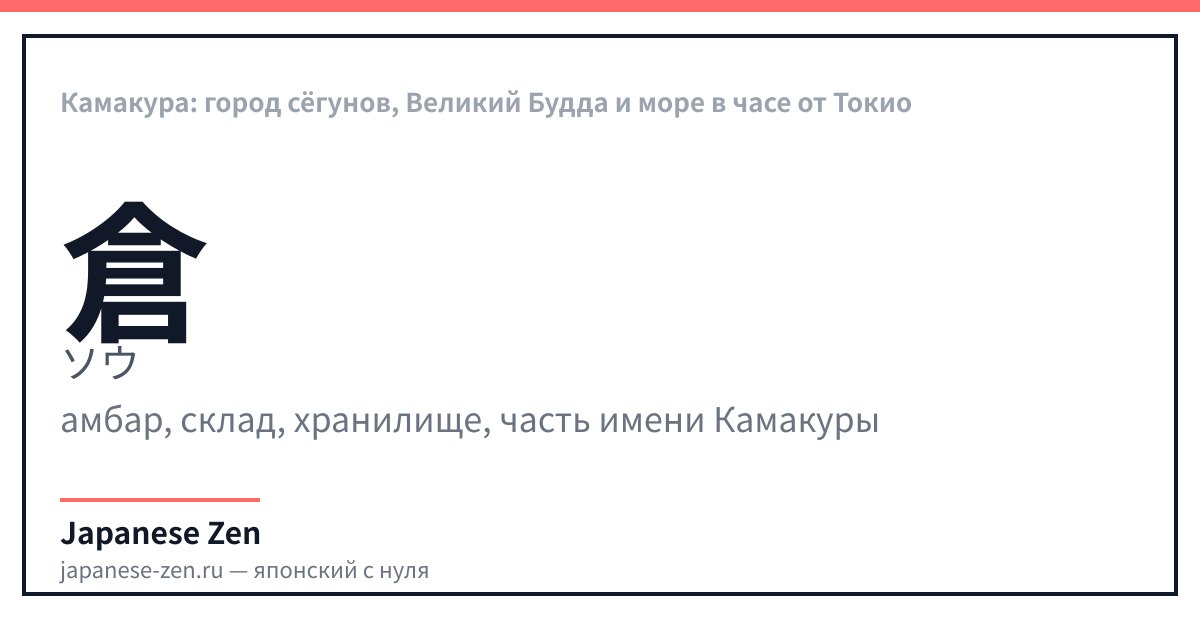
倉 is the second character in the name Kamakura, "storehouse, granary": according to one theory, together with the first character 鎌 "sickle" it does not describe the city literally but goes back to old words for the terrain — a cliff and a ravine. The same character appears in the ordinary word 倉庫, "warehouse," and in 穀倉 (kokuso), "granary."
倉 — значение: storehouse, granary, warehouse, part of the name Kamakura — онъёми: ソウ — кунъёми: くら — 10 штрих(ов). 倉 — "storehouse, granary": the second character in the name Kamakura. The same character appears in the ordinary word 倉庫 "warehouse" and in 穀倉, "granary."
The on reading ソウ and the kun reading くら
The on reading of 倉 is ソウ (sō), found in words like 倉庫 "warehouse"; the kun reading is くら (kura), and this word also lives on its own, "storehouse." In the city's name itself it is the kun reading that works: 鎌倉 is kama "sickle" plus kura "storehouse," two kun readings in a row.
The winter "kamakura" — a snow hut with the same name but no connection to the city
In northern Japan, in Akita and neighboring regions, people build snow huts in winter and call them "kamakura" — the same word, but without fixed characters, just by sound. Attempts to link this custom to the shogunate or to a legendary warrior named Kamakura Gongoro are a pretty but, according to authoritative reference works, later stretch: it is a chance coincidence of sound, not a common origin.
| Japanese | Reading | Translation |
|---|---|---|
| 鎌倉 | Kamakura · Kamakura | Kamakura — the city's name itself |
| 鎌倉時代 | Kamakura jidai · Kamakura jidai | The Kamakura period — the era of the first shogunate |
| 倉庫 | sōko · sōko | Warehouse — an ordinary word with the same character 倉 |
| 穀倉 | kokusō · kokusō | Granary, grain storehouse — a word with the same character 倉 |
| かまくら | kamakura · kamakura | A snow hut in northern Japan — a homonym with no connection to the city |
Write 倉 along the guides — the "storehouse" character, the second in the name Kamakura.
FAQ
- What kind of city is Kamakura and where is it located?
- Kamakura is a coastal city in Kanagawa Prefecture, about an hour from Tokyo. At the end of the 12th century it became the seat of Japan's first shogunate, and today it is known for its Buddhist temples, its open-air Great Buddha, and its beaches on Sagami Bay.
- What is known about the origin of the name "Kamakura"?
- There is no single answer: dictionaries give several theories at once. The most common is topographical, where "kama" means "cliff" and "kura" is an old word for "valley." There are also legendary versions, such as the tale of a sickle supposedly buried by the general Fujiwara no Kamatari, but they have no more proof than the others.
- Why does the Great Buddha in Kamakura stand in the open air?
- Originally a wooden hall sheltered the bronze statue of Buddha Amida at Kotoku-in, but storms brought it down twice — in 1335 and 1369 — and at the end of the 15th century a tsunami washed the hall away. It was never rebuilt, and since then the statue, about 11.3 meters tall, has stood in the open air — this is what distinguishes it from the Great Buddha at Todai-ji in Nara, which remains under a roof.
- Why does the Kamakura period have two possible starting years?
- Minamoto no Yoritomo chose Kamakura as his seat back in 1180, but some historians take 1185, the defeat of the Taira clan, as the starting point of the shogunate, while others take 1192, when Yoritomo officially received the title of sei-i taishogun. There is no single decision, so both dates appear in the literature.
- Is the winter snow hut "kamakura" connected to the city of Kamakura?
- According to reference works, not directly: it is a simple coincidence of sound. Snow huts with this name are built in northern Japan, in Akita and neighboring regions, and attempts to link the custom to the Kamakura shogunate or to the legendary warrior Kamakura Gongoro are considered a later, far-fetched parallel.
- Which characters are used to write "Kamakura"?
- 鎌倉, read かまくら. 鎌 means "sickle," 倉 means "storehouse, granary," but together they most likely convey not these objects but old words for the terrain — a cliff and a valley. The name itself appears in written sources as early as the beginning of the 8th century, long before the legends that try to explain it.
Sources
Updated: 2026-09-15