Todai-ji in Nara: The Great Eastern Temple and the Bronze Daibutsu
Tōdai-ji (also written Todaiji or Todai-ji, without the macron) is a Buddhist temple in Nara with a bronze Buddha, the Daibutsu, 14.7 meters tall. Emperor Shomu ordered the statue cast in 743, after a smallpox epidemic and crop failures; the "eye-opening" ceremony was held in 752. The current Daibutsuden hall is already the third building on this site, erected in 1709 after two fires.
Todai-ji is easy to mistake for untouched 8th-century antiquity, though the building seen today was rebuilt under the Tokugawa shoguns. Let's look at why the emperor needed a giant bronze statue, why the temple is called "eastern," and how the character 銅, "bronze," shows the logic of Japanese metal names.
The 14.7-Meter Daibutsu: Todai-ji's Main Statue
Todai-ji (東大寺) is a Buddhist temple in the city of Nara, one of the most significant in Japan: since the 8th century it served as the head temple of the network of provincial kokubunji monasteries, which the court ordered built throughout the country. The main attraction of the complex is the Daibutsu, the "Great Buddha": a bronze statue of Vairocana Buddha 14.7 meters tall, installed in the Daibutsuden hall.
The current hall is narrower than the one that stood in the Nara period
The current Daibutsuden is already the third building on this site, erected in 1709 after two fires: its facade is 57.5 meters wide, and its height to the roof ridge is 49.1 meters. Guidebooks often call the hall the largest wooden building in the world, but that claim is outdated: since the 20th century, larger wooden structures have been built using modern methods. Among traditional post-and-beam buildings without such techniques, the Daibutsuden does indeed remain the largest in the world, though noticeably narrower — by about a third — than the Nara-period hall.
The Edict of 743 and Two Fires That Destroyed the Temple
In 743, Emperor Shomu issued an edict to cast a giant bronze statue of Buddha: the country had recently been shaken by a smallpox epidemic and crop failures, and the ruler hoped that devotion to Buddha would protect the state. The casting took several years, and the solemn "eye-opening" ceremony — the symbolic touch of a brush to the statue's pupils — took place in 752 before a huge crowd, including Shomu, who had already abdicated. The Daibutsuden hall itself for the statue was completed by 758.
Two fires over nine centuries
The temple first burned in 1180, during the Genpei War, when the forces of the Taira clan burned Nara along with other monasteries; the statue and hall were restored by 1195 through the efforts of the monk Chogen. The second fire occurred in 1567, at the height of the Sengoku period, right during a battle on the temple grounds. This time the statue stood under the open sky for more than a century: fundraising for a new hall began only in 1684, and the building itself was completed in 1709. It is this third structure that stands on the temple site today. In 1998, Todai-ji, along with seven other monuments, was added to the UNESCO World Heritage list as the "Historic Monuments of Ancient Nara."
Why "Eastern": How the Temple Got the Name 東大寺
東大寺 is read とうだいじ (Todai-ji): 東 "eastern," 大 "great," 寺 "temple" — together "great temple to the east." "Eastern" here is not an image but a reference to location: the temple stood in the eastern part of the capital Heijo-kyo, present-day Nara. The name first appears in a document from 747, but sources do not say who invented it or when it became established — most likely the name arose naturally during the construction of the statue.
Why 大 in this word is read "dai"
The character 大 has two on readings — dai and tai — and the kun reading ōkii, "big." In the words 東大寺 and 大仏 (daibutsu), "Great Buddha," the reading dai is used. This character is read this way in almost all compound words of Chinese origin, while the kun reading ōkii usually appears in native Japanese words, for example in 大きい, "big."
銅 — Bronze: The Metal the Daibutsu Is Cast From
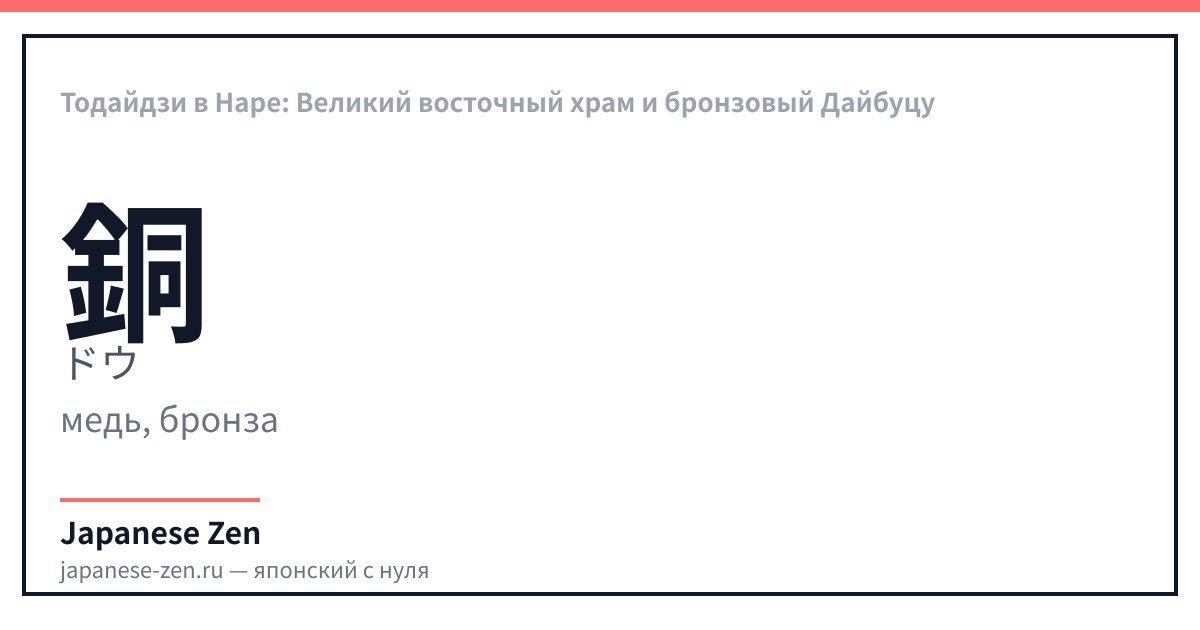
銅 — значение: copper, bronze — онъёми: ドウ — кунъёми: あかがね — 14 штрих(ов). 銅 — "copper, bronze": the Daibutsu is called 銅造, "bronze cast." The character consists of the radical 金 "metal" and the phonetic 同 — it shows how Japanese builds the names of metals.
In compound words, 銅 is read dō, for example in 青銅 (seidō), "bronze" as a material, and in 銅像 (dōzō), "bronze statue" — a general word for any cast monument, not only Buddhist ones. The kun reading of the character is akagane, "copper metal," which is almost never used separately in modern language.
One radical — different metals
The radical 金 in 銅 is the same as in the standalone character 金, "gold, money," and in 銀, "silver." Japanese often assembles metal names from the same building block, changing the second part of the character. The logic is easiest to see in the pair 銅像 and 金色 (kin'iro), "golden color": both words begin with the same radical but continue differently.
| Japanese | Reading | Translation |
|---|---|---|
| 東大寺 | Tōdai-ji · Tōdai-ji | Todai-ji |
| 大仏 | daibutsu · daibutsu | Great Buddha |
| 大仏殿 | Daibutsu-den · Daibutsu-den | The hall where the statue stands |
| 銅像 | dōzō · dōzō | Bronze statue |
| 青銅 | seidō · seidō | Bronze |
Write 銅 along the guides — the character for "bronze," from which the Daibutsu is cast.
FAQ
- What is Todai-ji?
- Todai-ji is a Buddhist temple in Nara where the Daibutsu stands, a bronze statue of Vairocana Buddha 14.7 meters tall. The complex was founded in the 8th century by order of Emperor Shomu as a spiritual center meant to protect the country through prayer.
- When were Todai-ji and the Daibutsu statue built?
- Emperor Shomu issued the edict to cast the statue in 743, and the solemn "eye-opening" ceremony was held in 752. The Daibutsuden hall for the statue was completed by 758 — since then it has had to be rebuilt twice after fires.
- Is it true that the Daibutsuden is the largest wooden building in the world?
- Not in a general sense anymore: since the 20th century, larger wooden structures have been built using modern methods. But among traditional post-and-beam buildings without such techniques, the Daibutsuden does indeed remain the largest in the world, though noticeably narrower than the Nara-period hall.
- Why is the temple called "eastern"?
- 東大寺 means "great temple to the east": it stood in the eastern part of the capital Heijo-kyo, present-day Nara. The name is first recorded in a document from 747, and sources do not explain exactly how it became attached to the temple.
- How many times did Todai-ji burn?
- Twice: in 1180 during the Genpei War and in 1567 during a battle right on the temple grounds in the Sengoku period. After the second fire, the statue stood under the open sky for more than a century, and the current hall was completed only in 1709.
- Which kanji are used to write "Todai-ji"?
- 東大寺, read とうだいじ. 東 means "eastern," 大 means "great" (in this word it is read dai), 寺 means "temple": together — "great temple to the east." The statue itself inside is called 銅造, "bronze cast," from the character 銅, "bronze."
Sources
Updated: 2026-09-15