Tomoe Gozen — who she was and what she is famous for
Tomoe Gozen was a female warrior of the late Heian period, a companion (by different accounts, wife or concubine) of the commander Minamoto no Yoshinaka in the Genpei War. The Heike Monogatari describes her as a beauty, a skilled archer and horsewoman, whom Yoshinaka sent into battle first. In her last battle at Awazu in 1184, she beheaded the warrior Onda no Hachiro Moroshige and, by her lord's command, left the field — after which her traces disappear.
Tomoe Gozen's biography is known almost exclusively from the Tale of the Heike (Heike Monogatari) — a literary monument, not a chronicle, and this changes how her story should be read. Some historians consider her a character of legend rather than a documented person: Tomoe's name does not appear in the official Azuma Kagami. Below is what the text itself tells about her, and what theater and modern pop culture have added.
Who Tomoe Gozen really was
Tomoe Gozen (巴御前) was a female warrior of the late Heian period, a companion of Minamoto no Yoshinaka (better known as Kiso Yoshinaka), cousin of the future Minamoto no Yoritomo and Yoshitsune, in the Genpei War (1180–1185). She is known almost exclusively from the Heike Monogatari, where she is described as a beauty, an excellent archer and horsewoman, whom Yoshinaka sent into battle first. According to different versions of the source, Tomoe was either his wife, his concubine, or simply his closest companion — the text itself is not definite on this point.
| Year | Event |
|---|---|
| 1180–1185 | The Genpei War between the Taira and the Minamoto — the backdrop of Tomoe's entire story |
| 1183 | Minamoto no Yoshinaka (Kiso Yoshinaka) occupies Kyoto after defeating the Taira at Kurikara |
| 1184 | Battle of Awazu: Yoshinaka's death; Tomoe's last battle — according to the Heike Monogatari, she beheads the warrior Onda no Hachiro Moroshige and leaves the field at her lord's command |
| after 1184 | Her subsequent fate is unknown: later compilations call her the wife of Wada Yoshimori or a nun who lived to old age |
Why Yoshinaka sent her into battle first
The Heike Monogatari describes Tomoe as a fearless rider, able to handle the most spirited horse on the most dangerous descent. She was an archer who, at full gallop, would face any opponent — with or without a sword. In battle, the source arms her with a bow and a sword, not a naginata: that image with a polearm took hold later, when the recognizable iconography of the female warrior emerged, which today is associated with the onna-bugeisha in general.
Name and kanji: 巴御前
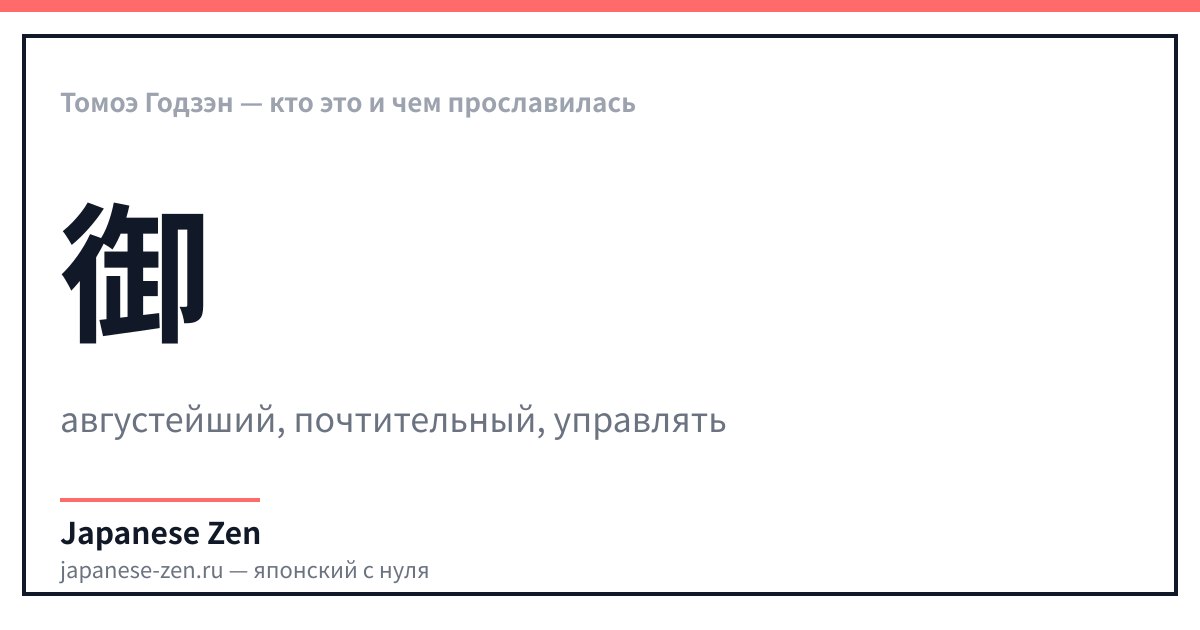
巴御前 is read ともえごぜん. 巴 (tomoe) — a heraldic whirlpool pattern, familiar from family crests (mon) and taiko drums — gave her her personal name. 御前 (gozen) is an honorific title meaning "lady," not a surname or part of a personal name. Literally, 御前 means "before the august one": 御 is an honorific prefix meaning "august, reverent," and 前 means "before, in front."
御 — значение: august, reverent, to govern — онъёми: ギョ、ゴ — кунъёми: おん-、お-、み- — 12 штрих(ов). 御 — an honorific prefix meaning "august, reverent": 12 strokes, an N1-level character. In everyday use it lives as the prefix お- (お茶, ocha, "tea"). In more formal words it is read ご- — as in 御所 (gosho, "palace") and in "gozen" itself: 御 + 前 ("before") together give "before the august one," an honorific title for a noblewoman.
Why "gozen" is a title, not a name
In old Japan, the same word "gozen" was used for other noblewomen as well, not only Tomoe — it was a title of address, not a personal name or surname. There is no modern Japanese surname "Gozen": the word survives only in historical and literary texts, attached to the names of women like Tomoe.
| Japanese | Reading | Translation |
|---|---|---|
| 巴御前 | Tomoe Gozen · Tomoe Gozen | The heroine of this page |
| 御前 | gozen · gozen | The title "lady" for a noblewoman |
| 木曾義仲 | Kiso Yoshinaka · Kiso Yoshinaka | Minamoto no Yoshinaka — her lord |
| 源平合戦 | Genpei kassen · Genpei kassen | The Genpei War, in which she fought |
| 薙刀 | naginata · naginata | The weapon she is most often depicted with |
| 弓 | yumi · yumi | The bow — the weapon the primary source describes her with |
Listen and repeat the name, the title, and related words.
Tomoe Gozen in anime, manga, and games
Tomoe has few direct adaptations — unlike Yoshitsune or Benkei, whose fates grew into separate cycles of legend, she more often appears as one character in a larger story of the Genpei War. Three titles show her prominently enough to mention separately.
- The Heike Story (2021, Science SARU studio, directed by Naoko Yamada) — an anime adaptation of the Heike Monogatari, where Tomoe fights shoulder to shoulder with Yoshinaka as a full-fledged warrior of his troop.
- Fate/Grand Order — Tomoe Gozen is featured as a playable servant: one of many historical and mythological characters whom the mobile game turns into heroes for summoning and battle.
- Nioh 2 — in the action game by Team Ninja, Tomoe Gozen appears as a boss: her image is woven into a fictional plot about yokai demons.
What the games added to her
All three versions preserve the main thing — her reputation as an unmatched warrior — but add what is not in the Heike Monogatari or in the sparse historical evidence: supernatural strength, magical abilities, or direct participation in fictional storylines. The period source describes Tomoe as an exceptionally skilled human fighter, not a bearer of superpowers.
How much is chronicle and how much is legend
Everything we know about Tomoe comes from the Tale of the Heike (Heike Monogatari) — a literary monument, not a document by contemporaries of the events. It took shape decades after the Genpei War and was chanted for centuries by wandering biwa-hoshi storytellers. Tomoe's name does not appear in the Azuma Kagami — the official chronicle of the Kamakura shogunate, which records far less significant figures of the war. Therefore some historians consider her a literary figure, composite or fictional, rather than a documented real person — and this does not diminish her place in culture, but simply honestly describes the genre of the source.
- In the Heike Monogatari: participation in the war on Yoshinaka's side, beauty, skill as a rider and archer, the last battle at Awazu, where she beheads the warrior Onda no Hachiro Moroshige and leaves the field at her lord's command.
- In official chronicles: nothing — the Azuma Kagami does not mention Tomoe at all, hence historians' doubts about her existence as a documented person.
- The Noh play "Tomoe" (attributed to Zeami) added a plot not in the Heike Monogatari: the warrior's ghost appears to a traveler at Awazu, unable to find peace.
- In the Genpei Seisuiki and later lore: her fate after 1184 — either the wife or concubine of Wada Yoshimori, or a nun who lived to old age. Neither version is confirmed by sources close to the events.
- In modern games and anime: supernatural abilities and participation in fictional plots — a device of mass culture, not a detail of the original story.
What Noh theater added
The play "Tomoe," attributed to the playwright Zeami (14th–15th centuries), formally belongs to the warrior plays — the second of the five classical categories of Noh theater — and remains the only one in that category where the main role is given to a woman. As befits such a play, the heroine first appears to a traveler at Awazu as a simple woman from a nearby village, and only then reveals herself as the spirit of Tomoe, doomed to wander because she did not die beside her lord. This posthumous frame is a creation of the theater, not a continuation of the Heike Monogatari plot.
FAQ
- Who is Tomoe Gozen?
- Tomoe Gozen was a female warrior of the late Heian period, a companion of the commander Minamoto no Yoshinaka in the Genpei War. She is known almost exclusively from the Tale of the Heike, where she is described as a beauty, a skilled archer and horsewoman. Her historicity is not proven — Tomoe is not mentioned in the official chronicles of the period.
- What is Tomoe Gozen famous for?
- For her ability to fight on horseback and with a bow on par with any male warrior. The key episode is the Battle of Awazu in 1184: before the death of her lord Minamoto no Yoshinaka, she went into battle one last time, beheaded the strong warrior Onda no Hachiro Moroshige, and left the field at his command.
- Is Tomoe Gozen a real historical figure or a literary character?
- It is not known for certain. Everything known about her comes from the Tale of the Heike — a literary monument, not a chronicle; in the official Azuma Kagami her name does not appear at all. Some historians consider Tomoe real, others a composite or entirely fictional figure.
- What does the name Tomoe Gozen mean and how is it written in Japanese?
- 巴御前, read ともえごぜん. 巴 (tomoe) — a heraldic whirlpool pattern that became her personal name; 御前 (gozen) — not a surname, but an honorific title "lady," used in old Japan for noblewomen, not only Tomoe.
- When did Tomoe Gozen live?
- The events belong to the late Heian period and the Genpei War of 1180–1185; the last reliably described episode of her life is the Battle of Awazu in 1184. There are no exact dates of birth or death: her subsequent fate is unknown, and later compilations differ in their versions.
- In which anime and games does Tomoe Gozen appear?
- In the anime The Heike Story (2021, Science SARU studio) she fights alongside Yoshinaka. In games — as a playable servant in Fate/Grand Order and as a boss in Nioh 2. The supernatural abilities in these versions are a fiction of the genre.
Sources
Updated: 2026-09-11