The Shimazu Clan — Who They Were and What They Are Known For
The Shimazu clan was a samurai family that ruled Satsuma Province in southern Kyushu for nearly seven centuries, from the late 12th century. The clan survived the Mongol invasions, the Sengoku period, and submitted to Hideyoshi in 1587; at Sekigahara in 1600 they fought on the losing side but kept their domains. Two and a half centuries later, it was men from Shimazu who led the overthrow of the Tokugawa shogunate.
For nearly seven centuries the same family governed the same land — a rarity even by Japanese standards, where clans seldom outlived their founder by more than a few generations. The Shimazu survived the Mongols, neighboring daimyo, the unification of the country, and defeat in a decisive battle, and then they themselves took on the system that had once forced them to their knees.
Who the Shimazu Were and Where the Clan Came From
The Shimazu clan (島津氏) was a samurai family that ruled Satsuma Province in southern Kyushu for nearly seven centuries, from the late 12th century. Its founder is considered to be Shimazu Tadahisa, appointed by shogun Minamoto no Yoritomo as land steward (jitō) over the lands of Satsuma, Osumi, and Hyuga around 1185–1197; a later legend called Tadahisa an illegitimate son of Yoritomo himself, but this is not documented. By the Sengoku period the Shimazu controlled the whole of southern Kyushu and laid claim to power over the entire island.
| Name | Role | Fate |
|---|---|---|
| Shimazu Tadahisa | First jitō of Satsuma, late 12th century | According to legend, son of Minamoto no Yoritomo; not documented |
| Shimazu Yoshihisa (1533–1611) | 16th head of the clan | Submitted to Hideyoshi in 1587, kept part of his domains |
| Shimazu Yoshihiro (1535–1619) | Commander, brother of Yoshihisa | Broke through the enemy lines at Sekigahara in 1600, secured peace with Tokugawa |
| Shimazu Nariakira (1809–1858) | One of the last heads of the clan before Meiji | Began Westernization, was patron of the future hero of the Restoration, Saigo Takamori |
What the Shimazu's Power Rested On Besides the Sword
Besides war, the Shimazu for centuries controlled the maritime trade of southern Japan. In 1609 they subjugated the Ryukyu Kingdom and through it traded with China, bypassing the Tokugawa shogunate's isolation policy. Another source of income was the monopoly on sugarcane from the Amami Islands, which the clan held until the domain was abolished in the 19th century.
Name and Kanji: 島津氏
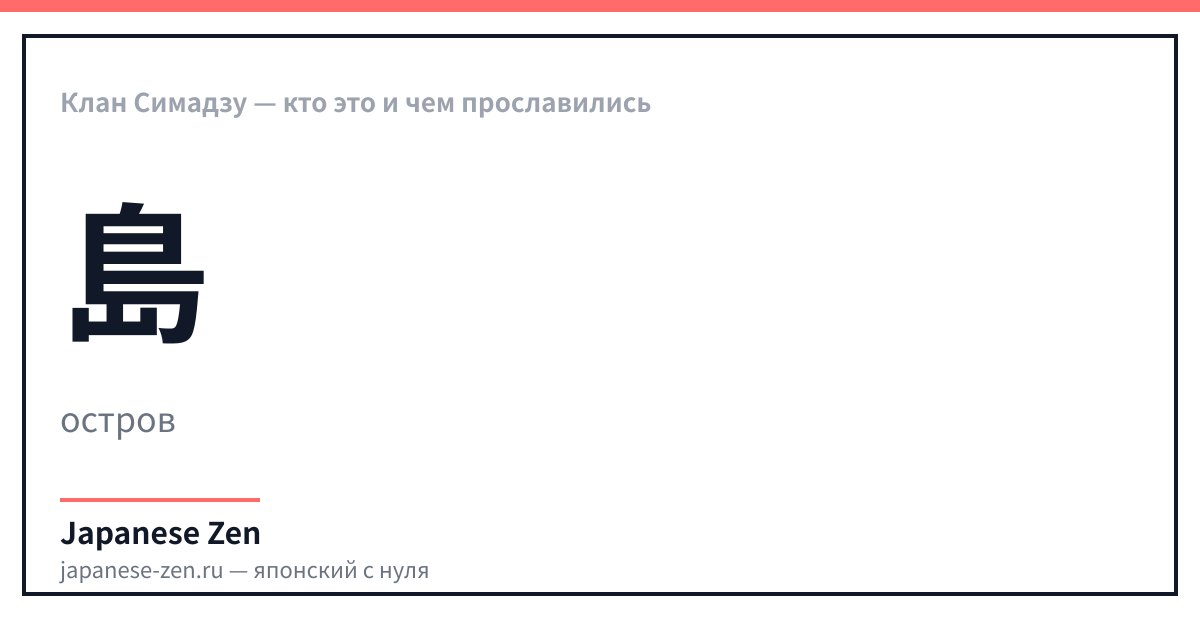
島 — значение: island — онъёми: トウ — кунъёми: しま — 10 штрих(ов). 島 — "island": 10 strokes. The same character appears in 列島 (rettō, "archipelago") and 半島 (hantō, "peninsula"); in the clan name it comes first — 島津, "island harbor."
| Japanese | Reading | Translation |
|---|---|---|
| 島津氏 | Shimazu-shi · Shimazu-shi | Name of the clan |
| 薩摩 | Satsuma · Satsuma | Province in southern Kyushu ruled by the Shimazu |
| 大名 | daimyō · daimyō | Provincial ruler — the title of the clan heads |
| 外様 | tozama · tozama | "Outer" daimyo — the Shimazu's status under the Tokugawa shogunate |
| 丸に十字 | maru ni jūmonji · maru ni jūmonji | Family crest — a circle with a cross, known since the Kamakura period |
How 島津 Is Read and What the Name Is Made Of
島津 is read しまづ and breaks down into 島 "island" and 津 "harbor, port" — together, "island harbor." The name became attached to the family of Shimazu Tadahisa in the late 12th century and has not changed since, though the clan's domains were many times reshaped over seven centuries by war and shogunal decrees.
Write 島 along the guides — the first character in the name of the Shimazu clan.
How It All Ended
Most participants in Sekigahara lost their lands or became ordinary salaried daimyo, but the Shimazu were the exception: the clan kept almost all its pre-war domains, about 730,000 koku of revenue — the third-largest domain under the Tokugawa. Two and a half centuries later this proved decisive: in 1866 Satsuma and neighboring Choshu concluded an alliance that drove the overthrow of the Tokugawa shogunate — the very power their ancestors had acknowledged after Sekigahara. Saigo Takamori, a native of the clan, led the Meiji Restoration; in 1871 the Satsuma domain was abolished by the decree on the elimination of the han, and the Shimazu's nearly seven-hundred-year rule ended by decree, not by the sword.
FAQ
- What is the Shimazu clan?
- The Shimazu clan (島津氏) was a samurai family that ruled Satsuma Province in southern Kyushu for nearly seven centuries, from the late 12th century. It survived the Mongol invasions, the Sengoku period, and Sekigahara, and in the 19th century played a key role in the fall of the Tokugawa shogunate.
- How many years did the Shimazu clan rule Satsuma?
- Nearly seven centuries — from the late 12th century, when Shimazu Tadahisa received Satsuma from shogun Minamoto no Yoritomo, until 1871, when the domain was abolished by the decree on the elimination of the han during the Meiji Restoration. This is one of the longest periods of rule by a single family over a single land in Japanese history.
- What does the name 島津 (Shimazu) mean?
- 島津 is read しまづ and is made up of 島 "island" and 津 "harbor, port" — literally "island harbor." The name became attached to the family in the late 12th century, when its founder Shimazu Tadahisa received lands in southern Kyushu.
- What are the Shimazu known for?
- The Shimazu were one of the few clans that submitted to Hideyoshi in 1587 without being completely crushed, and at Sekigahara in 1600 they broke through the enemy lines instead of surrendering. In 1609 they subjugated the Ryukyu Kingdom, and in the 19th century men from their clan led the overthrow of the Tokugawa shogunate.
- Where does the Shimazu clan appear in games and anime?
- The Shimazu clan is one of the nine playable factions in Total War: Shogun 2, with a favorable starting position for trade. The commander Yoshihiro is a character in the Sengoku Basara series; Shimazu Toyohisa, Yoshihiro's nephew, is the protagonist of the manga and anime "Drifters."
- How do the Shimazu differ from other clans of the Sengoku period?
- Unlike most participants in Sekigahara, the Shimazu kept their domains after defeat and for nearly seven centuries never lost power over Satsuma. In 1868 men from this clan led the overthrow of the Tokugawa shogunate — a historic turn that almost all their rivals from the Sengoku period did not live to see.
Sources
Updated: 2026-09-11