Butsudan — What It Is and Why You Need It
A butsudan is a home Buddhist altar, usually a wooden cabinet with doors, where a statue of Buddha or a scroll, memorial tablets of ancestors (ihai), and photographs of the deceased are kept. Every day, incense is lit, rice and water are offered before it — it is both a place of prayer and a living connection with departed relatives.
A butsudan can easily be mistaken for beautiful furniture. In reality, it is a daily ritual in miniature: incense, water, and a short conversation with those who are no longer with us.
What is a butsudan and why is it needed
A butsudan is a home Buddhist altar: a wooden cabinet with doors, inside which is a statue or scroll of Buddha, and in front of it are memorial tablets of ancestors (ihai) and often photographs of deceased relatives. It serves both as a place of prayer and as a point of memory for specific people — unlike kamidana, a Shinto shelf for a patron deity, the butsudan is specifically directed toward one's own departed.
- Honzon — the main image or statue, usually of Buddha or a bodhisattva, depending on the school.
- Ihai — wooden tablets with the posthumous name of the ancestor.
- Incense burner and candlesticks — incense and light are lit daily or on holidays.
- Photograph — often placed nearby, although formally it is not part of the Buddhist canon.
Incense, rice, and talking with the deceased
In front of the butsudan, incense is lit, a bowl of rice or water is placed, and a short prayer is said or simply a conversation with the deceased — telling about the day, sharing family news. During the Obon festival, the whole family gathers in front of the butsudan, and the tablets are sometimes moved to a separate table for a more solemn memorial service.
Name and characters: 仏壇
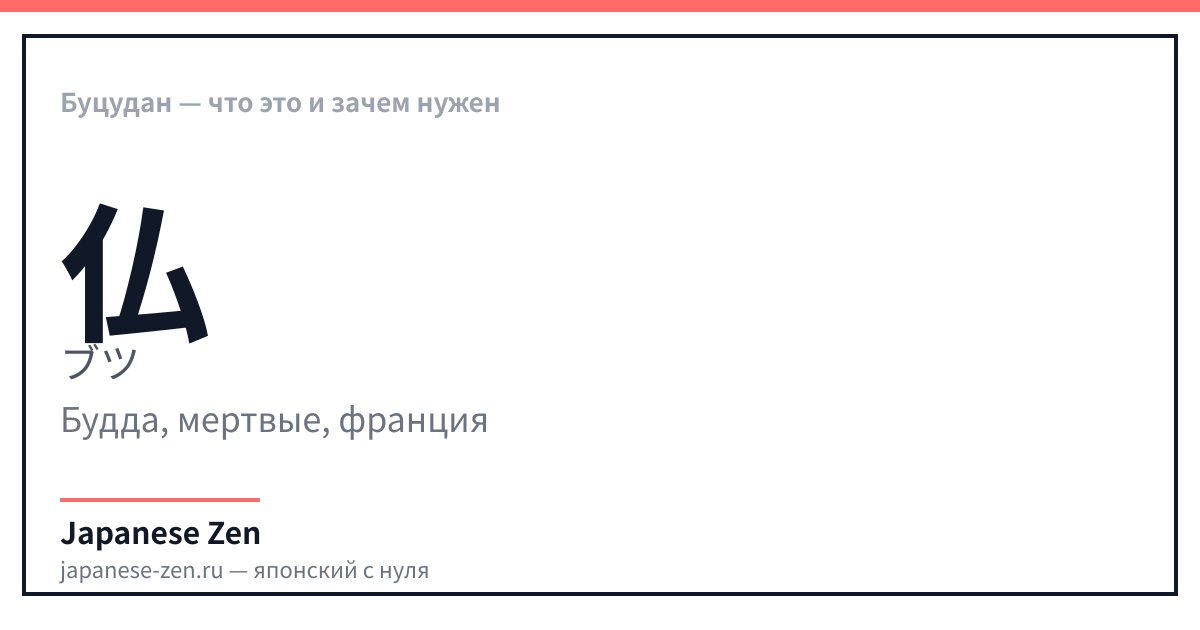
仏 — значение: Buddha, the dead, France — онъёми: ブツ、フツ — кунъёми: ほとけ — 4 штрих(ов). 仏 — 'Buddha': the first character in 仏壇. The same character is in 仏教 'Buddhism' and 仏教徒 'Buddhist': without it, almost no word about this religion in Japanese can be read.
| Japanese | Reading | Translation |
|---|---|---|
| 仏壇 | butsudan · butsudan | Butsudan |
| 仏 | hotoke · hotoke | Buddha |
| 線香 | senkō · senkō | Incense, sticks |
| 写真 | shashin · shashin | Photograph |
| 火 | hi · hi | Fire, candle |
仏壇 — altar of Buddha
仏壇 is composed of 仏 'Buddha' and 壇 'platform, altar' — 'altar of Buddha', without hidden meaning. The ihai tablets inside are inscribed with the posthumous Buddhist name of the ancestor — it most often differs from the name the person bore during life.
Repeat the stroke order of the character 仏 in the trainer — the first symbol of the word 仏壇.
Where the butsudan stands
The butsudan is precisely a household item, not something a tourist sees on the street: it stands in the living room or a separate room of a private house and is passed down by inheritance along with the duty to care for it. You can see a butsudan up close in museums of folk life or in Buddhist temples, where its large temple versions are exhibited.
Why a butsudan is not given as a gift
A butsudan is not bought as a gift between acquaintances — it is a decision of the whole family, usually after the death of a loved one, and often requires consultation with a priest of one's Buddhist school. As a gift, incense or candles for an existing altar are more appropriate, not the cabinet itself.
FAQ
- What is a butsudan?
- A home Buddhist altar: a wooden cabinet with doors, inside which is a statue or scroll of Buddha and memorial tablets of ancestors. It stands in the living room or a separate room of the house.
- Why is a butsudan needed?
- To pray and maintain a connection with deceased relatives: in front of it, incense is lit, rice and water are placed, and sometimes one simply talks with the departed.
- How is 'butsudan' written in Japanese?
- 仏壇: 仏 'Buddha' plus 壇 'platform, altar' — literally 'altar of Buddha', without hidden meaning or metaphors.
- What does butsudan mean?
- A home altar where an image of Buddha and memorial tablets of ancestors are kept — a place for both prayer and memory of specific departed people.
- Where is a butsudan found in Japan?
- In the living room or a separate room of a private house — it is a family, not a public, item. Large temple versions can be seen in Buddhist temples and museums of daily life.
- How is a butsudan different from a kamidana?
- Kamidana is a Shinto shelf for the patron deity of the house, while butsudan is a Buddhist altar for the memory of specific ancestors. Many families have both at home simultaneously.
Sources
Updated: 2026-08-24