Yagyū Jūbei — who he is and what he is famous for
Yagyū Jūbei Mitsuyoshi (1607–1650) was a swordsman from the Yagyū clan, hereditary instructors of the shōguns in the Shinkage-ryū school. His image with a black eyepatch is a later invention of fiction and cinema: there is no documentary evidence that he lost an eye, and no contemporary mentions of it exist.
The most recognizable detail of Yagyū Jūbei's image — the eyepatch — was invented centuries later, and that is precisely why the character became such a convenient hero for anime and games.
Who Yagyū Jūbei really was
Yagyū Jūbei Mitsuyoshi was born in 1607 into the family of Yagyū Munenori, the fencing instructor to the Tokugawa shōguns. The Yagyū clan taught the Shinkage-ryū school to the shōguns for several generations, and Jūbei was prepared from childhood to continue this work. Little is known about his adult life: some sources mention several years away from shogunate service, which he spent traveling across the country — the reasons for this break are not explained in documents. He died in 1650, according to one version, during a hunt.
| Year | Event |
|---|---|
| 1607 | Born into the family of Yagyū Munenori, fencing instructor to the shōguns |
| c. 1629–1636 | According to some sources, years away from shogunate service; reasons unknown |
| 1650 | Died, according to one version, while hunting |
Why no treatises were left after him
No direct evidence of Jūbei's literary or other activities has survived — unlike his father Munenori, who left treatises on fencing. Jūbei himself is known almost exclusively as a continuator of the family Shinkage-ryū school.
Name and characters: 柳生十兵衛
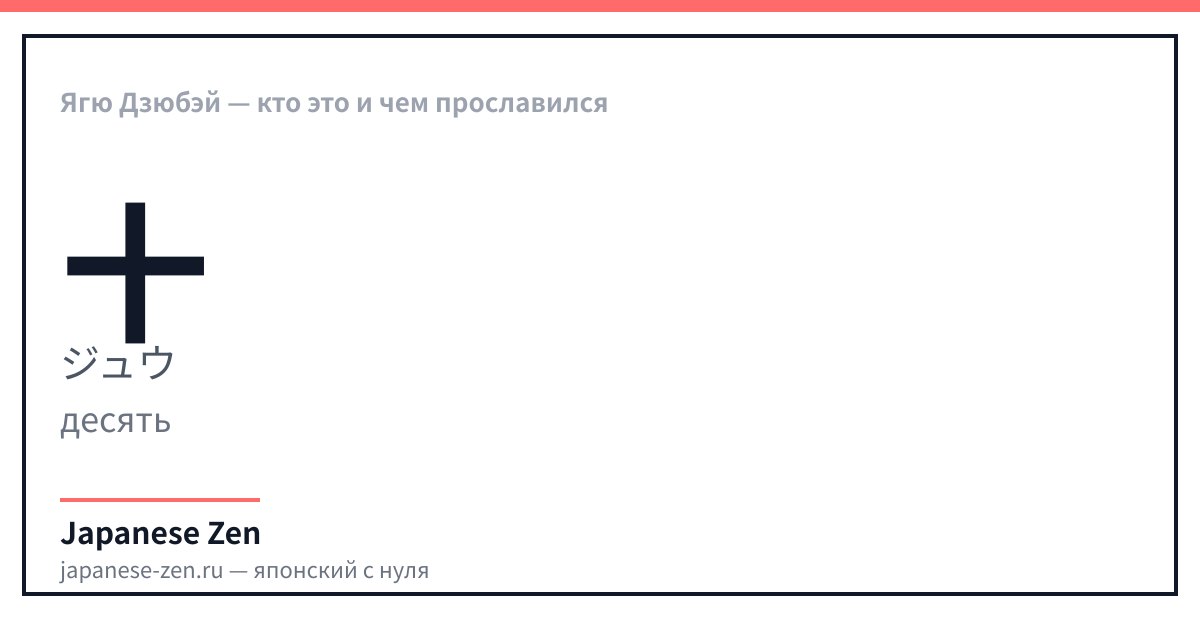
十 — значение: ten — онъёми: ジュウ、ジッ、ジュッ — кунъёми: とお、と、そ — 2 штрих(ов). 十 — 'ten': part of the name Jūbei (十兵衛). The character of the surname 柳 ('willow') and the second character of the name 衛 are not in the kanji database, so the card only analyzes 十.
| Japanese | Reading | Translation |
|---|---|---|
| 柳生十兵衛 | Yagyū Jūbei · Yagyū Jūbei | Name of the swordsman |
| 新陰流 | Shinkage-ryū · Shinkage-ryū | School of the Yagyū clan |
| 兵法 | heihō · heihō | Military art, strategy |
| 剣豪 | kengō · kengō | Master of the sword |
柳生十兵衛 — variants of writing the name
The name is sometimes found in the form 'Yagyū Jūbei' without the final 'e' — this is a variant of rendering the same syllable, which in some transliteration systems is written shorter.
Listen to the name Yagyū Jūbei and the name of the Shinkage-ryū school — the app will evaluate your pronunciation.
Where the black eyepatch came from
The image of one-eyed Yagyū Jūbei with a black eyepatch is an invention of 20th-century fiction and cinema, not a historical fact: no document from his era mentions the loss of an eye. Most likely, the detail appeared in novels and films for the sake of character recognition — such an image is easier to remember and easier to draw. That is why Jūbei with an eyepatch turned out to be such a convenient hero for further retellings: he has a minimum of confirmed biography and one striking, easily reproducible detail of appearance.
- True: the Yagyū clan really were hereditary instructors of the shōguns in the Shinkage-ryū school.
- True: several years of Jūbei's adult life are not documented.
- Fiction: the loss of an eye and the black eyepatch are not confirmed by any source of the era.
FAQ
- Who is Yagyū Jūbei?
- A 17th-century swordsman from the Yagyū clan — hereditary instructors of the Tokugawa shōguns in the Shinkage-ryū fencing school.
- What is Yagyū Jūbei famous for?
- For continuing the family tradition of the Shinkage-ryū school and — already in the 20th century — for the recognizable image of a one-eyed swordsman in cinema and games.
- How is the name Yagyū Jūbei written in Japanese?
- 柳生十兵衛, read as 'Yagyū Jūbei'. The surname 柳生 means 'willow' plus 'to be born', and the part of the name 十兵衛 is connected with the word 'warrior'.
- Is it true that Yagyū Jūbei lost an eye?
- No. The black eyepatch is an image invented by 20th-century fiction and cinema. No document from his era mentions such an injury.
- When did Yagyū Jūbei live?
- From 1607 to 1650, in the first half of the Edo period — a time when the Yagyū clan held the position of personal fencing instructors to the shōguns.
Sources
Updated: 2026-08-29