Japanese Eras — Periods of History and Reign Names in Order
Japanese eras are counted in two different ways: 時代 (jidai) — periods defined by historians, such as Heian or Edo, and 元号 (gengō) — official reign names used to date documents in Japan: Shōwa, Heisei, Reiwa. Since 1868 the rule "one sovereign, one era name" has applied, whereas earlier era names were changed several times during a single reign.
A textbook usually dumps two scales at once — Heian, Edo, Meiji and then Shōwa, Heisei, Reiwa — without explaining why they are not the same thing. Let's sort out how a period differs from a reign name, how the whole list from Jōmon to Reiwa is structured, and what 元号 means. Along the way: how to convert a year like "Reiwa 8" into the familiar calendar and which details on screen reveal the era.
When Were the Japanese Eras: Full List in Order
Historians divide Japan's past into about fifteen periods — from Jōmon, the longest era, to the current Reiwa. Each has its own years and counting principle: for antiquity it is excavation data, for the classical era and the Middle Ages it is the capital or the shogun's headquarters, and for modern times, starting with Meiji, it is the official reign name.
| Era | Years | Writing | Known for |
|---|---|---|---|
| Jōmon | c. 14,000 – 300 BCE | 縄文時代 | Cord-marked pottery, hunting and gathering |
| Yayoi | 300 BCE – 250 CE | 弥生時代 | Rice fields and the first proto-states |
| Kofun | 250–538 | 古墳時代 | Kofun burial mounds, rise of Yamato |
| Asuka | 538–710 | 飛鳥時代 | Buddhism arrives in Japan, first law codes |
| Nara | 710–794 | 奈良時代 | First permanent capital |
| Heian | 794–1185 (or 1192) | 平安時代 | Court culture, The Tale of Genji, birth of kana |
| Kamakura | 1185 (or 1192) – 1333 | 鎌倉時代 | First shogunate, Mongol invasions |
| Muromachi | 1336–1573 | 室町時代 | Ashikaga shogunate, Zen, tea ceremony |
| Azuchi–Momoyama | 1573–1603 | 安土桃山時代 | Oda Nobunaga and Toyotomi Hideyoshi unify the country |
| Edo | 1603–1868 | 江戸時代 | Peace under Tokugawa rule, country largely closed |
| Meiji | 1868–1912 | 明治時代 | End of the shogunate, Westernization |
| Taishō | 1912–1926 | 大正時代 | First party cabinets, Great Kantō earthquake |
| Shōwa | 1926–1989 | 昭和時代 | War and postwar recovery |
| Heisei | 1989–2019 | 平成時代 | Economic stagnation after the bubble, major earthquakes |
| Reiwa | from 2019 | 令和時代 | Current era |
Period and Reign Name — Two Different Counts
時代 (jidai, "era") is a period defined by historians in hindsight: Heian was named after the capital, Edo after the shogun's residence. 元号 (gengō, also found as nengō, 年号) is the official reign name used to date years in documents. Before 1868 these two counts did not coincide: the era name could be changed even without a change of emperor — because of a disaster or simply "to renew good fortune." Over the two and a half centuries of the Edo period, more than thirty era names were changed. From Meiji onward the rule 一世一元 ("one sovereign, one era name") was introduced: a new era name is chosen only when the emperor changes, and since then the period name and the era name coincide for each era.
Jōmon Period
Jōmon is the earliest and longest period of Japanese history: it began, according to archaeologists' estimates, around 14,000 BCE and lasted several millennia, until the transition to rice farming in the Yayoi period. It takes its name from the characteristic "cord-marked" pattern on pottery of that time (縄文 — "cord mark"). There was no writing yet, and everything known about Jōmon comes from excavations.
Name and Kanji: 元号
元号 is read げんごう (gengō) and means "reign name" — the very word used to date documents: 令和, 平成, 昭和. It has an almost complete synonym, 年号 (nengō, literally "year name"), and a separate word for a historical period as a whole — 時代 (jidai), "era." The first era name in Japanese history is 大化 (Taika), 645; the Taika Reforms were named after it. Since then about 248 have come and gone, counting the era names of both courts during the Nanboku-chō period, when two emperors ruled the country at once.
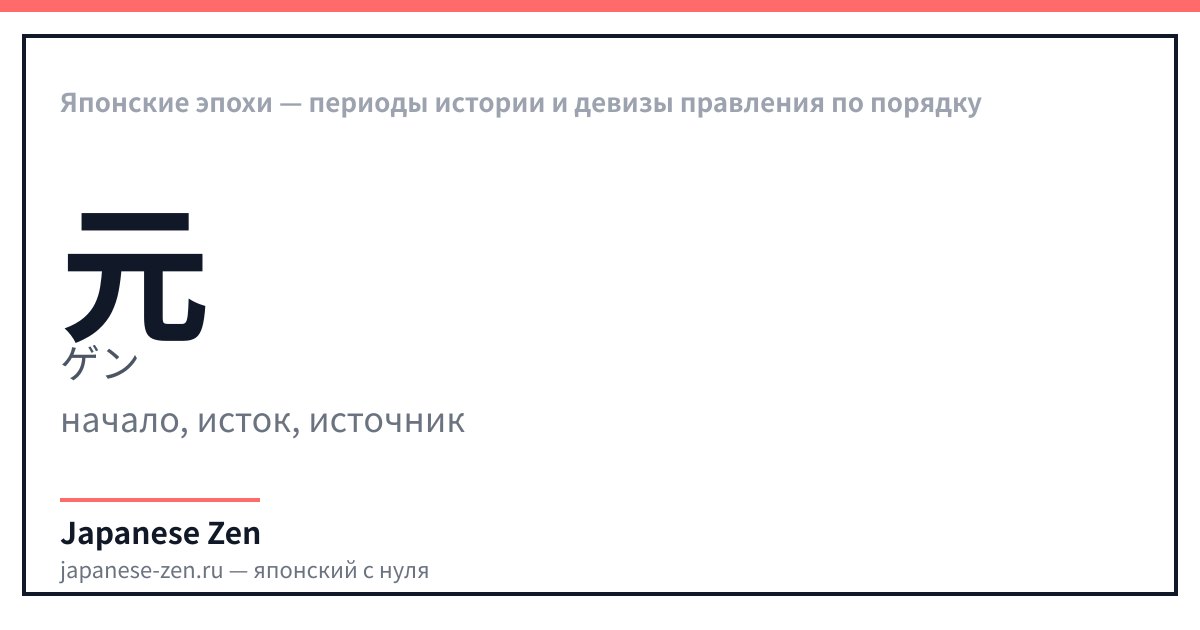
元 — значение: beginning, origin, source — онъёми: ゲン、ガン — кунъёми: もと — 4 штрих(ов). 元 — "beginning, origin": 4 strokes. The same root is in 元号 (gengō, "reign name") and in 元年 (gannen, "first year" of a new era).
| Japanese | Reading | Translation |
|---|---|---|
| 時代 | jidai · jidai | Era, historical period |
| 元号 | gengō · gengō | Reign name — the official name of an era |
| 令和 | Reiwa · Reiwa | Current era, since 2019 |
| 平成 | Heisei · Heisei | Era before Reiwa, 1989–2019 |
| 昭和 | Shōwa · Shōwa | Era before Heisei, 1926–1989 |
| 元年 | gannen · gannen | First year of any new era |
Write 元 along the guides — the character for "beginning" from 元号, reign name.
How to Convert Reiwa 8 into a Regular Year
The formula is simple if you remember the starting point: Reiwa N = 2018 + N, Heisei N = 1988 + N, Shōwa N = 1925 + N. Reiwa 1 is 2019, Heisei 1 is 1989, Shōwa 1 is 1926: those are the years when a new emperor's reign began. By this formula, "Reiwa 8" is 2026. The era year still appears on Japanese coins and in official documents — alongside or instead of the common year.
The custom of "one sovereign, one era name" has been in effect since 1868, but it gained the status of law only in 1979: the Era Name Act (元号法) established that the era name is changed exclusively upon the accession of a new emperor. Before that law, Japanese era names formally lacked a clear legal basis — the previous norm was abolished by the postwar reform of the imperial household in 1947.
Eras in Anime: How to Tell the Time Period from Details
- Heian period — The Tale of Genji: A Thousand-Year Chronicle (2009), a direct adaptation of Murasaki Shikibu's classic novel about court life.
- Sengoku period — the comedic manga and anime Nobunaga no Shinobi about the kunoichi Chidori in the service of Oda Nobunaga.
- Edo period — Gintama (銀魂): a parodic alternate version of late Edo where aliens walk alongside samurai.
- Meiji period — Rurouni Kenshin: the main story begins in 1878, when the former hitokiri Himura Kenshin, who has sworn never to kill again, wanders through Japan.
- Taishō period — Demon Slayer (鬼滅の刃): the story begins in the early Taishō years, around 1912–1915.
- Shōwa period — Grave of the Fireflies (火垂るの墓, 1988, Studio Ghibli): the summer of 1945, the final months of the war and the lives of two orphaned children.
How to Tell the Era from Details on Screen
Each era has its own set of visual cues. Heian is revealed by layered jūnihitoe robes and ox-drawn carriages, while Sengoku is revealed by arquebuses and sashimono banners behind foot soldiers. Edo is revealed by toppatsu hairstyles, two swords at the samurai's waist and wooden city blocks, while Meiji is revealed by military tunics and top hats alongside kimono. Taishō is revealed by trams, bowler hats and the first automobiles, while the wartime Shōwa years are revealed by blackout curtains, uniforms and neighborhoods destroyed by bombing.
FAQ
- How many eras are there in Japanese history?
- The periods (時代) defined by historians number from 12 to 15, depending on the level of detail: from Jōmon to the current Reiwa. But official reign names (元号) in Japanese history are far more numerous — about 248, starting with 大化 in 645.
- How does a period differ from a reign name?
- A period (時代) is a historical era defined by scholars in hindsight: Heian after the name of the capital, Edo after the shogun's residence. A reign name (元号) is the official name used to date documents in Japan right now: Shōwa, Heisei, Reiwa. Since 1868 they always coincide, but earlier they did not.
- How do you convert a reign-name year into a regular year?
- By the formula: Reiwa N = 2018 + N, Heisei N = 1988 + N, Shōwa N = 1925 + N. Reiwa 1 is 2019, Heisei 1 is 1989, Shōwa 1 is 1926: the year when a new emperor's reign began. For example, "Reiwa 8" is 2026, and "Heisei 25" is 2013.
- What year is it now on the Japanese calendar?
- 2026 in Japan is 令和8年, the eighth year of Reiwa. The era name has been in effect since May 1, 2019, when Emperor Naruhito ascended the throne, so the year on the Japanese calendar equals the Western year minus 2018.
- When was the first reign name in Japan?
- In 645, when 大化 (Taika) was proclaimed; the Taika Reforms, which strengthened central power on the Chinese model, were named after this era name. Since then, up to the current Reiwa, about 248 era names have come and gone in Japan, counting the era names of both courts during the Nanboku-chō period.
- Why were reign names changed so often before Meiji?
- Because they were not strictly tied to a change of emperor: an era name could be changed after an earthquake, an epidemic, or simply "to renew good fortune," sometimes several times during a single reign. The rule "one sovereign, one era name" was introduced in 1868, and it gained the status of law in 1979.
- Which anime show different Japanese eras?
- The Tale of Genji: A Thousand-Year Chronicle is about Heian, Rurouni Kenshin is about Meiji in 1878, Demon Slayer is about Taishō, and Grave of the Fireflies is about the wartime Shōwa years. Each era has its own recognizable set of details on screen.
Sources
Updated: 2026-09-29