Japanese Kanji and Its Derivatives: How Complex Signs Grow from Simple Ones
Japanese kanji and their derivatives are clearly connected: 木 (tree) gives 林 (grove, two trees) and 森 (forest, three), 日 (sun) plus 月 (moon) combine into 明 (bright). About 80% of kanji are structured as 'radical + phonetic': one part hints at meaning, the other at reading. Understanding this logic reduces rote memorization significantly.
Kanji only seem like a set of strokes: almost every complex character is assembled from simple ones, and the assembly is usually meaningful. Let's break down four ways of formation — and how to use them for memorization.
Four Ways Kanji Are Formed
| Type | How It Works | Example |
|---|---|---|
| Pictogram | drawing of an object | 山 mountain, 川 river, 木 tree |
| Indicative | a stroke indicates position | 上 up, 下 down, 一 one |
| Compound semantic | meanings of parts combine | 林 grove (two trees), 明 bright (sun and moon) |
| Radical plus phonetic | part gives meaning, part gives reading | 銅 copper: 金 metal + 同 reading 'do:' |
What is a phonetic and why it saves time
In the characters 銅, 洞, 胴, the element 同 repeats — and they all read 'do:'. Noticing such a pair gives you the reading of a whole group of characters at once. It doesn't always work, but often enough to check this guess with each new complex kanji.
How It Looks in Practice
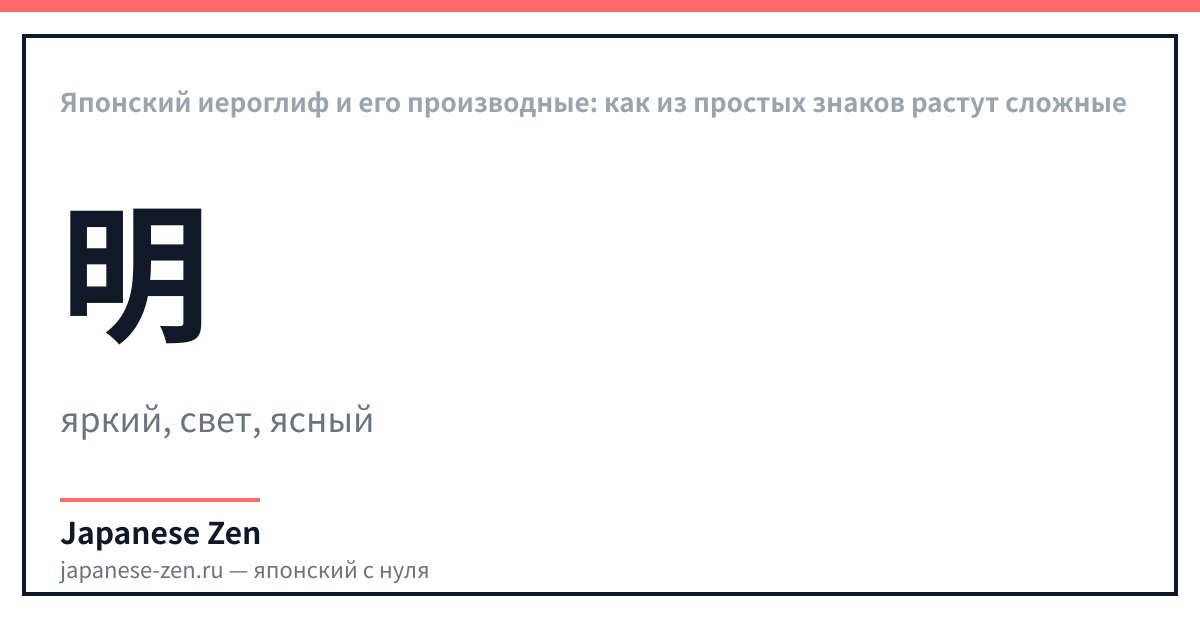
明 — значение: bright, light, clear — онъёми: メイ、ミョウ、ミン — кунъёми: あ.かり、あか.るい、あか.るむ、あか.らむ、あき.らか、あ.ける、-あ.け、あ.く、あ.くる、あ.かす — 8 штрих(ов). 明 — 'sun' 日 plus 'moon' 月. The most illustrative example of a compound character: two sources of light together.
| Japanese | Reading | Translation |
|---|---|---|
| 木 | ki · ki | Tree |
| 林 | hayashi · hayashi | Grove (two trees) |
| 森 | mori · mori | Forest (three trees) |
| 休 | yasumu · yasumu | To rest (person 亻 by a tree 木) |
| 明 | akarui · akarui | Bright (sun and moon) |
| 鳴 | naku · naku | To make a sound (mouth 口 and bird 鳥) |
Where the logic breaks down
Not every character decomposes neatly: over two thousand years, the shapes have changed, and some original images are lost. If the breakdown doesn't come together in a minute — don't torture yourself, memorize the character together with the word. That's faster than forcing a mnemonic.
FAQ
- How are Japanese kanji formed?
- In four ways: drawing of an object, indicative sign, combination of meanings, and the 'radical + phonetic' pair. The last covers about 80% of kanji.
- What is a phonetic in a kanji?
- A part of the character that hints at the reading: 同 in 銅, 洞, 胴 gives them all the reading 'do:'.
- Does breaking down into parts help with memorization?
- Yes, greatly: a character made of familiar parts is remembered on the first try, while an unfamiliar set of strokes has to be repeated dozens of times.
- Do all kanji decompose logically?
- No. Some images have been lost over the centuries. If the breakdown doesn't come together quickly, the character is learned together with the word.
Updated: 2026-07-25