The Koga Clan — Ninja of the Koga Region and the Truth About the Feud with Iga
The Koga clan were landholding warriors of Koga district in Omi province, present-day Shiga Prefecture: they governed themselves through a council of households and acknowledged the Rokkaku clan as their overlords. The legend of an eternal feud between the Koga clan and the neighboring Iga clan was invented by twentieth-century fiction — according to documents, the two leagues more often acted together than fought each other.
Many people know the phrase "Koga ninja" from anime and games, where Koga is Iga's sworn enemy. The real history has a much calmer tone: the neighboring regions lived by a similar order and more than once helped each other in battle. Let's look at where Koga was located, how the warriors of the district handled common affairs without a single ruler, and why today the same name on the map is read differently than in a conversation about ninja.
Koga — a district where people handled common affairs themselves
Koga district (甲賀郡) lay in Omi province, next to Iga across a mountainous border; today the city of Koka in Shiga Prefecture stands on that spot. The local landholding samurai did not answer to a single master: from the mid-sixteenth century they governed the district jointly, through the league "Koka-gunchūso" (甲賀郡中惣), settling disputes by vote, and if the votes did not agree — by lot. This self-government was supported by the Rokkaku clan: for loyal service in campaigns, it left the landholders of Koga free to handle the district's affairs themselves.
Koga or Koka: why one name has two readings
The name 甲賀 is officially read today as "Koka" (こうか): that is the name of the modern city in Shiga Prefecture, which appeared in 2004 when five towns of the former district merged. When speaking of ninja, by tradition it is pronounced "Koga" (こうが) — the same way the word "Koga-shū" (甲賀衆), "the warriors of Koga," still sounds in reference books. The difference is not an error, but two traditions of reading the same name.
In 1667, former warriors of Koga submitted a petition to the shogunate government for recognition of samurai status. In this same document, the "53 houses of Koga" (甲賀五十三家) were named for the first time — participants in the campaign of a century earlier, which we will discuss below — and the most distinguished of them were singled out as the "21 houses" (甲賀二十一家). Both numbers are known from a seventeenth-century document, not from an exact count from the time of the campaign itself.
The Omi campaign of 1487 and service to Tokugawa
The warriors of Koga were made famous not by a single battle, but by a long guerrilla war. In 1487, shogun Ashikaga Yoshihisa led an army against the rebellious Rokkaku Takayori in Omi province, and he took refuge in the mountains of Koga. The local landholders wore down the shogun's army for almost three years with night sorties, arson, and sudden raids right on his camp. Yoshihisa died in camp in 1489, never having broken the resistance, and the fame of the daring fighters from Koga spread across the country.
How the warriors of Koga joined the guard of Edo Castle
In 1600, before the Battle of Sekigahara, a detachment of Koga warriors entered the garrison of Fushimi Castle on the side of Tokugawa. Before the decisive assault, the hostile commander Natsuka Masaie lured some of them away by taking their families hostage, and they set fire to the castle from within — but not all: some of the Koga warriors died in battle, defending the fortress to the end. After the victory at Sekigahara, the sons and relatives of the fallen were taken into Tokugawa's service — thus arose the "Koga unit" (甲賀組), one of the four musketeer companies guarding the main gates of Edo Castle.
Koga and Iga: neighbors set at odds by fiction
The image of Koga and Iga as mortal enemies was invented not by the sixteenth century, but by a much later book. It is Yamada Futaro's novel about the war between Koga and Iga (甲賀忍法帖), serialized in 1958–1959, and the 2005 anime "Basilisk" by studio Gonzo based on it. According to documents of the era, the regions lived rather in harmony: in 1487 the warriors of Iga helped Koga fight off the shogun's army, and the clans of the two districts often intermarried.
How Koga's self-government differed from neighboring Iga
At first glance, both districts were organized the same way — a council of houses instead of a single ruler. But this similarity also had differences; here are the main ones.
| Feature | Iga | Koga |
|---|---|---|
| Province | Iga | Omi |
| Whom they served | Acted independently, without a suzerain | Acknowledged the Rokkaku clan as overlords |
| Self-government | "Iga sokoku ikki" — a league of the whole province | "Koka-gunchūso" — a league of the district |
| How it is read today | Iga (いが) — unchanged | Officially Koka, for ninja by tradition Koga |
The character 賀: from a district name to a New Year's card
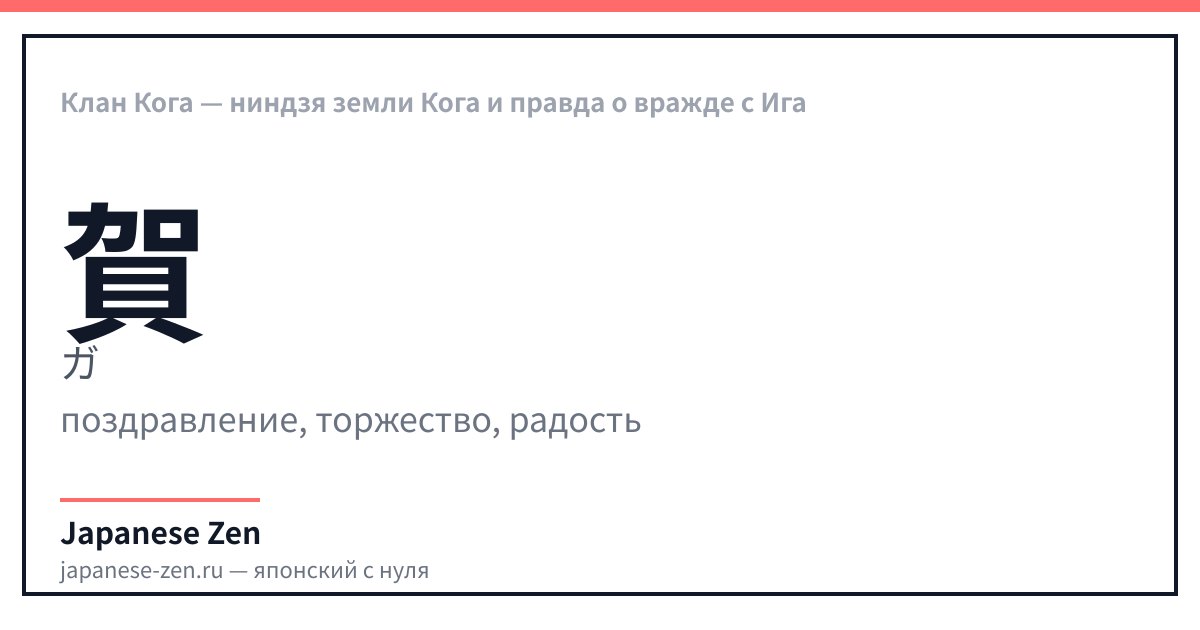
賀 — значение: congratulation, celebration, joy — онъёми: ガ — 12 штрих(ов). 賀 — the second character in the name 甲賀: by itself it means "congratulation, celebration" and has nothing to do with the landholders of Koga — both characters were chosen for the place by sound, not by meaning.
甲賀 is composed of 甲 "shell," figuratively "first," and 賀 "congratulation": together the characters convey only the sound of an ancient place name, and do not describe either the warriors or their occupation. Usually 賀 sounds according to the Chinese model, "ga," but in the official name 甲賀 it is read "ka."
"Nengajō" — a card with the same character
The same character 賀 appears in two ordinary words: 年賀状 (nengajō) — a New Year's card that people in Japan send before January 1, and 祝賀 (shukuga) — a celebratory congratulation at festivities and anniversaries. Neither word is connected with ninja: the character carries only the meaning of a joyful event.
| Japanese | Reading | Translation |
|---|---|---|
| 甲賀衆 | Kōga-shū · Kōga-shū | Landholding warriors of the Koga region |
| 甲賀 | Kōga · Kōga | The name of the region — this is how it is called when talking about ninja (the city on this spot today is officially called Koka) |
| 甲賀市 | Kōka-shi · Kōka-shi | The modern city in Shiga Prefecture |
| 伊賀 | Iga · Iga | The neighboring province and the second school of ninjutsu |
| 年賀状 | nengajō · nengajō | A New Year's card — the same character 賀 |
| 祝賀 | shukuga · shukuga | A celebratory congratulation |
Write 賀 along the guides — the second character in the name of Koga district and in the New Year's card 年賀状.
FAQ
- Who were the Koga ninja?
- The Koga ninja were landholding warriors of Koga district in Omi province, present-day Shiga Prefecture. In ordinary times they cultivated the land, and for hire they served the Rokkaku clan in reconnaissance and sabotage; the district's common affairs were decided jointly, in councils of houses. In sources they were called "Koga-shū" (甲賀衆).
- Where was the Koga region located?
- Koga district lay in Omi province, next to Iga across a mountainous border. Today the city of Koka in Shiga Prefecture stands on that spot: it appeared in 2004 when five towns of the former Koga district merged.
- Is it true that Koga and Iga were enemies?
- They were portrayed as mortal rivals by twentieth-century fiction — Yamada Futaro's novel of 1958–1959 and the anime "Basilisk" (2005). According to documents of the era, the neighboring districts lived rather in harmony: in 1487 the warriors of Iga helped Koga fight off the shogun's army, and the clans often intermarried.
- Whom did the Koga ninja serve?
- In campaigns — the Rokkaku clan, the rulers of Omi province: in return they left the landholders of Koga the right to handle the district's affairs themselves. After the decline of the Rokkaku, some Koga warriors entered the service of Tokugawa, and their descendants formed the "Koga unit" — the guard of the gates of Edo Castle.
- Which is correct: Koga or Koka?
- Both readings are correct for different cases. The name of the modern city in Shiga Prefecture is officially read "Koka" (こうか); when speaking of ninja, by tradition it is pronounced "Koga" (こうが) — the same way the word "Koga-shū," "the warriors of Koga," still sounds in reference books.
- What characters are used to write the name Koga?
- 甲賀, read こうが in conversation about ninja or こうか in the name of the modern city. 甲 means "shell," figuratively "first," 賀 means "congratulation": both characters were chosen by the sound of an ancient place name, not by meaning.
Sources
Updated: 2026-09-15