JDM — what the abbreviation means and why it isn't used in Japan
JDM (Japanese Domestic Market) means the Japanese domestic market: it refers to cars and parts that Japanese manufacturers make for sale inside Japan, not for export. The term wasn't coined in Japan but by car enthusiasts abroad in the 1990s. In Japan itself the abbreviation is hardly used — people say 国内仕様, "domestic market specification".
JDM sounds like a technical abbreviation, but behind it stands a whole culture of foreign enthusiasts that grew up separately from the Japanese language. Let's look at how a car for the Japanese domestic market differs from the same model for export, what the Japanese themselves call this phenomenon, and why the term "reverse import" — 逆輸入車 — means almost the opposite.
What JDM means and where the abbreviation came from
JDM stands for Japanese Domestic Market. It refers to cars, parts and trim levels that Japanese manufacturers produce for sale in Japan itself: with local engines, interiors and options that may not be available in export versions of the same model.
The term wasn't coined in Japan
The abbreviation JDM took hold in English-speaking car enthusiast circles in the 1990s, when interest in Japanese sports cars and parts that weren't officially sold locally grew in the US and Europe. Sometimes the term is inaccurately used for any car made in Japan, though strictly it refers only to versions for the Japanese domestic market.
How a Japanese car differs from an export version
The same model on the domestic and foreign markets often gets different names, trim levels and even different model names — the manufacturer caters to the tastes and taxes of a particular country.
- Honda Vezel (for Japan) and Honda HR-V (for export markets) — in early generations the same body under different names.
- Toyota Harrier (for Japan) and Lexus RX (for export) were the same car from 1997 to 2008, after which the models diverged onto different platforms.
- Nissan Silvia — a name only for the domestic market since 1975; abroad, different generations of the same car were sold as the Datsun 200SX, and later as the Nissan 240SX.
Right-hand drive is a road rule, not a JDM feature
Cars for the domestic market are almost always right-hand drive simply because in Japan, as in the UK, traffic drives on the left — this is a requirement of the country's road rules, not some technical trait of JDM itself. The export version of the same model gets a steering wheel suited to traffic in the destination country.
What it's called in Japan itself
In Japanese speech the abbreviation JDM is almost never encountered: car enthusiasts in Japan say 国内仕様 (kokunai shiyō) — "domestic market specification" — or simply call the model by name, without any qualifying abbreviation at all.
逆輸入車 means almost the opposite
There's another term that looks similar but means almost the opposite — 逆輸入車 (gyaku-yunyūsha), "reverse import car". This refers not to a car for the domestic market, but to a Japanese model made specifically for export and then imported back into Japan — for example, a sports version with a different engine that wasn't in the local lineup. The phenomenon grew noticeably from the mid-1980s amid trade friction over the Japanese auto industry. Slang like JDM grew up outside Japan because it was foreign buyers — not Japanese at home — who needed a separate name for cars that weren't sold in their country.
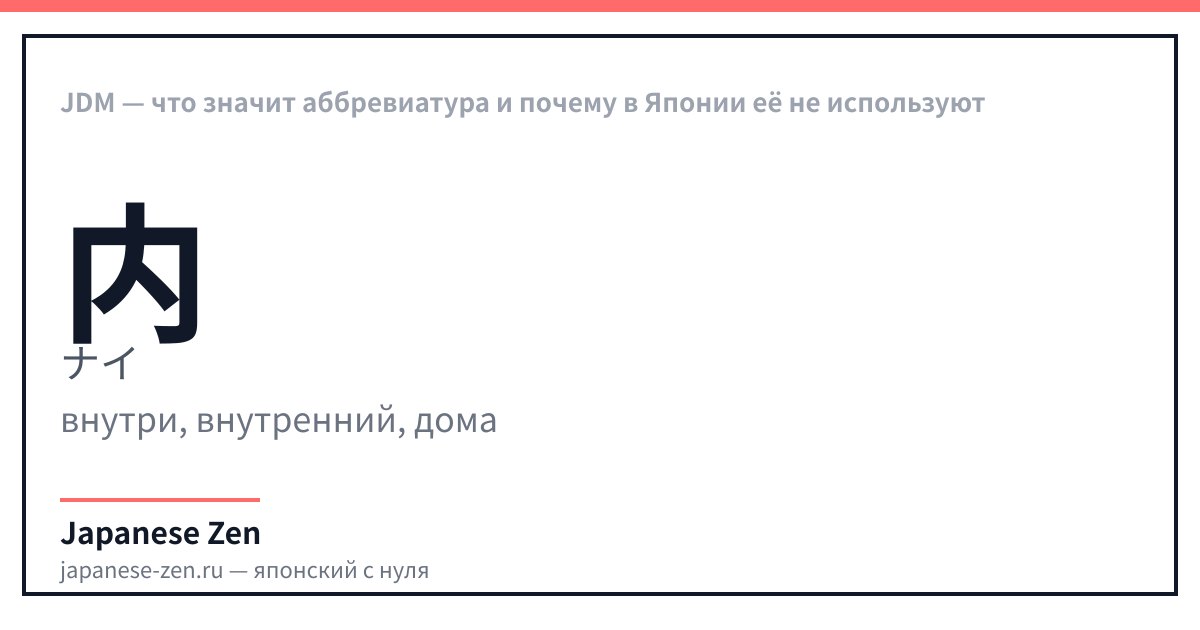
内: the character for "inside" that is the meaning of JDM
内 — значение: inside, internal, home — онъёми: ナイ、ダイ — кунъёми: うち — 4 штрих(ов). 内 — "inside": this is the character in 国内 (kokunai), "inside the country", and it is the very domestic part of the abbreviation JDM.
Readings of 内: ナイ and うち
The on'yomi ナイ is heard in words like 国内 (kokunai) "inside the country" and 案内 (annai) "to guide, show the way". The kun'yomi うち is the same word as "home" in the sense of "my family, my household": 内側 (uchigawa) means "inner side".
市場: one word, two markets
市場 is read differently depending on the meaning: しじょう (shijō) is the market as an economic concept, like the stock market or a country's domestic market; いちば (ichiba) is the market as a place where people go for fresh fish or vegetables. In JDM itself, it's the abstract しじょう that's meant.
| Japanese | Reading | Translation |
|---|---|---|
| 内 | uchi · uchi | Inside; home, family |
| 国内 | kokunai · kokunai | Inside the country, domestic |
| 国内仕様 | kokunai shiyō · kokunai shiyō | Domestic market specification |
| 逆輸入車 | gyaku-yunyūsha · gyaku-yunyūsha | Reverse import car |
| 市場 | shijō · shijō | Market (economic concept) |
Write 内 along the guides — the character for "inside", without which you can't put together either 国内 or the very concept of JDM.
FAQ
- What is JDM?
- JDM is short for Japanese Domestic Market: it refers to cars, parts and trim levels that Japanese automakers make specifically for sale inside Japan, not for export.
- What does JDM stand for?
- Japanese Domestic Market — literally "Japanese domestic market". Sometimes the term is mistakenly used for any car made in Japan, though strictly it refers only to versions intended for sale in the country itself.
- Does JDM have a Japanese equivalent?
- There's no direct match: in Japan people say 国内仕様 (kokunai shiyō), "domestic market specification", or do without a general term altogether. The abbreviation JDM itself is an invention of foreign car enthusiasts, not of the Japanese language.
- What is 逆輸入車 and is it the same as JDM?
- No, it's almost the opposite concept: 逆輸入車 (gyaku-yunyūsha) is a car that a Japanese manufacturer made for export and that was then imported back into Japan. JDM, by contrast, is a car originally intended for sale inside the country.
- Is it true that all JDM cars are right-hand drive?
- Right-hand drive isn't a feature of JDM specifically, but a consequence of the fact that in Japan, as in the UK, traffic drives on the left. The export version of the same model simply gets a steering wheel suited to the road rules of the country it's sold in.
- How does a Japanese domestic market car differ from an export one?
- Often in name and trim level despite the same platform: for example, the Honda Vezel in Japan and the Honda HR-V for export. The Toyota Harrier and Lexus RX from 1997 to 2008 were actually the same car under different brands.
Sources
Updated: 2026-09-15