The Hoo Bird — the Japanese Phoenix: On a Coin, a Banknote, and a Temple Roof
The hoo (鳳凰) is the phoenix bird of East Asian mythology: it appears in the good times of wise rule and hides again in troubled ones, rather than burning and rising from the ashes like the Western phoenix. This bird is depicted on coins, old banknotes, kimono, and temple roofs — the golden Kinkaku-ji in Kyoto and the Phoenix Hall at Byodo-in are both crowned with a hoo.
The hoo is often confused with the Western phoenix, though it belongs to a separate tradition: Chinese and Japanese mythology knows neither a pyre nor a rebirth from ashes for it. Let's look at how the hoo appears in old texts, where to find it in Japan — from a temple roof to a coin in your wallet — and what Osamu Tezuka's "Phoenix" has to do with it.
The Hoo: A Bird That Neither Burns Nor Rises
The hoo goes back to the Chinese fenghuang — a pair of mythical birds, 鳳 and 凰. By a common explanation, 鳳 is the male and 凰 the female. But dictionaries agree that it was originally a single word, only later arbitrarily split into "husband" and "wife," as often happens with two-syllable names in the Chinese tradition.
The classic Chinese dictionary Shuowen Jiezi describes the hoo thus: a chicken's beak, a snake's neck, in front it resembles a qilin, behind a deer, with a turtle's back and a fish's tail. Japan adopted this image along with the name.
How the Hoo Differs from the Western Phoenix
The Western phoenix burns and rises from the ashes alone, without a mate. The hoo is different: it is thought of as a pair of male and female, and, according to legend, it simply appears in calm, virtuous times and disappears in turbulent ones — without fire or resurrection. The identification of the hoo with the phoenix in Western texts is late and rather loose.
In the Liji treatise, the hoo is counted among the "four benevolent creatures" (四霊) alongside the qilin, the wondrous turtle, and the dragon — together they foretell a rule worthy of universal trust.
Where the Hoo Lives in Japan: From Temple to Wallet
In 1053, by order of the regent Fujiwara no Yorimichi, the Phoenix Hall (鳳凰堂) was built at Byodo-in temple in Uji, near Kyoto. The silhouette of the pavilion resembles a bird with spread wings on both sides, and a pair of bronze hoo still sits on the roof ridge.
The Hoo on Money and on a Golden Roof
The 10-yen coin, minted since 1951, does not depict the bird itself but the Phoenix Hall building — a pair of hoo statues can be seen on its roof ridge. From November 2004, a bronze hoo statue from Byodo-in was also printed on the reverse of the 10,000-yen banknote; the new banknote series, issued from 2024, carries a different design.
A golden hoo also crowns the roof of the Kinkaku-ji pavilion in Kyoto.
The Hoo on Kimono, Awards, and in Tezuka's Comics
Even Sei Shonagon in The Pillow Book recalled a Chinese belief: the wondrous bird alights only on a paulownia tree. The combination "paulownia and hoo" (桐に鳳凰) became a fixed motif on kimono, tableware, and utensils.
The hoo still adorns official award certificates in Japan today: in the traditional layout, 鳳 is placed on the left, 凰 on the right, and in the center a dragon in clouds and a pattern of paulownia leaves.
Tezuka's "Phoenix" — Is It the Same Hoo?
Manga artist Osamu Tezuka named the heroine of his grand saga of life and death "Phoenix" (火の鳥). Within the manga itself, it is called both a hoo and a phoenix, and 不死鳥 "immortal bird" — Tezuka freely mixed Eastern and Western traditions rather than retelling the classical image. Incidentally, 不死鳥 is the usual Japanese word for the Western phoenix, the one that burns and rises from the ashes.
鳳凰: A Pair of Characters for One Magical Bird
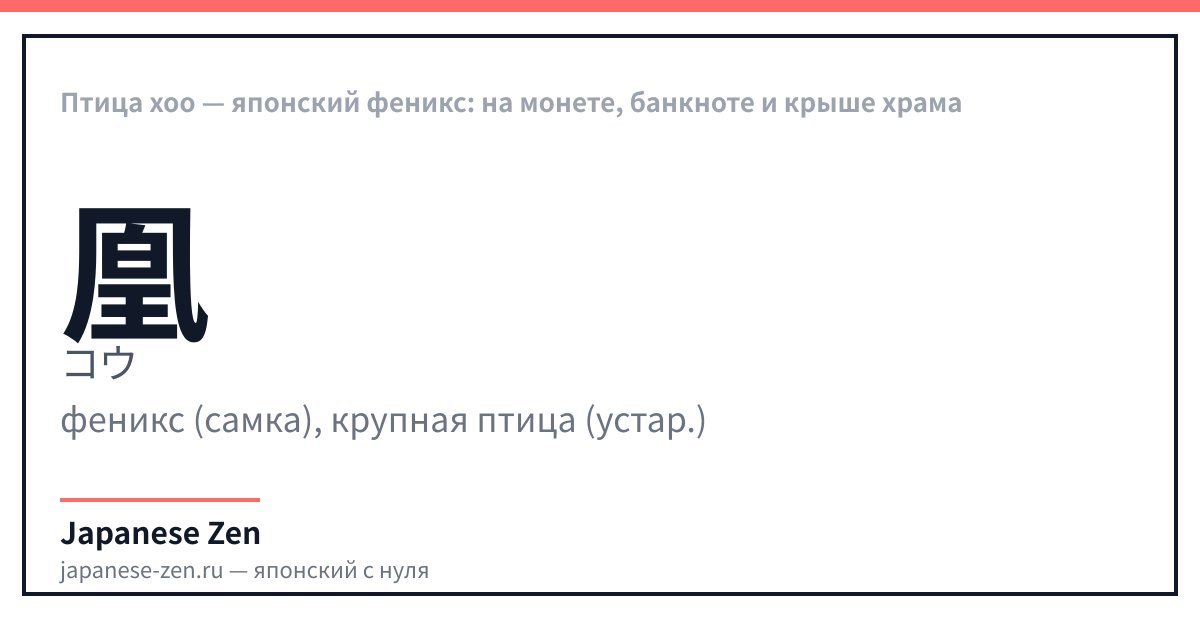
凰 — значение: phoenix (female), large bird (archaic) — онъёми: コウ、オウ — кунъёми: おおとり — 11 штрих(ов). 凰 — the second character in the name hoo, traditionally meaning the "female" of the pair; dictionaries give it a separate meaning "phoenix, female" and the kun reading おおとり — the same word in old language simply meant "large bird."
鳳凰 is read hōō: 鳳 gives the long syllable "ho," 凰 the long syllable "o," and together they form the name from which the word "hoo" derives. Visually, both characters are enclosed in the same frame, but kanji dictionaries assign 鳳 to the "bird" radical 鳥 and 凰 to the 几 "table" radical. The similarity of the characters is purely visual, not based on the radical system.
The Pair That Dictionaries Call a Later Explanation
Many reference works explicitly call the division of 鳳凰 into "male" 鳳 and "female" 凰 a later explanation of a single whole word, not an original fact. A similar story applies to the pair 麒麟 "qilin": in Chinese tradition, both words often first existed as a single concept, and the division by sex was added later.
| Japanese | Reading | Translation |
|---|---|---|
| 鳳凰 | hōō · hōō | The phoenix bird of Chinese-Japanese legends |
| 鳳 | hō · hō | The male half of the name hoo |
| 凰 | ō · ō | The female half of the name hoo |
| 桐 | kiri · kiri | Paulownia — the tree often depicted with the hoo |
| 不死鳥 | fushichō · fushichō | Immortal bird — the Japanese word for the Western phoenix |
| 五色 | goshiki · goshiki | The five colors of the hoo's plumage in old descriptions |
Write 凰 along the guides — the character for the "female" half of the name hoo.
FAQ
- What is the hoo bird?
- The hoo is a mythical bird of Chinese-Japanese tradition: it is considered a messenger of good and wise rule, not a character in a cycle of death and rebirth like the Western phoenix. In classical Chinese descriptions, it has a chicken's beak, a snake's neck, a turtle's back, and a fish's tail, and it is depicted as a pair — 鳳 and 凰.
- How does the hoo differ from the phoenix?
- The Western phoenix burns and rises from the ashes alone. The hoo has neither a pyre nor a resurrection: it is thought of as a pair of male and female, and it simply appears during virtuous rule, rather than undergoing a cycle of death and rebirth.
- Where in Japan can you see a hoo?
- A pair of bronze hoo crowns the roof of the Phoenix Hall at Byodo-in temple in Uji, built in 1053, and a golden hoo crowns the roof of the Kinkaku-ji pavilion in Kyoto. In addition, the hoo is depicted on the 10-yen coin and was printed on the 10,000-yen banknote series issued from 2004.
- What is depicted on the 10-yen coin?
- The 10-yen coin does not depict the bird itself but the entire Phoenix Hall building at Byodo-in temple. The coin has been minted since 1951, and a pair of hoo statues can be seen on the pavilion's roof ridge.
- Is the hoo male or female?
- It is written as a pair of two characters: 鳳 is traditionally considered the "male" and 凰 the "female." But dictionaries explicitly call this division a later explanation of a single originally whole word, not a strict fact about the bird's sex.
- How is "hoo" written in kanji?
- 鳳凰, read hōō: 鳳 is read with a long "ho," 凰 with a long "o." Both characters look similar because of the shared frame, but kanji dictionaries assign them to different radicals — "bird" 鳥 for the first and 几 "table" for the second.
Sources
Updated: 2026-09-15