Akechi Mitsuhide — who he was and what he is famous for
Akechi Mitsuhide was a general of Oda Nobunaga who rebelled against him in 1582 and killed him at Honnō-ji. He then ruled for only thirteen days: Toyotomi Hideyoshi rushed back from a campaign and defeated him at Yamazaki, and Mitsuhide himself died while fleeing. The motive for the betrayal has never been established — historians name at least four theories.
Akechi Mitsuhide went down in history for a single night — the attack on Honnō-ji temple, where his lord Oda Nobunaga died — and everything before and after that readers usually remember less well. That is a mistake: there are at least four competing theories for the reason behind the betrayal, and none has been proven. Below is what is known for certain about Mitsuhide and what remains a hypothesis even four centuries later.
Who Akechi Mitsuhide really was
Akechi Mitsuhide (明智光秀, c. 1528–1582) was a military commander of the late Sengoku period. Before transferring to Oda Nobunaga he served Asakura Yoshikage, then the shogun Ashikaga Yoshiaki, and under Nobunaga he was responsible for Tamba Province and for relations with the imperial court; contemporaries also valued him as a connoisseur of the tea ceremony. On the night of June 21, 1582, Mitsuhide raised his army against Nobunaga at Honnō-ji temple in Kyoto. Nobunaga died, but Mitsuhide's power lasted less than two weeks. Toyotomi Hideyoshi rushed back from a campaign against the Mōri clan and defeated him at Yamazaki. The count of "thirteen days" follows the lunar calendar: the rebellion fell on the second day of the sixth month, the defeat on the thirteenth.
| Year | Event |
|---|---|
| c. 1528 | Presumed year of birth — the exact date is unknown |
| before the 1570s | Service under Asakura Yoshikage, then under the shogun Ashikaga Yoshiaki; transfer to Oda Nobunaga |
| 1579 | Receives Tamba Province as his domain, builds Kameyama and Fukuchiyama castles |
| June 21, 1582 | Rebellion and attack on Honnō-ji temple: death of Nobunaga |
| July 2, 1582 | Defeated by Toyotomi Hideyoshi at Yamazaki |
| July 1582 | Dies while fleeing through the village of Ogurusu |
Who he was before the rebellion
Before the rebellion, Mitsuhide had been Nobunaga's trusted general for two decades: he took part in the defeat of the Ikkō-ikki forces, led the burning of Enryaku-ji monastery in 1571, then governed Tamba and served as an intermediary in negotiations with the imperial court. In 1575 the court granted him the title Koretō Hyūga-no-Kami — chronicles of the era also mention him under that name.
Name and kanji: 明智光秀
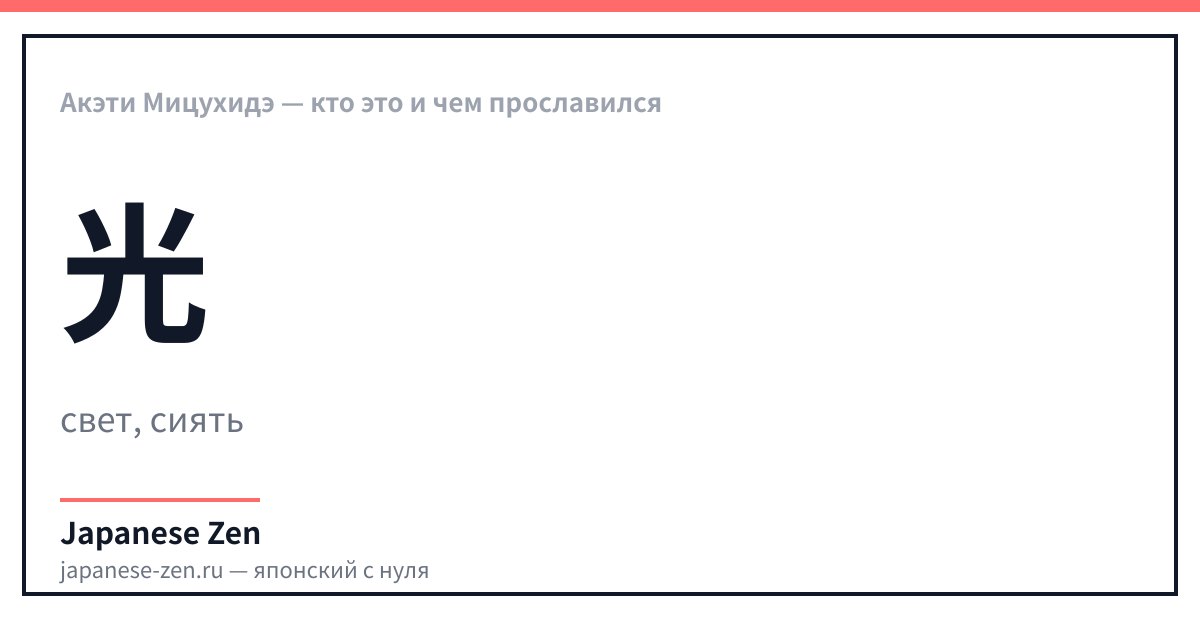
明智光秀 is read あけちみつひで. The family name 明智 (Akechi) comes from a place name in Mino Province, and the personal name 光秀 (Mitsuhide) is composed of 光 ("light") and 秀 ("excellent"). This is a common combination of auspicious characters for samurai names, in no way connected to the later reputation of a traitor.
光 — значение: light, to shine — онъёми: コウ — кунъёми: ひか.る、ひかり — 6 штрих(ов). 光 — "light": 6 strokes. The same character appears in 観光 (kankō, "tourism", literally "contemplation of light") and in 光栄 (kōei, "honor"). In the personal name Mitsuhide it comes first.
Under what name his contemporaries knew him
Besides his personal name, contemporaries often called Mitsuhide by his ceremonial title: in 1575 the imperial court granted him the rank of Koretō Hyūga-no-Kami (惟任日向守) — "governor of Hyūga Province". It is under this title, rather than the family name Akechi, that some documents of the era mention him.
| Japanese | Reading | Translation |
|---|---|---|
| 明智光秀 | Akechi Mitsuhide · Akechi Mitsuhide | Name of the page's subject |
| 惟任日向守 | Koretō Hyūga no Kami · Koretō Hyūga no Kami | Court title by which his contemporaries knew him |
| 本能寺の変 | Honnō-ji no Hen · Honnō-ji no Hen | The Honnō-ji Incident — the event of 1582 |
| 三日天下 | mikka tenka · mikka tenka | "Three-day rule" — an idiom for fleeting power |
| 謀反 | muhon · muhon | Rebellion, betrayal of one's lord |
| 城 | shiro · shiro | Castle |
Listen to the name of the rebel and the words of that night at Honnō-ji.
What we still do not know about him
The main mystery of Mitsuhide's biography — why he rebelled — remains unsolved. Historians name at least four theories. A personal grudge against Nobunaga; ambition and cold calculation; fear for his own fate if his lord decided to remove him; finally, the theory of hidden instigators — from the imperial court to the Mōri clan, the Jesuits, or even Hideyoshi. None is supported by documents contemporary with the events.
According to the chronicle Shinchō-kōki by his contemporary Ōta Gyūichi, Mitsuhide, defeated at Yamazaki, died from a peasant's spear in the village of Ogurusu; historians consider the exact circumstances not fully proven. The legend that he survived and lived for decades as the monk Tenkai at the Tokugawa court is a later invention without documentary basis. It nevertheless lasted for centuries: the game Sengoku Basara 3 plays on it directly. In popular culture Mitsuhide is almost always playable — from the first Samurai Warriors game, where in the fifth he became one of the two main characters alongside Nobunaga, and in the first two Sengoku Basara games. In 2020 NHK for the first time made a separate drama about him, "Kirin ga Kuru" (麒麟がくる) — about the years before the rebellion, for which there are almost no documents.
- Fact: service under Nobunaga, governance of Tamba, the rebellion at Honnō-ji on June 21, 1582, and the defeat at Yamazaki — confirmed by chronicles of the era.
- Disputed: the exact motive for the betrayal — historians offer at least four theories, none proven.
- Fiction: the legend that Mitsuhide survived and became the monk Tenkai — not confirmed by any source of the era, although it lived on into the game Sengoku Basara 3.
FAQ
- Who was Akechi Mitsuhide?
- Akechi Mitsuhide was a general of Oda Nobunaga in the Sengoku period (c. 1528–1582) who rebelled against him and killed him at Honnō-ji temple in 1582. His own power lasted only thirteen days before his defeat at Yamazaki.
- What is Akechi Mitsuhide famous for?
- For his rebellion against Oda Nobunaga and Nobunaga's death in the attack on Honnō-ji temple in 1582. Before that he governed Tamba Province and was known as a connoisseur of the tea ceremony and renga poetry.
- How is the name Akechi Mitsuhide written in Japanese?
- 明智光秀, read あけちみつひで. 明智 (Akechi) is the family name, from a place name in Mino; 光秀 (Mitsuhide) is the personal name, made up of the characters for "light" (光) and "excellent" (秀).
- Was Akechi Mitsuhide a real person or a legend?
- A real historical figure; the rebellion and his death after Yamazaki are documented. The legend is the theory that he survived and became the monk Tenkai; the motive for the betrayal also remains a set of theories rather than a fact.
- How is Akechi Mitsuhide portrayed in games and films?
- He is playable in Samurai Warriors from the first game, and in the fifth he is one of the two main characters alongside Nobunaga; he is also playable in the first two Sengoku Basara games. In 2020 NHK dedicated the drama "Kirin ga Kuru" to him.
- When did Akechi Mitsuhide live?
- Presumably from 1528 to 1582 — the exact date of birth is unknown. He died shortly after the rebellion at Honnō-ji, defeated by Toyotomi Hideyoshi at Yamazaki in that same year, 1582.
Sources
Updated: 2026-09-11