Dandere — Who They Are in Anime and How They Differ from Kuudere
A dandere is a character (ダンデレ) who is silent and flustered out of shyness, not coldness, and only opens up around someone they trust. The word is made from だんまり (danmari, "silence") and デレデレ (dere-dere, "melting with affection"): first awkward muteness, then timid tenderness. What sets a dandere apart from a kuudere is the reason for the silence.
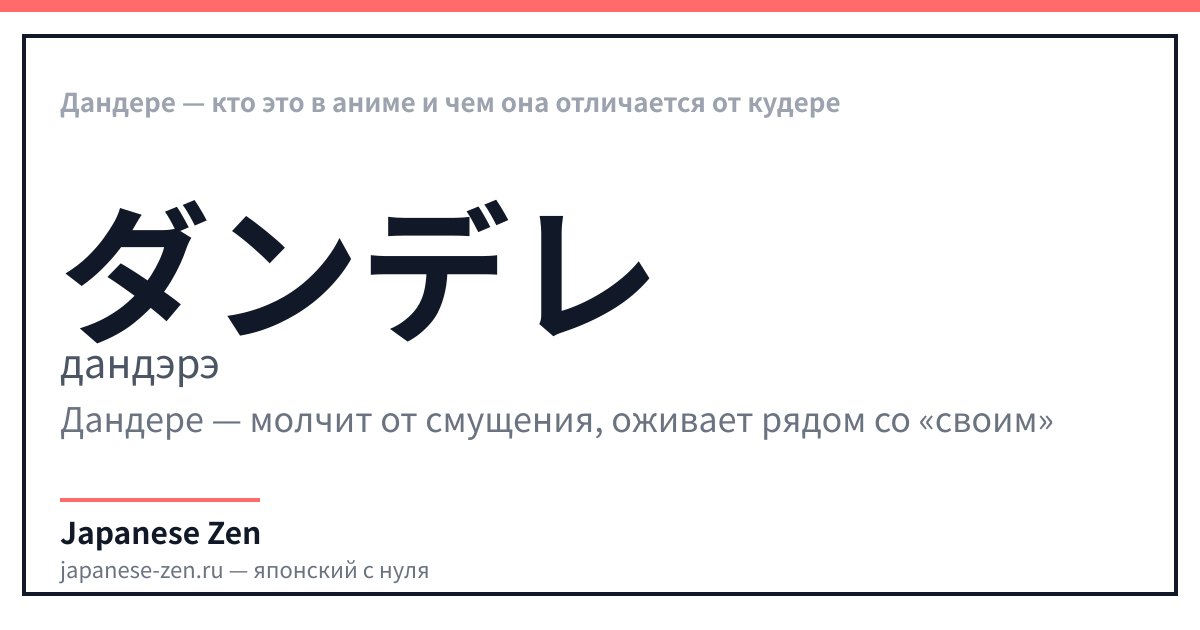
A dandere is easy to confuse with a kuudere: both seem closed off and sparing with words. The difference lies in the reason for the silence and in what happens when the ice breaks. Let's break the word down into its parts, learn to tell a dandere from neighboring types, and recall the characters most often called this — and along the way find out why the word has "dan" and not "dam".
A dandere is silent from shyness, not coldness
ダンデレ is built from ダン (from だんまり or the verb 黙る, "to be silent") and デレ. Unlike a kuudere, a dandere doesn't choose coldness deliberately — she gets flustered, blushes, and can't find words around people. Around "her" person, the one she trusts, the awkwardness falls away and her true nature comes out.
| Japanese | Reading | Translation |
|---|---|---|
| ダンデレ | dandere · dandere | Dandere — silent from shyness, comes alive around "her" person |
| 黙る | damaru · damaru | To be silent, to fall silent (the source verb) |
| だんまり | dammari · danmari | Silence, muteness (from it comes the first part of the type name) |
| 恥ずかしがり屋 | hazukashigariya · hazukashigariya | A shy person |
| 人見知り | hitomishiri · hitomishiri | Shyness around strangers |
| 無口 | mukuchi · mukuchi | Taciturn, silent |
Why "dan" and not "dam"
The type name was taken not directly from the verb 黙る (damaru) but from the word だんまり — "silence, keeping quiet". In it, after "da" comes the nasal ん: before "m" it sounds like "m" — "danmari". In the word ダンデレ, ン is followed by "de", and the same sound is pronounced as "n" — hence "dan", even though the root is the same: "to be silent".
黙 — значение: to be silent, silence — онъёми: モク、ボク — кунъёми: だま.る、もだ.す — 15 штрих(ов). 黙 — "to be silent": the same root as in だんまり, from which dandere got its name. The same character appears in 沈黙 (chinmoku) "silence".
Write 黙 along the guides — the character for "silence" that gave dandere its name.
Signs of a dandere and her favorite characters
- Avoids eye contact and answers in monosyllables if addressed first.
- Blushes and gets flustered by direct questions about feelings — but doesn't snap like a tsundere.
- Around someone she trusts, she becomes noticeably more talkative and softer.
- Her shyness is mistaken for coldness, though a dandere's reason is completely different from a kuudere's.
Who is most often called a dandere
People often cite Shoko Komi from the manga and anime "Komi Can't Communicate" (2021, OLM studio): the whole school sees her as an unapproachable beauty, but speaking first is almost impossible for her. A similar type is found in Hinata Hyuga from "Naruto" (2002, Pierrot studio): she gets flustered around Naruto and only opens up as her self-confidence grows.
FAQ
- What is a dandere?
- A dandere (ダンデレ) is a character who is silent and shy around people, rather than rude or keeping a cold distance. The word is made from だんまり ("silence") and デレデレ ("melting with affection").
- How does a dandere differ from a kuudere?
- A kuudere keeps their distance deliberately and speaks evenly even with someone they like. A dandere doesn't choose silence — they genuinely get flustered and only speak more freely with someone they trust.
- Are danderes only girls?
- No, the type describes behavior, not gender: shyness and silence before opening up also occur in male characters. It's just that in anime this type is more often given to heroines.
- How is dandere written in Japanese?
- In katakana: ダンデレ. Like other "dere" types, it's a slang coinage by fans, not an ordinary Japanese word — which is why it's written in katakana.
Updated: 2026-09-14