Deredere — what it means and why it's the most open dere type
Deredere — what it means: it's a character (デレデレ) who is openly in love from the very first scene, with no harshness or dark side. The word is the root デレデレ itself, a repetition of the word meaning 'to melt, to swoon with affection,' with none of the hidden half that tsundere or kuudere have. It's the only dere type without a second, opposite phase of personality.
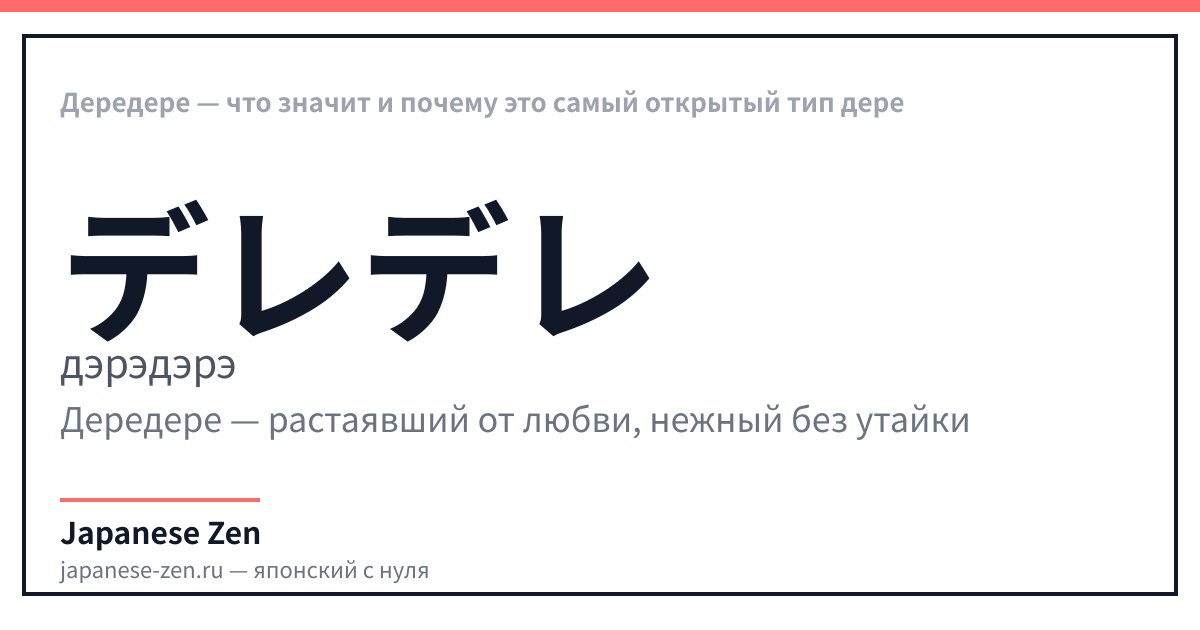
Most dere types have two faces — prickly or cold on the outside and tender inside. Deredere has only one face: she openly adores the person she likes from the very first scene. Let's look at what the repetition デレデレ means in ordinary Japanese speech, and how it differs from the seemingly similar affection of yandere, whose openness turns into something quite different.
What 'deredere' means literally
In ordinary, non-anime-jargon Japanese, デレデレする is not a compliment: the dictionary 'Daijitaru Daijisen' defines it as 'to behave in a disorganized way, to let oneself go,' especially about a man who has lost his head over a woman. In fan jargon the word softened to 'sincerely, openly in love,' but a slight shade of 'a lovesick slob' remains.
| Japanese | Reading | Translation |
|---|---|---|
| デレデレ | deredere · deredere | Deredere — melted with love, openly affectionate |
| デレデレする | deredere suru · deredere suru | To melt with affection, to coo (in ordinary speech — slightly mocking) |
| 甘える | amaeru · amaeru | To cling, to act spoiled out of affection |
| 優しい | yasashii · yasashii | Kind, gentle |
| 一途 | ichizu · ichizu | Devoted with all one's heart |
| ラブラブ | rabu rabu · rabu rabu | Head over heels (about a couple) |
でれでれ, きらきら, どきどき: why Japanese words for states are repeated twice
でれでれ is not an exception but an example of a whole class of repeated words, gitaigo: きらきら 'to sparkle,' どきどき 'to pound with excitement,' わくわく 'to look forward to.' The repetition of the syllable here conveys not quantity but the duration and intensity of the state — as if it were happening before the listener's eyes.
Deredere in action: traits and characters
- Doesn't hide affection and speaks about it directly, often from the first meeting.
- Openly rejoices in signs of attention, without feigned indifference.
- Cares for and looks after the one she holds dear, even when it seems clingy.
- Rarely gets jealous and almost never goes from tenderness to threats.
Who is called deredere and how it differs from yandere
Sakura Kinomoto from 'Cardcaptor Sakura' (カードキャプターさくら, 1998, Madhouse studio) is often cited as an example: she openly experiences every crush and isn't shy about admitting it. What distinguishes deredere from yandere is precisely the absence of a dark side: both are in love from the first frame, but with deredere, tenderness never turns into jealousy or threats.
FAQ
- What does deredere mean?
- Deredere (デレデレ) is a character who is openly and unreservedly in love from the very first scene. It's the root デレデレ itself, a repetition of the Japanese word meaning 'to melt, to swoon with affection.'
- Is deredere good or bad?
- In anime jargon it's neutral, just a description of an open personality. But in ordinary Japanese speech, デレデレする sounds slightly mocking: it's used about someone who has lost their head and composure over affection.
- How is deredere different from yandere?
- Both don't hide their love from the very start. But with yandere, that love can turn into obsession and threats, while deredere has no dark side at all — only open, sometimes clingy care.
- How do you say 'to melt with love' in Japanese?
- デレデレする (deredere suru) — this is the verb used when talking about someone who has melted with affection. The word デレデレ became the basis for the name of the deredere type.
Updated: 2026-09-14