Sayonara — what it means and why Japanese people rarely say goodbye this way
Sayonara (さようなら) means "goodbye," but with a nuance of parting for a long time or forever. Literally — "if that's how it is": from the colloquial 左様なら, "if things are that way." In everyday life, sayonara sounds rare: friends say じゃあね, while sayonara is reserved for a serious farewell or for the school farewell ritual with a teacher.
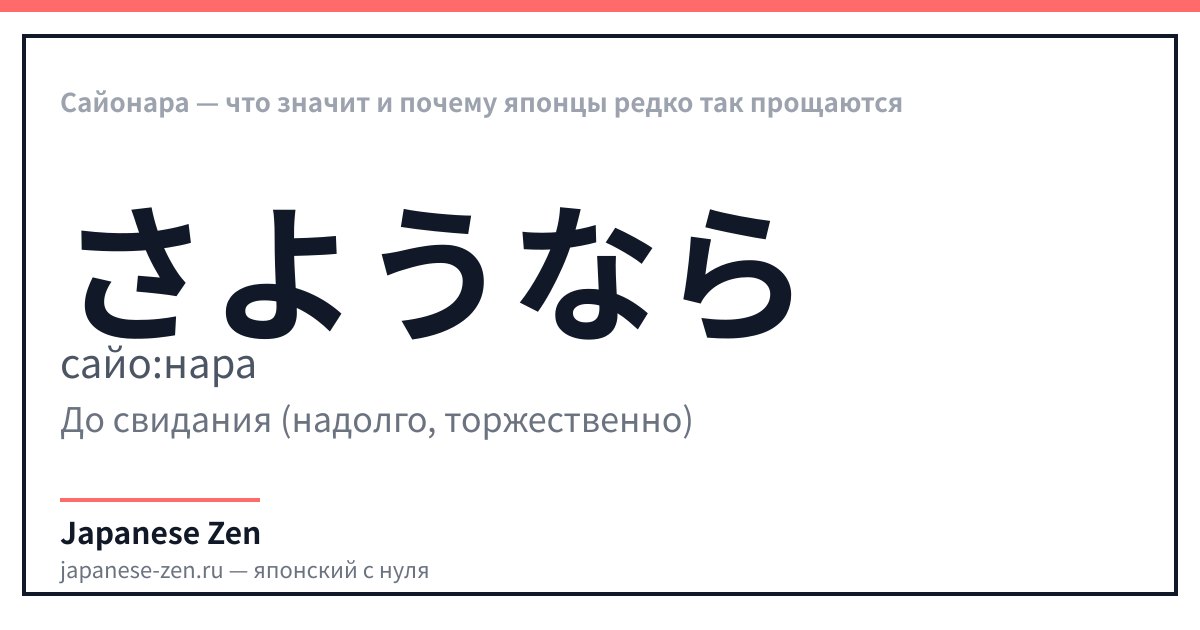
Phrasebooks teach this word as an ordinary "bye," and that's a trap: hearing sayonara, a Japanese person will think you're parting for a long time. Let's break down where the word came from, how the short さよなら differs from the full さようなら, why it's written as "sayonara" in English, and when this word is actually worth saying out loud.
What "sayonara" literally means
| Japanese | Reading | Translation |
|---|---|---|
| さようなら | sayōnara · sayōnara | Goodbye (for a long time, formal) |
| さよなら | sayonara · sayonara | Goodbye (shorter and more common than the full form) (it's this short form that sounds like the English "sayonara") |
| じゃあね | jā ne · jā ne | Well, see ya (between friends, instead of sayonara) |
| またね | mata ne · mata ne | See you |
| また明日 | mata ashita · mata ashita | See you tomorrow |
| お元気で | o-genki de · o-genki de | Take care, stay well (said before a long separation, like sayonara) |
さようなら literally goes back to 左様ならば — "if that is the case," a conjunction that in old literary speech began a farewell phrase like "if so, then take care." The first written examples of such a farewell appear in texts from the late 18th century, and by the end of the Edo period さようなら had established itself as an independent farewell word, separate from the original meaning "if so."
This history explains the weight of the word: sayonara does not promise a new meeting, it simply marks a parting. That's why in everyday life it's reserved for a real farewell — parting for a long time, a departure, the end of a relationship — while at school it sounds as a ritual phrase "sensei, sayonara" at the end of the school day, not as an everyday goodbye to a classmate.
Why "sayonara," not "sayounara"
The long sound in the syllable よう is rendered in Hepburn romanization as "ō" (or "ou"), and the syllable よ itself as "yo": strictly by the rules it would be "sayōnara." In English, the word most likely came through the romanized spelling sayonara: the Latin "yo" was read as "yo," and the length was lost — that's how the familiar "sayonara" stuck. The closest to the Japanese sound is the short colloquial さよなら — "sayonara."
様 — значение: appearance, form, manner, way — онъёми: ヨウ、ショウ — кунъёми: さま、さん — 14 штрих(ов). 様 — the second character in the spelling 左様, "that kind, in that way," from which さようなら derives. Here 様 means "appearance, manner," not the polite suffix -sama, although the character is the same.
Write 様 along the guides — the same character as in the old spelling 左様なら.
When sayonara is appropriate and when it isn't
- Appropriate: graduation, departure for a long time, end of a relationship.
- Appropriate as a ritual: in a Japanese school, students say in chorus to the teacher "sensei, sayonara" at the end of the day — this is an established order, not an assessment of how long the parting will be.
- Inappropriate: to a friend in the evening after meeting — here じゃあね or またね is enough.
- Inappropriate: to a colleague leaving work earlier than the others — there's a separate phrase for that, お先に失礼します.
Sayonara in songs and movies
The word regularly pops up outside Japanese lessons too — in song titles, as a ready-made image of farewell. One of the classic examples comes from Japan itself: in 1971, singer Ozaki Kiyohiko released the single さよならをもう一度 — "Sayonara Once More."
Say both variants out loud: the full form has a long second syllable, the short one doesn't.
FAQ
- What does sayonara mean?
- "Goodbye," but with a nuance of parting for a long time or forever, not an ordinary everyday farewell. さようなら literally goes back to "if that is the case" — an old literary formula that used to begin a farewell phrase before a parting.
- How is "sayonara" translated from Japanese?
- The closest English equivalent is "farewell": the word implies there won't be a quick new meeting, unlike the neutral "goodbye." For an ordinary "bye" between friends, Japanese people use じゃあね (jā ne) or またね (mata ne), not sayonara.
- Can you say "sayonara" to a friend?
- You can, but it will sound unusually heavy — as if you're parting seriously and for a long time. Friends usually say じゃあね (jā ne) or またね (mata ne), while sayonara is kept for real send-offs: a departure, graduation, or the end of a relationship.
- How is "sayonara" written in Japanese?
- さようなら (the full, more formal form) or さよなら (shorter and more common in conversation). It's almost never written in kanji — the word is so familiar in everyday life that hiragana has long been used instead of the older mixed spelling 左様なら.
- Sayonara or sayounara — which is correct?
- In English, "sayonara" has stuck — that's most likely how the romanized spelling sayonara was read. Closer to the Japanese sound is "sayōnara": that's how the short さよなら sounds, and the full さようなら also has a long second syllable.
Updated: 2026-09-14