What does 'yoroshiku' mean in Japanese
'Yoroshiku' (よろしく) roughly means 'please be favorably disposed toward me' — and it's the most untranslatable phrase in Japanese. It is used to end an introduction (よろしくお願いします), a request, a letter, and a handover of tasks. There is no exact Russian equivalent: depending on the context, it can mean 'nice to meet you', 'I'm counting on you', or 'please take care of this'.
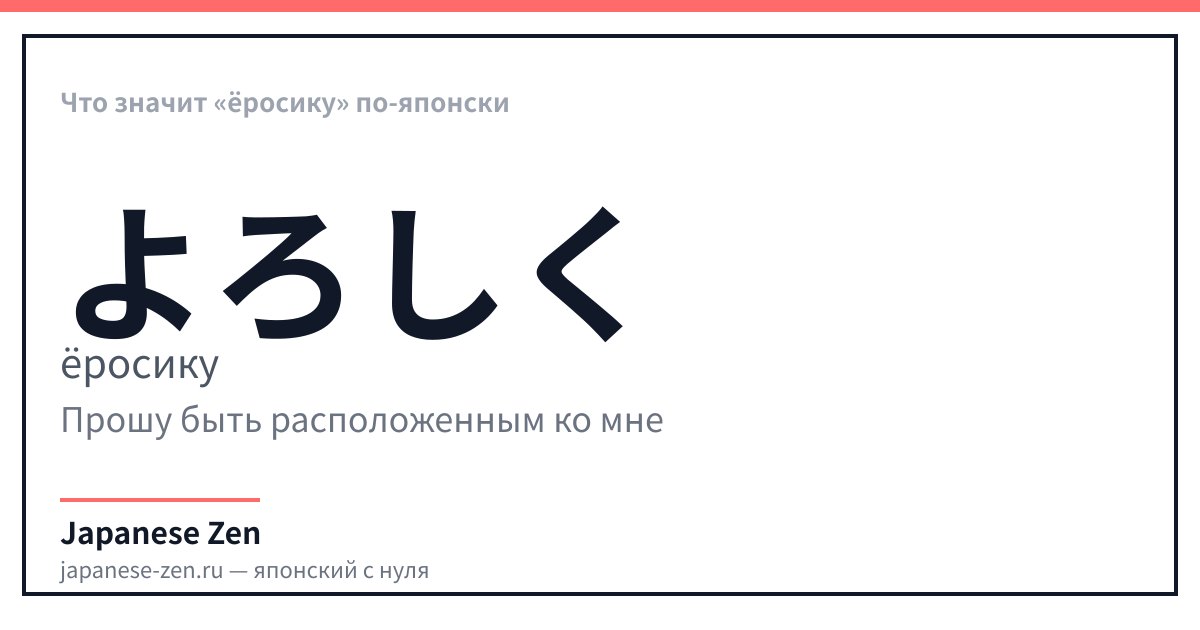
A phrase that a Japanese person says ten times a day, and the dictionary translates it differently every time. Let's break down what it consists of and where it is used.
What does 'yoroshiku' mean and why is there such a range of translations
| Japanese | Reading | Translation |
|---|---|---|
| よろしく | yoroshiku · yoroshiku | Please be favorably disposed toward me |
| よろしくお願いします | yoroshiku onegaishimasu · yoroshiku onegai shimas | Please treat me kindly (full polite form) |
| どうぞよろしく | dōzo yoroshiku · dōzo yoroshiku | I sincerely ask (when meeting someone) |
| よろしくね | yoroshiku ne · yoroshiku ne | Let's be friends (between friends) |
| 今後ともよろしく | kongo tomo yoroshiku · kongo tomo yoroshiku | I look forward to your continued support (in business correspondence) |
| よろしい | yoroshii · yoroshii | Good, acceptable (original adjective) |
Why it cannot be translated with a single word
Literally, よろしく is an adverb from よろしい ('good'), meaning 'treat me well'. The phrase does not state a fact but sets a relationship — so in different situations, in Russian it comes out as a greeting, a request, or an advance thank you.
Where it is used
- When introducing yourself — right after your name: 田中です。よろしくお願いします.
- When handing over a task to a colleague — 'it's up to you now'.
- At the end of a letter — as 'thanks in advance'.
- When sending greetings to a mutual acquaintance: 奥さんによろしく — 'greetings to your wife'.
- What not to do: do not reply with 'thank you' — the correct response is こちらこそよろしく ('it is I who ask you').
Say the short and full forms one after the other — the app will hear where the 'u' in 'onegai shimas' goes silent.
How to respond
The standard response is こちらこそよろしくお願いします: 'and I ask the same of you'. It returns the politeness rather than accepting it, and that is why it sounds correct.
FAQ
- What does 'yoroshiku' mean?
- よろしく means 'please be favorably disposed toward me'. Depending on the situation, it can mean 'nice to meet you' or 'I'm counting on you'.
- What is the difference between 'yoroshiku' and 'yoroshiku onegaishimasu'?
- The second is the full polite form used with strangers and in business, while the first is the short form used among friends.
- How do you respond to 'yoroshiku'?
- こちらこそよろしくお願いします — 'it is I who ask you'. It is not customary to reply with 'thank you'.
- Is it true that 'yoroshiku' means 'send my regards'?
- In the phrase 〜によろしく, yes: 奥さんによろしく means 'greetings to your wife'.
Updated: 2026-07-25