What does "tadaima" and "okaeri" mean
"Tadaima" (ただいま) means "I'm back" — said when entering home. The response is おかえり (okaeri), "welcome back". These are paired phrases: one without the other sounds incomplete. Full forms are ただいま帰りました and お帰りなさい, used when visiting or at work.
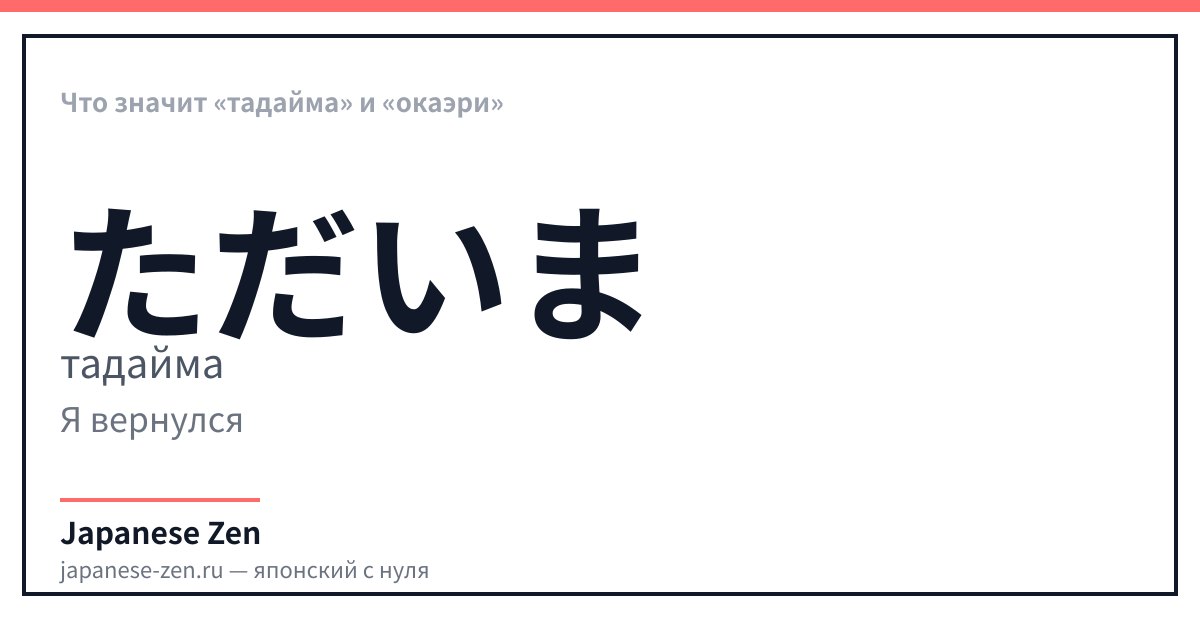
A pair of phrases that sounds every episode in anime, and every evening in a Japanese home. Let's break down what they literally mean and where else they appear.
Paired phrases of return
| Japanese | Reading | Translation |
|---|---|---|
| ただいま | tadaima · tadaima | I'm back |
| おかえり | okaeri · okaeri | Welcome back |
| ただいま帰りました | tadaima kaerimashita · tadaima kaerimashita | I'm back (polite) |
| お帰りなさい | okaerinasai · okaerinasai | Welcome back (polite) |
| いってきます | ittekimasu · ittekimasu | I'm leaving and will come back (said when leaving) |
| いってらっしゃい | itterasshai · itterasshai | Go and come back (response to the one leaving) |
What does "tadaima" literally mean
ただいま is "right now", a contraction of ただいま帰りました ("I just returned"). The same word in another context means "this very moment": ただいま準備中 — "preparation is currently underway". At the door, only the beginning of the full phrase remains.
Where else these phrases are heard
- At the office: returning from a meeting, one says ただいま戻りました, and colleagues respond お疲れ様です.
- In stores and cafes, ただいま means "now, at this moment" — the same word in its original meaning.
- At home, the phrase is said even if no one is there: it's an address to the house, not to people.
- The pair いってきます — いってらっしゃい works the same way and is said when leaving the house.
- What not to do: don't respond to ただいま with こんにちは — the paired phrase is required.
Say the pair "tadaima — okaeri" aloud: the phrases answer each other and are spoken one after the other.
Why it's said even in an empty apartment
The phrase is not only addressed to household members: it marks the transition from the outside world into one's own space. That's why it's said out of habit even when alone — just as in Russian one might sigh "well, I'm home".
FAQ
- What does "tadaima" mean?
- ただいま — "I'm back", a contraction of ただいま帰りました. In another context, it means "right now".
- What do you reply to "tadaima"?
- おかえり ("welcome back"), politely — お帰りなさい.
- And what do you say when leaving home?
- いってきます ("I'm leaving and will come back"), the response is いってらっしゃい.
- Do you say "tadaima" if no one is home?
- Yes. The phrase marks returning to one's own space, not addressing a specific person.
Updated: 2026-07-25