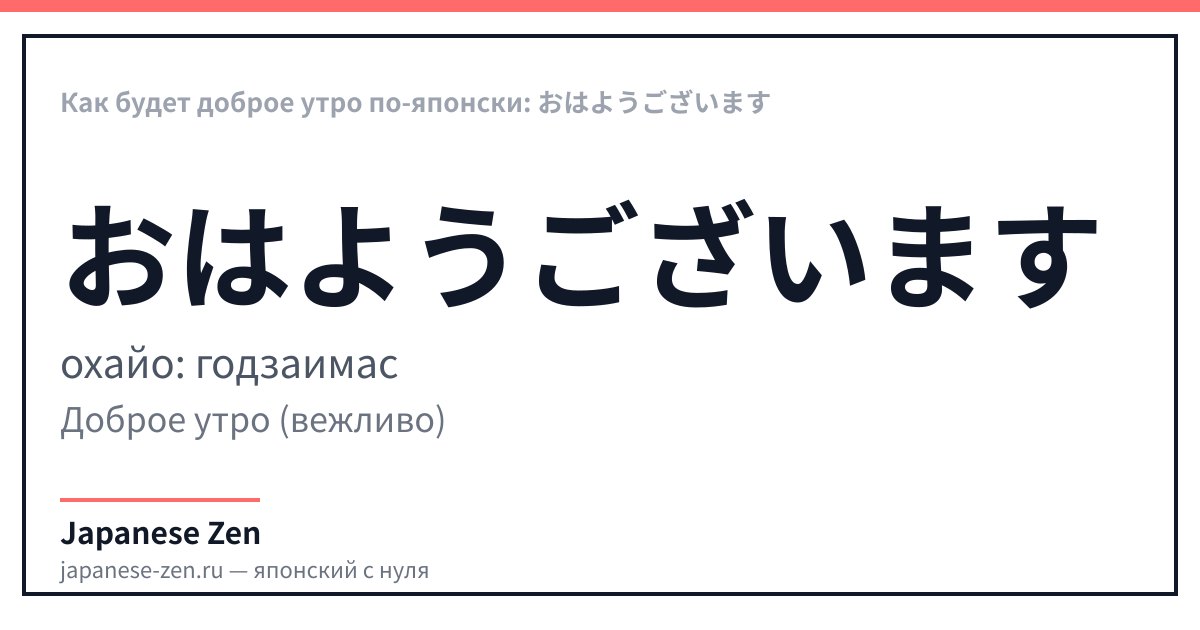
How to say good morning in Japanese: おはようございます
Good morning in Japanese is おはようございます (ohayō gozaimasu), polite. To friends and family, you say the short form: おはよう (ohayō). It works until about 10–11 AM, then you switch to こんにちは. In Russian letters: 'o-ha-yo: go-dza-i-mas', the colon indicates a long 'o'.
おはよう comes from 'お早く' meaning 'early'. So a Japanese person isn't wishing you a good morning, but noting that you got up early. Hence the oddity: on TV and in theater, おはようございます is said at any time of day — there it's a greeting to someone coming on shift.
How to say 'good morning' in Japanese
| Japanese | Reading | Translation |
|---|---|---|
| おはようございます | ohayō gozaimasu · охайо: годзаимас | Good morning (polite) |
| おはよう | ohayō · охайо: | Good morning (to friends/family) (friends, family, peers) |
| おはよっ | ohayo! · охаё! | Mornin'! (very informal, with a clipped ending) |
| 早いですね | hayai desu ne · хаяй дэс нэ | You're early today (common remark following a greeting) |
| よく眠れましたか | yoku nemuremashita ka · ёку нэмурэмасита ка | Did you sleep well? |
Why you can't just say 'ohayō' to your boss
The short form おはよう is 'familiar'. For a boss, teacher, or client, you need the full form: ございます is the part that makes the phrase polite. The rule works in reverse too: if a senior replies to you with a short おはよう, that's normal and not rude.
Until what time do people say 'ohayō'?
- The usual cutoff is 10–11 AM, after which you switch to こんにちは.
- At work with shift schedules, the greeting is tied not to the clock but to the start of the shift: on TV, in theater, and in restaurant kitchens, おはようございます is heard even at 7 PM.
- At school and university, the boundaries are stricter: after the first class, it's already こんにちは.
- In correspondence at night, if you're writing 'good morning' in advance, it's better to add 明日の朝 — otherwise it looks like a mistake.
Say 'ohayō gozaimasu' out loud
The long 'o' at the end of ohayō is held twice as long; the final 'su' is almost swallowed.
FAQ
- How do you say 'good morning' in Japanese?
- おはようございます (ohayō gozaimasu) — polite. To friends and family, the short おはよう (ohayō).
- How is it read in Russian letters?
- 'Oha-yo: go-dza-i-mas'. The colon indicates a long 'o', held twice as long. The final 'su' is voiceless, almost like 's'.
- Until what time do people say 'good morning'?
- Approximately until 10–11 AM. Exception: shift work — there, おはようございます is said at the start of the shift at any time of day.
- When can you just say 'ohayō'?
- With people close to you: friends, family, peers. For someone older or higher in rank, you need the full form with ございます.
Updated: 2026-07-25