How to say hello in Japanese: こんにちは and lively alternatives
“Hello” in Japanese is こんにちは (konnichiwa), but it’s more like “good afternoon” and is said during the day. In the morning — おはよう (ohayō), in the evening — こんばんは (konbanwa). Among friends, a real “hi” sounds like やっほー (yahhō) or おーい (ōi). In Russian letters: “konnichiwa”, with a “ch”.
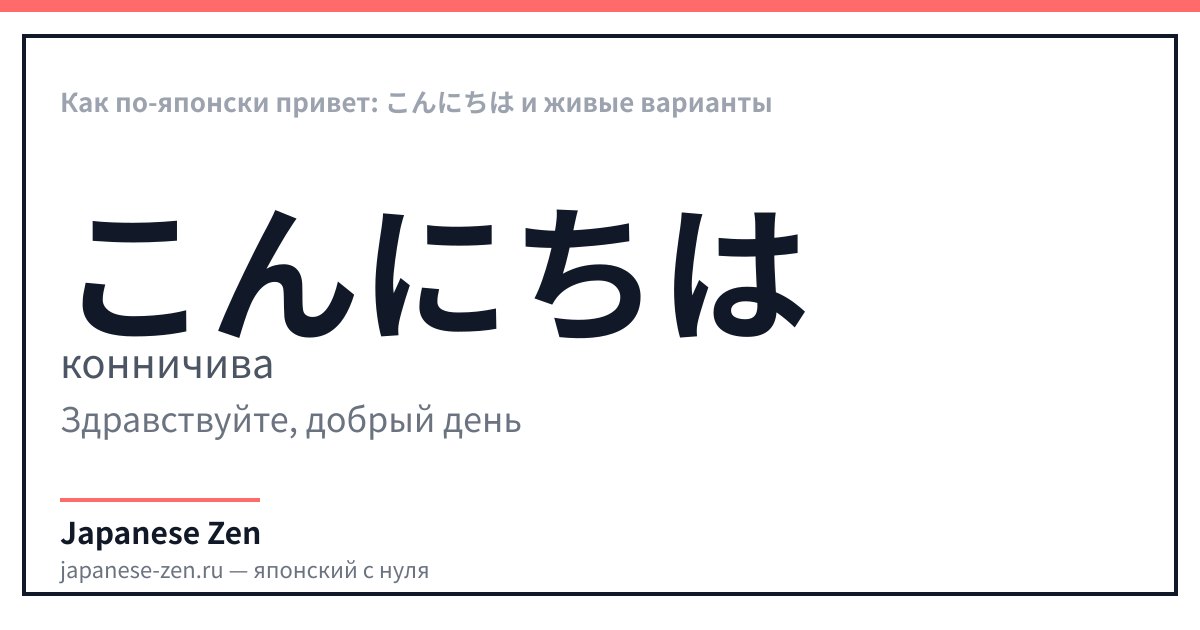
Phrasebooks promise that “hello” in Japanese is konnichiwa. In reality, it’s a daytime “good afternoon”: say it in the dormitory in the morning and it sounds like “good day” at seven in the morning. For Japanese people, greetings are tied not to the person but to the time of day.
How to greet in Japanese at different times of the day
| Japanese | Reading | Translation |
|---|---|---|
| こんにちは | konnichiwa · konnichiwa | Hello, good afternoon (roughly from 11 a.m. to 6 p.m.; universal with strangers) |
| おはようございます | ohayō gozaimasu · ohayō gozaimasu | Good morning (until 10–11 a.m.; short “ohayō” — among friends) |
| こんばんは | konbanwa · konbanwa | Good evening (after dark) |
| やっほー | yahhō · yahhō | Hey there! (that friendly “hi”, more common among girls) |
| おーい | ōi · ōi | Hey, hi! (to call out to a friend across the yard) |
| もしもし | moshimoshi · moshimoshi | Hello (on the phone) (only on the phone — not used in person) |
Why it’s written は but read “wa”
こんにちは ends with the character は, which is usually read “ha”. Here it’s a leftover from a particle: the phrase used to be longer — “as for this day…”. The particle は is read “wa”, and this reading is preserved in the greeting. The same story applies to こんばんは.
How friends greet each other
- They shorten it to one word: おはよう instead of the full おはようございます.
- They add the name: 田中くん、おはよう — “Tanaka, hi”.
- They often don’t greet with words at all, but nod or wave — a silent nod is not considered rude.
- The English ハイ (hai) appears in youth speech, but it sounds like a game, not the norm.
What you’d better not do
Don’t say こんにちは to someone you see every day at work: to a colleague in the morning — おはようございます, and later in the day Japanese people just nod. A daytime “konnichiwa” sounds like a greeting to a guest, not to one of your own.
Say “konnichiwa” out loud
The key is the double “n” in the middle: kon-ni-chi-wa.
FAQ
- How do you say “hello” in Japanese?
- こんにちは (konnichiwa) — but it’s “good afternoon” for daytime. A friendly “hi” is やっほー (yahhō) or おーい (ōi). In the morning you say おはよう, in the evening こんばんは.
- How do you write “hello” in Japanese in Russian letters?
- “Konnichiwa” — with a double “n” in the middle and a soft “chi”. The spelling “konnitiva” is also found (Polivanov system), but the pronunciation is closer to “chi”.
- Can you say “konnichiwa” in the morning?
- No, until 10–11 a.m. you say おはようございます. こんにちは starts around 11 a.m. and works until dark, then gives way to こんばんは.
- Why do they greet with “moshimoshi” in anime?
- もしもし is a telephone “hello”. Outside of a phone call, you don’t greet like that: it sounds like “can you hear me?”.
Updated: 2026-07-25