Japanese inscription: 13 ready-made options with translation
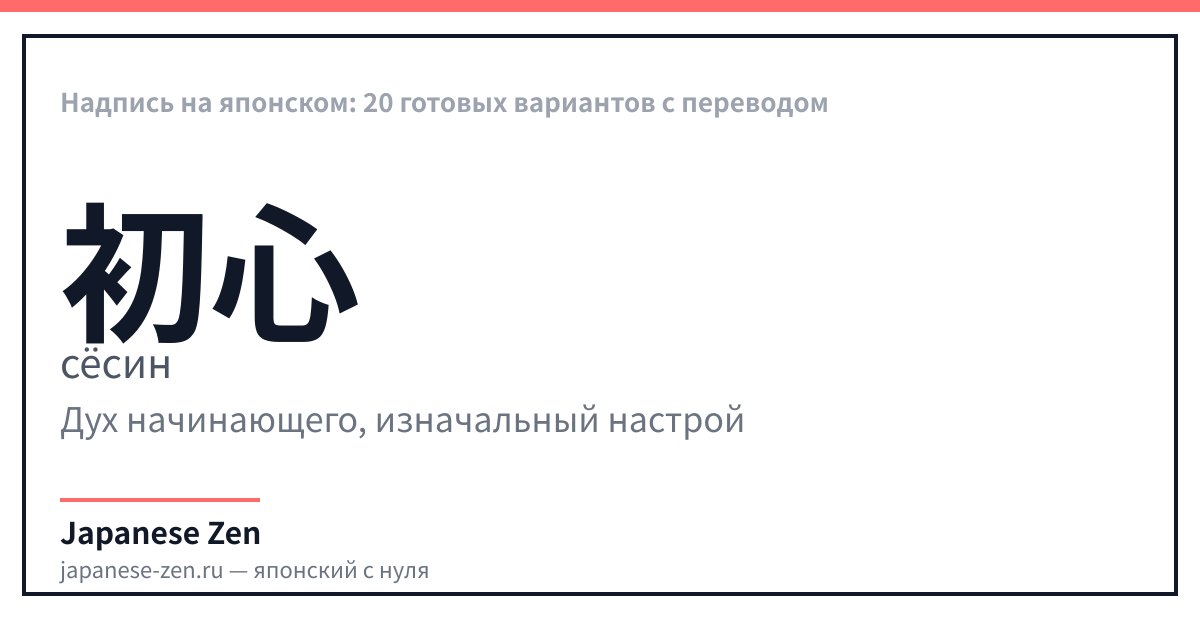
A Japanese inscription should be chosen from ready-made expressions, not assembled from individual characters: 一期一会 (ichigo ichie) "one encounter", 初心 (shoshin) "beginner's mind", 静寂 (seijaku) "silence", 我慢 (gaman) "endurance". Below are 13 inscriptions with romanized readings and an explanation of what they really mean to a Japanese person.
The main problem with Japanese inscriptions is not mistakes in strokes, but non-existent combinations. Two beautiful characters next to each other do not automatically form a word: a Japanese person will see exactly what we see in the inscription "СИЛА ЛУНА" on a T-shirt.
Short inscriptions: one or two characters
| Japanese | Reading | Translation |
|---|---|---|
| 初心 | shoshin · shoshin | Beginner's mind, original intention |
| 我慢 | gaman · gaman | Patience, endurance |
| 静寂 | seijaku · seijaku | Silence, stillness |
| 自由 | jiyū · jiyū | Freedom |
| 覚悟 | kakugo · kakugo | Resolve, readiness for consequences |
| 無心 | mushin · mushin | Mind without thoughts, state of flow |
| 縁 | en · en | The bond that brought people together |
Why a single character is not always a word
Some kanji exist as standalone words (愛, 縁, 力), others live only in combinations. For example, 静 by itself is not a word — you need 静か (shizuka) or 静寂. A simple check: if the character appears in a dictionary as a separate entry with a reading, it can be written alone.
Phrase inscriptions
| Japanese | Reading | Translation |
|---|---|---|
| 一期一会 | ichigo ichie · ichigo ichie | This encounter is unique and will never happen again |
| 七転び八起き | nanakorobi yaoki · nanakorobi yaoki | Fall seven times, get up eight |
| 永遠の愛 | eien no ai · eien no ai | Eternal love |
| 人生は一度きり | jinsei wa ichido kiri · jinsei wa ichido kiri | You only live once |
| 今を生きる | ima o ikiru · ima o ikiru | Live in the present |
| 花鳥風月 | kachō fūgetsu · kachō fūgetsu | Flowers, birds, wind, moon — the beauty of nature |
What to check before applying
- Whether the expression exists as a whole — look it up in a dictionary as a single entry, not by individual characters.
- Whether particles are missing: の and は are part of the phrase; without them the meaning falls apart.
- Which writing is being drawn for you: Japanese 愛 or simplified Chinese 爱.
- Stroke order: on a finished work, you can see whether the master wrote the character or traced a contour.
- Direction: vertical inscriptions are read from top to bottom and from right to left.
Write the character yourself and see how it is constructed
Trace 縁 along the guides — fifteen strokes, and six of them in the "thread" radical 糸.
FAQ
- What kinds of Japanese inscriptions are there?
- Short concept characters (初心, 我慢, 縁, 自由) and set phrases (一期一会, 七転び八起き, 永遠の愛). The main thing is to use existing expressions, not to assemble characters yourself.
- Where can I get an inscription with a translation?
- The tables above give both the romanized reading and the exact meaning. Using a machine translator is dangerous: it readily glues together non-existent combinations.
- How are vertical inscriptions written?
- From top to bottom, and columns go from right to left. This is how scrolls and signs are formatted; in horizontal writing, modern Japanese is read from left to right.
- What mistakes are most common?
- Non-existent combinations of characters, lost particles の and は, mirrored elements, and mixing Japanese and simplified Chinese forms in one inscription.
Updated: 2026-07-25