Netsuke — what it is and what it is for
Netsuke is a miniature carved fastener that holds a pouch or inro box on the obi belt of a kimono: traditional attire has no pockets, and netsuke with a cord solves this problem. Each figurine is a separate work of carving in wood or bone, often with a story or pun.
Netsuke is commonly considered a souvenir for a shelf. Originally, it was a clothing detail without any decorative purpose — it became an ornament later.
What is netsuke and what is it for
Netsuke is a miniature carved figurine with holes for a cord that works as a fastener: a pouch, inro box, or wallet is hung on a cord from the obi belt, and netsuke prevents the cord from slipping. Traditional kimono has no pockets, and netsuke along with sagemono — what is hung — replaced a bag. Carving subjects range from animals and deities to everyday scenes and puns understandable only to those who know the language.
- Katabori — a figurine in the shape of an animal, person, or mythical creature, the most common type.
- Manju — a flat round netsuke resembling a cookie, with carving around the circle.
- Kagamibuta — a bowl with a metal lid-medallion decorated separately from the body.
- Materials — boxwood, bone, deer antler, rarely ivory in old pieces.
How netsuke holds sagemono
The cord is threaded through two himotoshi holes in the netsuke, attached to the sagemono, and passed under the obi: the netsuke lies on top of the belt as an anchor, preventing the whole structure from falling. Today the function is almost unnecessary — any clothing has pockets — but figurines continue to be carved as an independent art.
Name and characters: 根付
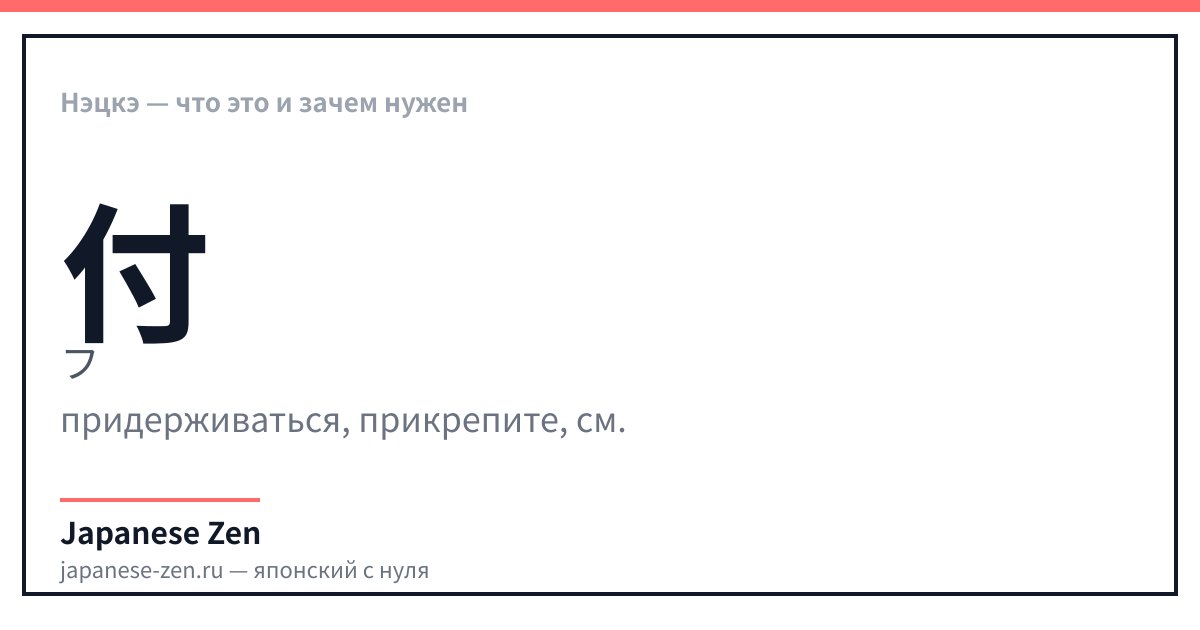
付 — значение: to adhere, attach, see, add — онъёми: フ — кунъёми: つ.ける、-つ.ける、-づ.ける、つ.け、つ.け-、-つ.け、-づ.け、-づけ、つ.く、-づ.く、つ.き、-つ.き、-つき、-づ.き、-づき — 5 штрих(ов). 付 — “to attach, to affix”: the second character in 根付, itself explains the purpose of the thing. The same root is in 付ける “to attach” and 受付 “reception desk” — where something is attached to something.
| Japanese | Reading | Translation |
|---|---|---|
| 根付 | netsuke · netsuke | Netsuke |
| 帯 | obi · obi | Kimono belt |
| 職人 | shokunin · shokunin | Craftsman, master |
| 彫刻 | chōkoku · chōkoku | Carving, sculpture |
| 小さい | chiisai · chiisai | Small |
根付 — attached at the root
根付 breaks down into 根 “root” and 付ける “to attach” — “attached at the root,” that is, at the base of the cord. Signatures on netsuke themselves are rare: a carver might leave a tiny character of his name on the hidden side, but most figurines are anonymous.
Repeat the stroke order of the character 付 in the trainer — the second symbol of the word 根付.
Netsuke in anime and games
- An antique dealer or collector character in a detective anime almost certainly keeps a couple of netsuke on display — a recognizable detail of a “connoisseur of old things.”
- In games with inventory and an Edo-period setting, netsuke sometimes appears as a decorative or plot item.
- A netsuke carver is a rare but recognizable character profession in a historical setting: a master with a knife working by the window.
- Animal figures of the eastern zodiac are a frequent standalone amulet design, not just a ready netsuke on a belt.
Netsuke and okimono: the difference is in the hole
Netsuke is confused with okimono — similar carved statuettes without holes for a cord and, accordingly, without a practical function. If a figurine does not have two himotoshi holes, it is no longer netsuke, but simply carving for a shelf.
From pocket to museum display
Today netsuke is more of a museum and collectible item than an everyday thing: almost no one wears kimono without pockets every day. Major collections are in museums of decorative art, and antique shops in tourist areas sell both originals and new pieces.
Which subjects are chosen as gifts
As gifts, they choose figurines of the animal of the year according to the eastern calendar or subjects with an explicit wish for good luck — turtle, crane, god Hotei. They avoid subjects with explicit or dark themes, which also exist in the netsuke tradition, but not as a gift.
FAQ
- How is netsuke written?
- 根付, read “netsuke”: 根 “root” plus 付ける “to attach” — “attached at the base of the cord.” The name describes not the figurine, but its function as a fastener.
- What do netsuke mean?
- There is no single meaning: subjects range from animals of the eastern calendar to gods of luck and everyday scenes. The symbolism depends on the specific figurine, not on netsuke in general.
- What is netsuke?
- A miniature carved fastener for the kimono belt: it holds a pouch, inro box, or wallet on a cord, replacing the pocket that kimono does not have.
- What is netsuke for?
- To hold items hung on a cord on the obi belt — traditional clothing has no pockets. Today the function is almost unnecessary, but figurines are carved and collected as art.
- What does the Hotei netsuke mean?
- Hotei is one of the seven gods of luck, a fat laughing monk with a sack on his back. Netsuke with his figure are given for luck and prosperity — one of the most common carving subjects.
- How is netsuke different from okimono?
- Netsuke always has two himotoshi holes for a cord, okimono does not — it is a purely decorative statuette without a practical function. By this feature, they cannot be confused even without a signature.
Sources
Updated: 2026-08-24