Funny Japanese Words: 12 with Translations
Funny Japanese words are doubled onomatopoeia and literal compounds. もふもふ (mofumofu) — 'fluffy and soft'. ぺこぺこ (pekopeko) — 'stomach growling from hunger'. 猫舌 (nekojita) — 'cat tongue'. 三日坊主 (mikka bōzu) — 'a monk for three days', about someone who quickly gives up what they started.
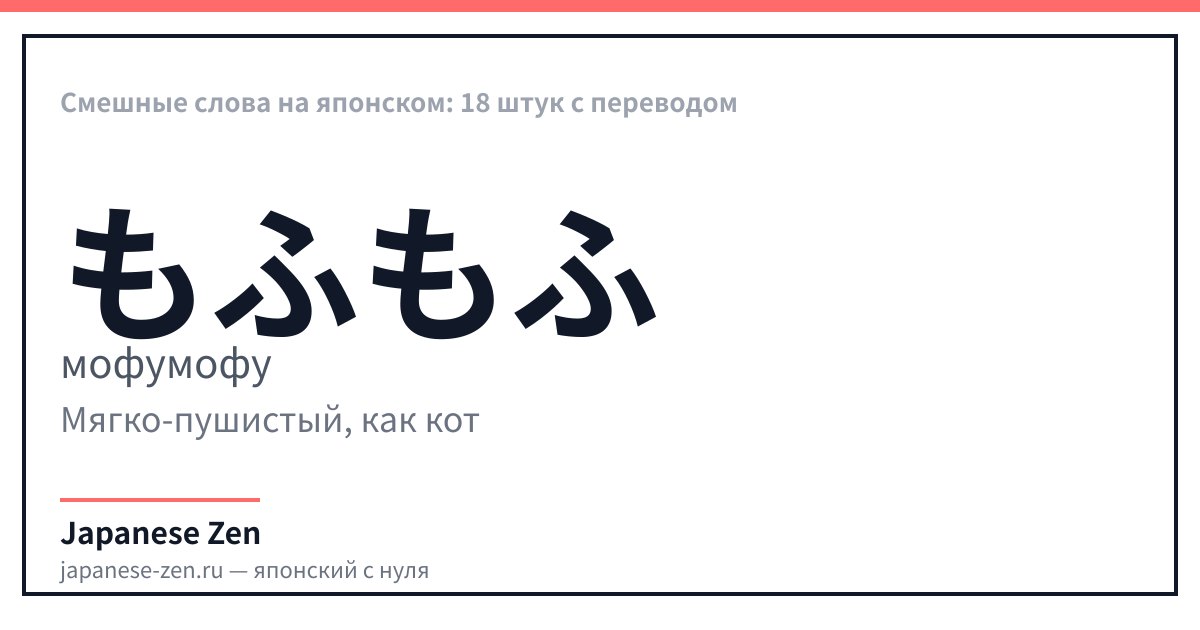
Half of funny Japanese words are sounds given a job: mofumofu describes not fur, but the feeling of burying your face in it. The other half are literal metaphors like 'a monk for three days'.
Sound Words
| Japanese | Reading | Translation |
|---|---|---|
| もふもふ | mofumofu · mofumofu | Soft and fluffy, like a cat |
| ぺこぺこ | pekopeko · pekopeko | Stomach growling from hunger |
| ごろごろ | gorogoro · gorogoro | Lying around doing nothing; a cat's purr |
| びっくり | bikkuri · bikkuri | To startle from surprise |
| うろうろ | urouro · urouro | To wander aimlessly, to pace |
| ぼんやり | bonyari · bonyari | Absent-mindedly, with one's head in the clouds |
How to Understand an Unfamiliar Doubling
There is a pattern: voiceless sounds denote something light and small, while voiced sounds denote something heavy and large. ころころ (korokoro) — something rolls lightly, ごろごろ (gorogoro) — rolls heavily. Hearing a new word, you can guess the scale of what's happening even without a dictionary.
Words Funny Because of Their Literal Meaning
| Japanese | Reading | Translation |
|---|---|---|
| 三日坊主 | mikka bōzu · mikka bo:zu | 'A monk for three days' — someone who quickly gives up everything |
| 猫舌 | nekojita · nekojita | 'Cat tongue' — can't eat hot food |
| 猫背 | nekoze · nekoze | 'Cat back' — stooped posture |
| 目玉焼き | medamayaki · medamayaki | Fried egg, literally 'fried eyeballs' |
| 食いしん坊 | kuishinbō · kuishimbo: | Glutton, food lover |
| 腹八分 | hara hachibu · hara hachibu | 'Stomach at eight-tenths' — eating until not quite full |
Why 'A Monk for Three Days'
Monastic life required strict discipline, and someone who entered a monastery and returned three days later became a symbol of inconstancy. Today, 三日坊主 is said about oneself with irony: started running, bought sneakers, quit on the fourth day.
Say the Word Aloud
Try もふもふ — four syllables with the same rhythm.
FAQ
- What funny words are there in Japanese?
- もふもふ (mofumofu) 'fluffy', ぺこぺこ (pekopeko) 'hungry', 三日坊主 (mikka bōzu) 'a monk for three days', 猫舌 (nekojita) 'cat tongue', 目玉焼き 'fried eyeballs' (fried egg).
- Why are there so many doubled words in Japanese?
- This is onomatopoeia — a full-fledged part of speech. Doubling conveys duration and character: voiceless sounds about light and small things, voiced sounds about heavy and large ones.
- What does 'mikka bōzu' mean?
- 三日坊主 — 'a monk for three days': someone who gives up what they started almost immediately. It's usually said about oneself, with irony.
- Are these childish words?
- No. Japanese onomatopoeia is used by adults in everyday speech and in books; unlike in Russian, it doesn't sound infantile.
Updated: 2026-07-25