Thank you in Japanese: ありがとう and 6 more ways to express gratitude
“Thank you” in Japanese is ありがとう (arigatō), more polite is ありがとうございます (arigatō gozaimasu). Short and friendly: どうも (dōmo). In response, they say どういたしまして (dō itashimashite) or just nod. In Russian letters it reads “arigatō”, where the colon indicates a long “o” sound.
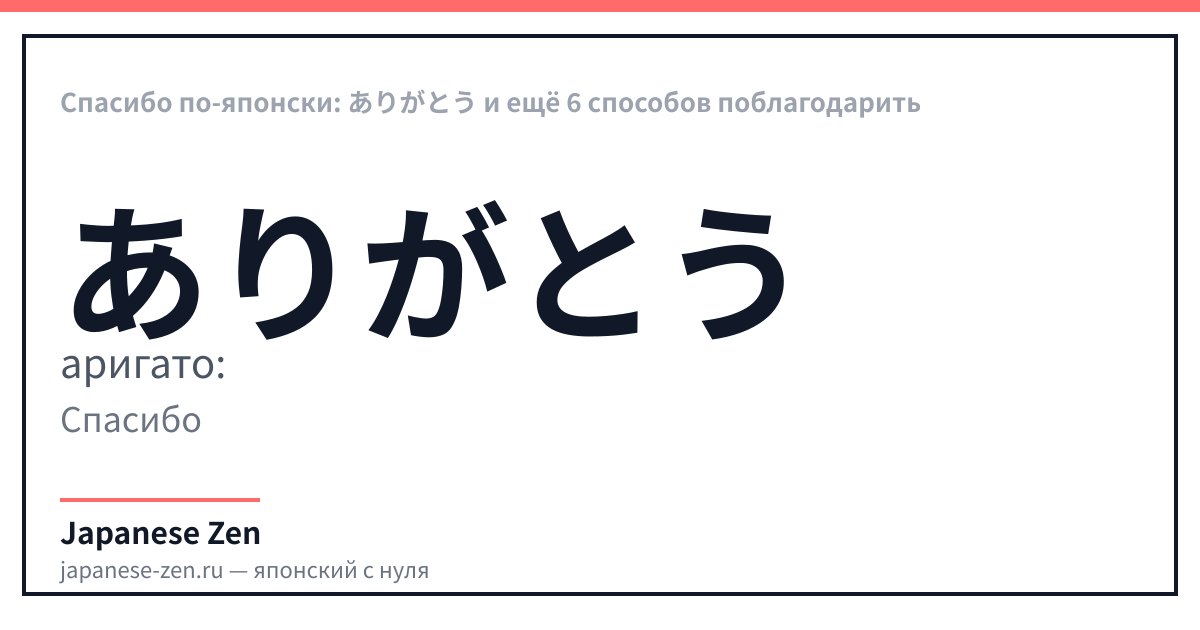
Japanese gratitude grows with the bow: the lower the head, the longer the phrase. “Arigato” is a nod to a friend. “Arigato gozaimasu” is a bow to a shopkeeper. And in response to a big favor, a Japanese person will also add “sumimasen” — an apology for having troubled you.
How to say “thank you” in Japanese
| Japanese | Reading | Translation |
|---|---|---|
| ありがとう | arigatō · arigatō | Thank you (to friends, peers, close ones) |
| ありがとうございます | arigatō gozaimasu · arigatō gozaimasu | Thank you very much (universally polite: to a shopkeeper, colleague, stranger) |
| どうもありがとうございます | dōmo arigatō gozaimasu · dōmo arigatō gozaimasu | Thank you so much (for a real favor, not a trifle) |
| どうも | dōmo · dōmo | Thanks; yeah, thanks (briefly, almost on the go) |
| すみません | sumimasen · sumimasen | Excuse me; thank you (for the trouble) (when gratitude is mixed with awkwardness) |
| お世話になりました | o-sewa ni narimashita · o-sewa ni narimashita | Thank you for your care (when leaving an office, hospital, after prolonged help) |
| 感謝します | kansha shimasu · kansha shimasu | I am grateful (in writing and formally; in speech it sounds bookish) |
How “thank you” is written in Japanese letters
ありがとう is five hiragana characters: あ-り-が-と-う. The final う is not read separately; it lengthens the “o” in と. The word can also be written with kanji — 有難う — but this is rare: in letters, signs, and handwriting, hiragana is more often used.
What to reply to “arigato”
| Japanese | Reading | Translation |
|---|---|---|
| どういたしまして | dō itashimashite · dō itashimashite | You're welcome (textbook answer; in real speech it sounds less common than in phrasebooks) |
| いいえ | iie · iie | Oh, not at all (the most common answer along with a slight nod) |
| とんでもないです | tondemonai desu · tondemonai desu | Oh, it's nothing (politely brush off gratitude) |
When it's better not to say “thank you”
- You don't reply “thank you” to a compliment: a Japanese person would rather say そんなことない (“no, not at all”) — accepting praise directly is considered bragging.
- For a big favor, instead of gratitude, an apology すみません often follows: you took someone's time, and that is acknowledged first.
- In a store, it's the shopkeeper who thanks, not the customer — ありがとうございました flies at your back, no need to respond.
- “Arigato” to a boss sounds too simple: there you need the full form with ございます.
Say “arigato” out loud and check your pronunciation
Speak the phrase into the microphone — AI will compare it with the Japanese sound.
FAQ
- How to say “thank you” in Japanese?
- ありがとう (arigatō) is the usual “thank you”. ありがとうございます (arigatō gozaimasu) is the polite form, appropriate almost always. どうも (dōmo) is a short “thanks” on the go.
- How to say “thank you very much” in Japanese?
- どうもありがとうございます (dōmo arigatō gozaimasu). This is the strongest everyday form; どうも at the beginning works like “very”.
- How is “thank you” in Japanese read in Russian letters?
- “Arigatō” — the colon means a long “o”, held twice as long as usual. The full polite form is “arigatō gozaimasu”, with a voiceless “s” at the end and the “u” barely heard.
- What is the difference between “arigato” and “dōmo”?
- どうも is shorter and more casual — like the Russian “aga, spasibo”. ありがとう is neutral. Together they give emphasis: どうもありがとう — “thank you very much”.
- What to reply if someone thanks you in Japanese?
- Most often いいえ (iie) with a nod — “not at all”. The textbook どういたしまして sounds formal in real speech. Between close people, a smile is enough.
Updated: 2026-07-25