Japanese Texts for Beginners: 4 Short Passages with Translation
Japanese texts for beginners are three or four simple sentences made from the words of the first weeks of study: introductions, family, food, daily routine. Below are four such texts with hiragana reading, transcription, and translation, and every sentence has audio. Transcription helps at the start, but it is better to leave it behind as soon as the characters can be read on their own.
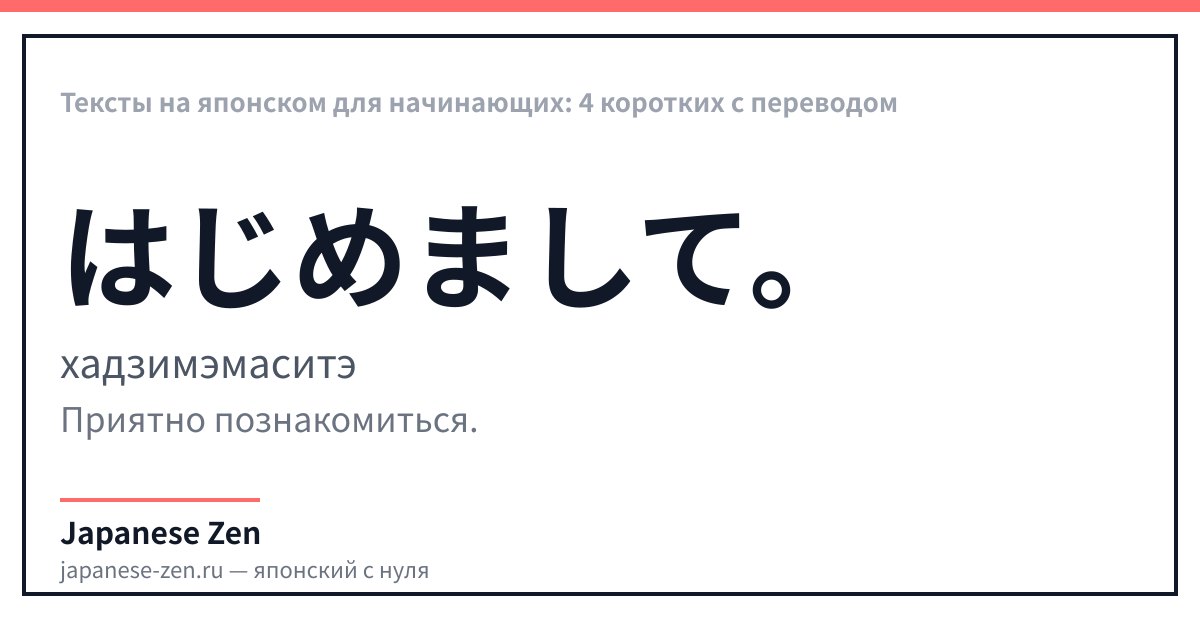
The first Japanese text is frightening not because of grammar but because of the very look of a line without spaces and with unfamiliar characters. That is why it is worth starting with tiny texts in hiragana, where every word is familiar from the textbook. Below are four such texts, a breakdown of the particles that appear in them, and the three-pass rule that removes the crutch of romaji.
Four Short Texts with Translation and Audio
Each text below is three or four sentences in the polite です and ます style. The words come from the basic vocabulary of the first lessons, and the characters are written without complex kanji. Read aloud and tap the audio: Japanese speech sounds more even than the transcription suggests.
Text 1. Introductions
| Japanese | Reading | Translation |
|---|---|---|
| はじめまして。 | hajimemashite. · hajimemashite | Nice to meet you. |
| 私はアンナです。 | watashi wa Anna desu. · watashi wa Anna desu | I am Anna. |
| 学生です。 | gakusei desu. · gakusei desu | I am a student. |
| どうぞよろしく。 | dōzo yoroshiku. · dōzo yoroshiku | Glad to meet you. |
Text 2. My Family
| Japanese | Reading | Translation |
|---|---|---|
| 私の家族は四人です。 | watashi no kazoku wa yonin desu. · watashi no kazoku wa yonin desu | There are four people in my family. |
| 父と母、妹、私です。 | chichi to haha, imōto, watashi desu. · chichi to haha, imōto, watashi desu | My father, mother, younger sister, and me. |
| 妹の名前はユキです。 | imōto no namae wa Yuki desu. · imōto no namae wa Yuki desu | My younger sister's name is Yuki. |
Text 3. A Boxed Lunch
| Japanese | Reading | Translation |
|---|---|---|
| これは私のお弁当です。 | kore wa watashi no obentō desu. · kore wa watashi no obentō desu | This is my boxed lunch. |
| ご飯と卵、野菜があります。 | gohan to tamago, yasai ga arimasu. · gohan to tamago, yasai ga arimasu | There is rice, egg, and vegetables. |
| とてもおいしいです。 | totemo oishii desu. · totemo oishii desu | It is very delicious. |
Text 4. My Day
| Japanese | Reading | Translation |
|---|---|---|
| 毎日、朝七時に起きます。 | mainichi, asa shichiji ni okimasu. · mainichi, asa shichiji ni okimasu | Every day I get up at seven in the morning. |
| 朝ご飯を食べます。 | asagohan o tabemasu. · asagohan o tabemasu | I eat breakfast. |
| それから勉強をします。 | sorekara benkyō o shimasu. · sorekara benkyō o shimasu | Then I study. |
How to Read a Text with Transcription and When to Drop It
Transcription is a support: it helps in the first days, but getting used to it prevents you from truly learning kana. The eye finds the familiar Latin letters and stops looking closely at the characters. That is why the same short text is read several times, each time removing one hint.
The Three-Pass Rule
- First pass — with all the hints. Read the hiragana line aloud, checking against the transcription and audio, and only then look at the translation.
- Second pass — without transcription. Read the kana alone, memorizing the characters you stumbled on.
- Third pass — without translation. You should understand the meaning from familiar words, not from the English line beneath.
It is time to leave transcription behind when you can read any line of these four texts without stopping and without peeking. Spaces between words in learning texts are also a hint: in ordinary Japanese print, words are not separated, and you have to find the boundaries by particles.
Which Particles Appeared in the Texts
| Particle | What It Does | Example from the Texts |
|---|---|---|
| は (read as wa) | marks the topic of the sentence | 私は アンナ です — “I am Anna” |
| の | shows possession | 私の お弁当 — “my lunch” |
| と | connects, like “and” | 父と母 — “father and mother” |
| が | marks what exists, paired with あります | 野菜が あります — “there are vegetables” |
| を (read as o) | marks the object of an action | 朝ご飯を 食べます — “I eat breakfast” |
| に | shows a point in time | 七時に 起きます — “I get up at seven” |
章: The Character for “Chapter” and “Connected Text”
章 — значение: chapter, section, sign, distinction — онъёми: ショウ — 11 штрих(ов). 章 — “chapter, section.” The character appears in words about written speech: 文章 — “sentence, text,” 第一章 — “first chapter.”
Words with the Character 章
The on reading ショウ is heard in all the common words. The word 文章 (bunshō) means a connected text of several sentences — exactly what you read above. The words 章 (shō) and 第一章 (dai-isshō) will appear in any book where the text is divided into chapters.
| Japanese | Reading | Translation |
|---|---|---|
| 文章 | bunshō · bunshō | Sentence, connected text |
| 第一章 | dai-isshō · dai-isshō | First chapter |
| 短い文章 | mijikai bunshō · mijikai bunshō | Short text |
FAQ
- Which Japanese texts for beginners are best?
- Short ones, three to five sentences, in hiragana, in the polite です and ます style. The topics are introductions, family, food, and daily life: the words are familiar from the textbook, and attention goes to reading the characters rather than looking up words in a dictionary.
- Do you need transcription when reading Japanese texts?
- Only at the beginning. Transcription helps you check yourself, but the eye quickly gets used to the Latin letters and does not memorize kana. Read in three passes: first with all the hints, then without romaji, and finally without translation.
- When can you start reading simple texts?
- When you have learned hiragana and know a few dozen words. The texts above are designed for exactly that moment. Katakana and the first kanji are picked up along the way: start by reading what is already familiar.
- Why are there spaces between words in these texts?
- That is how learning texts hint at word boundaries. In ordinary Japanese print there are no spaces, and words are separated by kanji and particles. So the learning spaces are a temporary support that you should not get used to.
- How do you check that a text is understood, not just read?
- Close the translation and retell the meaning in your own words, then answer the questions: who, does what, when. If you can answer without peeking, the text is done and you can move on to the next one.
Updated: 2026-09-29