I love you in Japanese: 愛してる, 好き and what they actually say
“I love you” in Japanese is 愛してる (aishiteru), but Japanese people almost never say this phrase. A living confession sounds like 好き (suki) “I like you” or 大好き (daisuki) “I really like you.” The full polite form is 愛しています (aishite imasu).
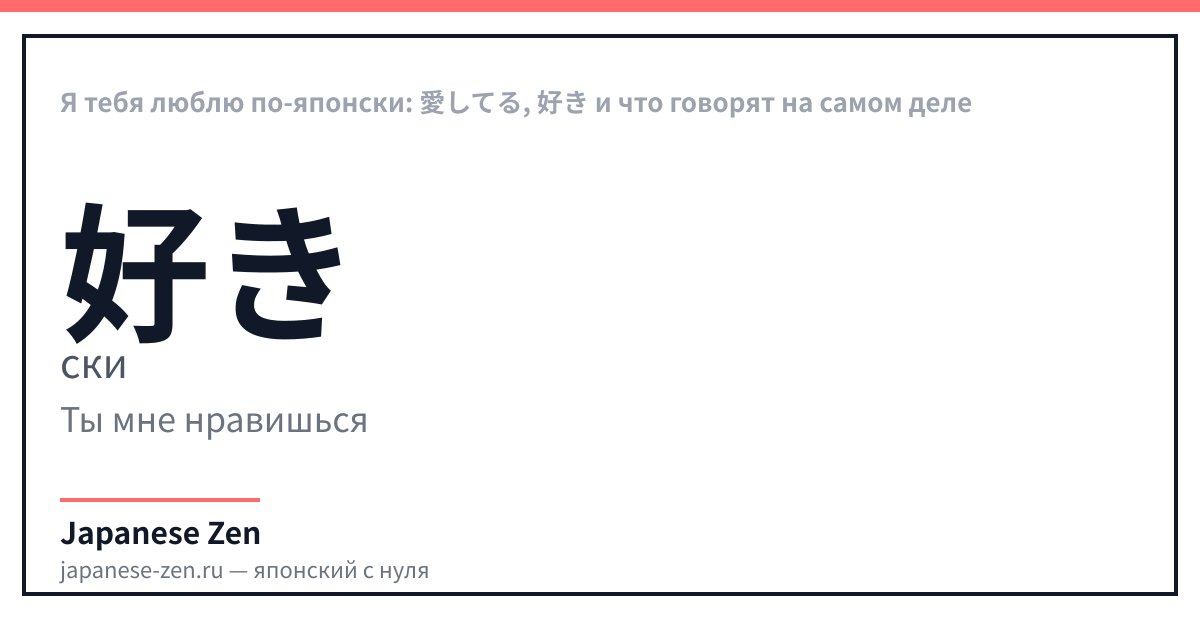
In Japanese dramas, a confession lasts a second and a half and consists of one word: 好き. Not “love” — “like.” 愛してる weighs so much that it is reserved for wedding vows and songs, and a person can live with someone for thirty years without ever saying it out loud.
How to say “I love you” in Japanese
| Japanese | Reading | Translation |
|---|---|---|
| 好き | suki · ski | I like you (this is how people confess for the first time) |
| 好きです | suki desu · ski des | I like you (polite) (polite — for someone you still address formally) |
| 大好き | daisuki · daiski | I really like you, I adore you (stronger than 好き and sounds warm, not pompous) |
| 愛してる | aishiteru · aishiteru | I love you (very weighty; almost never heard in everyday life) |
| 愛しています | aishite imasu · aishite imas | I love you (polite) (full polite form — letters, vows) |
| 付き合ってください | tsukiatte kudasai · tsukiatte kudasai | Let's go out (what a confession actually ends with) |
Why 愛してる is almost never said
愛 is love as responsibility and decision, not as a momentary feeling. Saying 愛してる is roughly like saying in Russian “I vow before you.” So in speech, 好き with intensifiers works: 好き → 大好き → 本当に大好き. And 愛してる remains for songs, dramas, and very rare moments.
How to write “I love you” in Japanese
With pronouns, the full phrase looks like this: 私はあなたを愛しています (watashi wa anata o aishite imasu). In living Japanese, pronouns are dropped — and 愛してる remains. By the way, あなた (“you”) in a wife's mouth sounds like “dear,” so it is almost never used in a confession.
How to respond to a confession
| Japanese | Reading | Translation |
|---|---|---|
| 私も好き | watashi mo suki · watashi mo ski | I like you too |
| ありがとう | arigatō · arigato: | Thank you (soft rejection: gratitude instead of reciprocated feelings) |
| ごめんなさい | gomen nasai · gomen nasai | I'm sorry (polite rejection; a direct “no” is avoided) |
Say the confession out loud
In 好き, the “u” is almost swallowed: it sounds like “ski,” not “su-ki.”
FAQ
- How to say “I love you” in Japanese?
- 愛してる (aishiteru) is the literal “I love you.” But a living confession is 好き (suki) “I like you” or 大好き (daisuki) “I really like you”; these are what people actually say in life.
- What is the difference between 好き and 愛してる?
- 好き means “I like you,” from food to a person, light and frequent. 愛してる is a heavy confession with a hint of promise. Between them stands 大好き — strong but still everyday.
- How to say “I love you” in Japanese in Russian letters?
- “Aishiteru” (愛してる), politely — “aishite imasu” (愛しています). Friendly “I like you” — “ski” or “daiski.”
- How to write this phrase in full?
- 私はあなたを愛しています — watashi wa anata o aishite imasu. In speech, pronouns are omitted, leaving 愛してる: it is clear from context who loves whom.
- What do people reply to a confession?
- If feelings are mutual — 私も好き (watashi mo suki) “I like you too.” Rejection is usually soft: ありがとう (thank you) or ごめんなさい (I'm sorry); a direct “no” is avoided.
Updated: 2026-07-25