Japanese Wisdom: 16 Sayings About Life with Readings and Meanings
Japanese wisdom consists of sayings and principles, most often four-character idioms, that have a written source: the tea tradition, Zen texts, Chinese classics. Below are 16 such expressions with readings and meanings, a separate breakdown of the character 智 "wisdom," and an honest paragraph on how to tell a genuine saying from an internet invention.
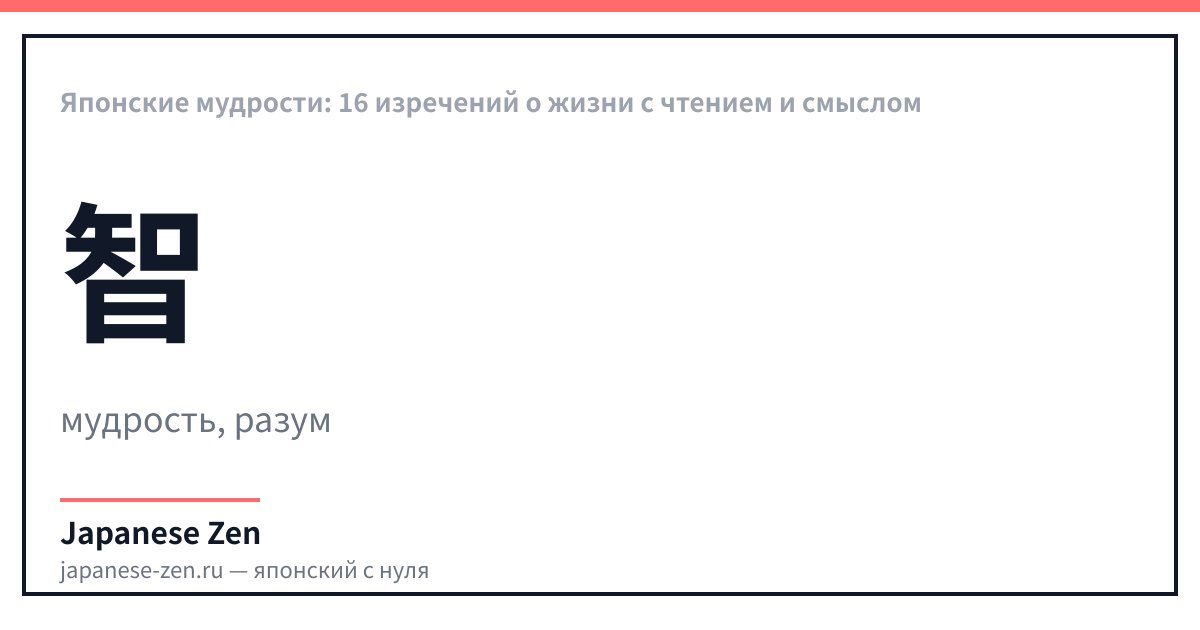
The word "wisdom" in captions to pictures is often unsupported: there are no kanji, and the translation goes in circles. Meanwhile, genuine Japanese sayings have an author, a book, or a dictionary entry. Here are those that can be verified—about the path, perseverance, calm, and moderation—along with three questions that help distinguish them from inventions.
Japanese Wisdom About Life's Path and Perseverance
The first selection is about how to move toward a goal and not stop. Some expressions came from China, some grew in Japan itself, but in Japanese they sound like their own.
| Saying | Reading | Translation and Meaning |
|---|---|---|
| 一期一会 | いちごいちえ | "One life, one encounter" — every meeting is unique, so cherish it |
| 七転び八起き | ななころびやおき | "Fall seven times, get up eight" — don't give up after failures |
| 継続は力なり | けいぞくはちからなり | "Perseverance is power" — small efforts, if continued, lead to success |
| 温故知新 | おんこちしん | "Study the old to know the new" — the past opens the way to new knowledge |
| 一日一善 | いちにちいちぜん | "One day, one good deed" — a small good deed every day |
| 思い立ったが吉日 | おもいたったがきちじつ | "The day you decide is a lucky day" — the best moment to start is now |
| 少年老い易く学成り難し | しょうねんおいやすくがくなりがたし | "Youth passes quickly, but learning is hard to achieve" — don't waste time |
| 切磋琢磨 | せっさたくま | "Cut, sharpen, work, polish" — improve together with friends |
| 一所懸命 | いっしょけんめい | "Hold on to one domain with your life" — do things seriously, with all your might |
Where the saying "cut and polish" comes from
切磋琢磨 comes from the ancient Chinese "Book of Songs" (Shijing): the four characters denote four methods of working stone and jade — cutting, sharpening, grinding, and polishing. Later the expression became a metaphor for study and moral growth, especially among friends who spur each other on. Many four-character sayings work this way: a concrete image stands behind them.
Japanese Wisdom About Calm, Moderation, and Work
The second selection is closer to Zen and the way of tea: clarity of mind, contentment with little, harmony, and work as part of life.
| Saying | Reading | Translation and Meaning |
|---|---|---|
| 明鏡止水 | めいきょうしすい | "Clear mirror, still water" — a mind without prejudice, calm and pure |
| 足るを知る | たるをしる | "Know that enough is enough" — be content with what you have |
| 和を以て貴しと為す | わをもってとうとしとなす | "Consider harmony the highest value" — the opening of the "Seventeen-Article Constitution" |
| 一日作さざれば一日食らわず | いちにちなさざればいちにちくらわず | "A day without work is a day without food" — a Zen rule about labor |
| 不撓不屈 | ふとうふくつ | "Do not bend, do not yield" — resilience in the face of difficulties |
| 有言実行 | ゆうげんじっこう | "Said and done" — carry out what you promised aloud |
| 不言実行 | ふげんじっこう | "Don't speak, just do" — silently work toward the result |
Where the image of the "clear mirror" came from
明鏡止水, according to Kotobank, comes from the Daoist work "Zhuangzi": calm water and a clear mirror reflect everything without distortion, and the mind in such a state judges without prejudice. In Japan the expression became a fixed name for mental clarity; Kotobank notes that politicians also used it to assure others of the purity of their intentions.
What the Internet Passes Off as Japanese Wisdom
Many "Japanese wisdom" sayings from social media are not found in any Japanese dictionary. They were written in Russian, and then an "ancient origin" was attributed to them. The word "Japanese" sounds convincing, and no one is in a hurry to check.
Three questions that filter out inventions
- Is there a Japanese written form? A genuine saying always has one, and it can be entered into a search engine or the Kotobank dictionary.
- Does the translation match? If the literal translation diverges greatly from the picture on the postcard, it is probably a retelling or an invention.
- Is the source named? 一期一会 has the tea tradition, 明鏡止水 has "Zhuangzi," 温故知新 has the "Analects." A saying "from Japanese sages" without a book or a name raises questions.
The absence of a verifiable original does not prove that the thought is bad. But labeling it as Japanese without kanji and a source is dishonest. The selections on this page were checked against a dictionary, so disputed attributions are noted. For example, the line 少年老い易く学成り難し was long considered a poem by the Chinese philosopher Zhu Xi, but modern scholars dispute that authorship.
Name and Characters: 智 and 知恵
智 — значение: wisdom, intellect — онъёми: チ — 12 штрих(ов). 智 — "wisdom, intellect." The character appears in 智慧 (chie), the Buddhist spelling of the word "wisdom," and in its common variant 知恵 (chie) "intelligence, cleverness."
智慧 and 知恵: two ways to write one word
Both words are read ちえ. The common spelling 知恵 means the ability to judge the essence of things and find a reasonable solution. The spelling 智慧 is Buddhist: there 智 refers to discerning ordinary things, while 慧 refers to spiritual action that leads to enlightenment. Everyday speech and school texts more often use 知恵, while 智 remains in literary vocabulary.
| Japanese | Reading | Translation |
|---|---|---|
| 知恵 | chie · chie | Intelligence, wisdom, cleverness |
| 智慧 | chie · chie | Wisdom (Buddhist spelling) |
| 一期一会 | ichigo ichie · ichigo ichie | One life, one encounter |
| 継続は力なり | keizoku wa chikara nari · keizoku wa chikara nari | Perseverance is power |
| 温故知新 | onko chishin · onko chishin | Study the old to know the new |
| 足るを知る | taru o shiru · taru o shiru | Know that enough is enough |
Write 智 along the guides: on top 知 "to know," below 日 "sun."
FAQ
- What is Japanese wisdom?
- These are sayings and principles that have a Japanese written form and a source: the way of tea, Zen texts, Chinese classics. Most often they consist of four kanji, like 一期一会 or 温故知新, and convey a whole thought in four characters.
- What does 一期一会 mean and where did it come from?
- Literally "one life, one encounter": every meeting is unique. The expression came from the tea tradition: the idea of a once-in-a-lifetime meeting was recorded by Yamanoue Sōji, a disciple of Sen no Rikyū, and it was named 一期一会 by Ii Naosuke.
- How can you tell that a piece of Japanese wisdom is invented?
- Check three things: whether there is a Japanese written form, whether the translation matches it, and whether the source is named. If there are no kanji and the "ancient origin" is unconfirmed, most likely you are looking at a translation from Russian or English, not from Japanese.
- How does Japanese wisdom differ from a Japanese proverb?
- A proverb (諺) comes from folk speech and is built on an image: "a frog in a well." Wisdom or an aphorism (格言) is more often tied to an author, a school, or a text and sounds instructive. The boundary is fuzzy: the same expressions are assigned to both groups.
- How do you read four-character Japanese wisdom?
- Four-character expressions, 四字熟語, as a rule, are read with onyomi, without endings: 温故知新 — onko-chishin. The literal translation often splits into two pairs of characters, so first translate each pair, then combine the meaning.
Sources
Updated: 2026-09-29