What does “itadakimas” mean in anime and in life
“Itadakimas” (いただきます) means “I humbly receive” — it is said before eating, with hands clasped. It is not “bon appétit” nor “thanks to the chef”: the phrase is addressed to all who made the food possible, and to the food itself. After eating, one says ごちそうさまでした (gochisōsama deshita).
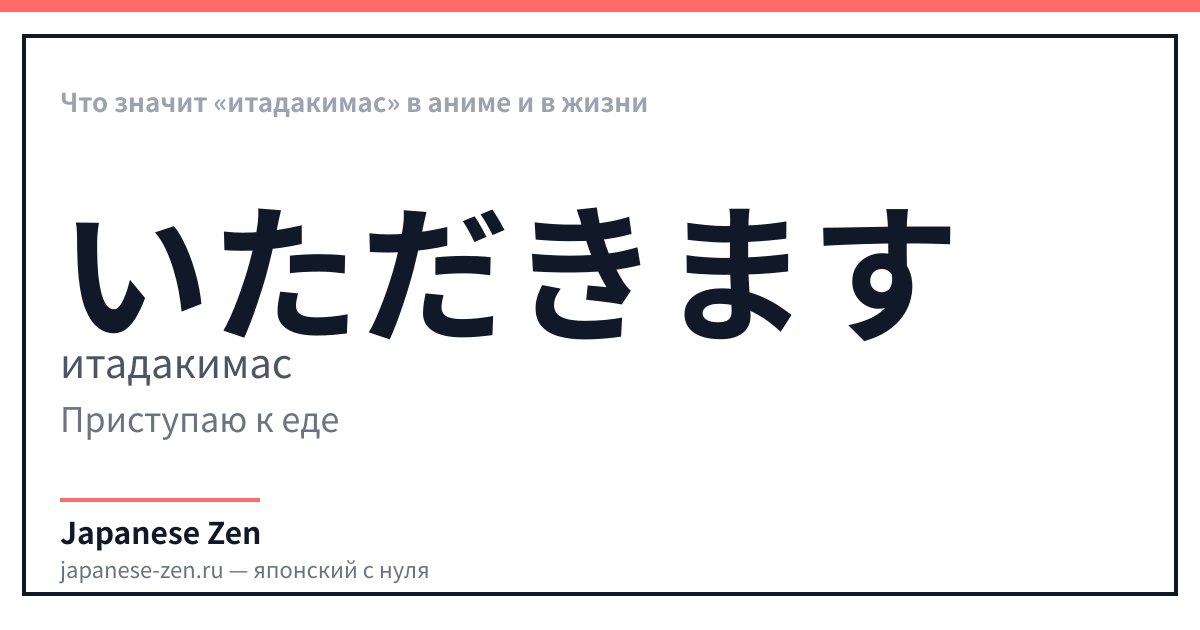
In anime, a character claps their hands and blurts out “itadakimas” — and subtitles write “bon appétit.” The translation is convenient but inaccurate: at that moment, the Japanese person is not wishing, but thanking, and not the neighbor, but the whole chain from field to plate.
What “itadakimas” literally means
This is the humble form of the verb いただく — “to receive from someone higher.” Literally, “I accept what is given to me.” Previously, 頂く meant “to raise above the head”: that’s how one received a gift from an elder, raising it to the forehead. Hence the gesture with clasped palms.
Who the phrase is addressed to
- To the one who grew and obtained the food — the fisherman, the farmer.
- To the one who cooked and set the table.
- To the one who pays for the meal, if you are a guest or being treated.
- To the food itself: the Japanese wording acknowledges that you are consuming someone’s life.
When it is said
| Japanese | Reading | Translation |
|---|---|---|
| いただきます | itadakimasu · итадакимас | I start eating |
| ごちそうさまでした | gochisōsama deshita · готисо:сама дэсита | Thank you, it was delicious |
| いただく | itadaku · итадаку | Humbly receive, accept |
| 頂きます | itadakimasu · итадакимас | The same phrase written with a kanji (usually written in hiragana) |
| お先にいただきます | o-saki ni itadakimasu · о-саки ни итадакимас | I’ll start before you, excuse me |
Not only about food
いただきます is also said when receiving a gift or a service: “thank you, I’ll accept.” In business speech, the phrase ~させていただきます (“allow me to do”) comes from the same root and sounds very polite: literally, “I will receive permission to do.”
Say the phrase aloud
Five even syllables and a voiceless “su” at the end: i-ta-da-ki-mas.
FAQ
- What does “itadakimas” mean?
- “I humbly receive” — gratitude before eating to all who contributed to the food’s existence, and to the food itself. Not “bon appétit”: the phrase is about oneself, not the interlocutor.
- When is “itadakimas” said?
- Right before the first bite, with palms clasped. Even when alone, and even over store-bought food. After eating — ごちそうさまでした.
- Why is it translated as “bon appétit” in anime?
- Because in Russian, that’s what you say at that moment. The meaning is lost: the Japanese phrase is the speaker’s gratitude, not a wish to another person.
- Is “itadakimas” used outside the table?
- Yes, when receiving a gift or a service: “thank you, I’ll accept.” The same root appears in the very polite phrase ~させていただきます — “allow me to do.”
Updated: 2026-07-25