What does “kawaii” mean in Japanese
“Kawaii” (可愛い, かわいい) means “cute, lovely, sweet.” It is an adjective, not an exclamation: 可愛い猫 — “cute cat,” 可愛いですね — “how lovely.” The word grew from 顔映し (kaha yushi) — “face flushed with embarrassment,” and the current characters 可愛い mean “worthy of love.” A kawaii compliment is soft and suits almost anyone, except a male boss.
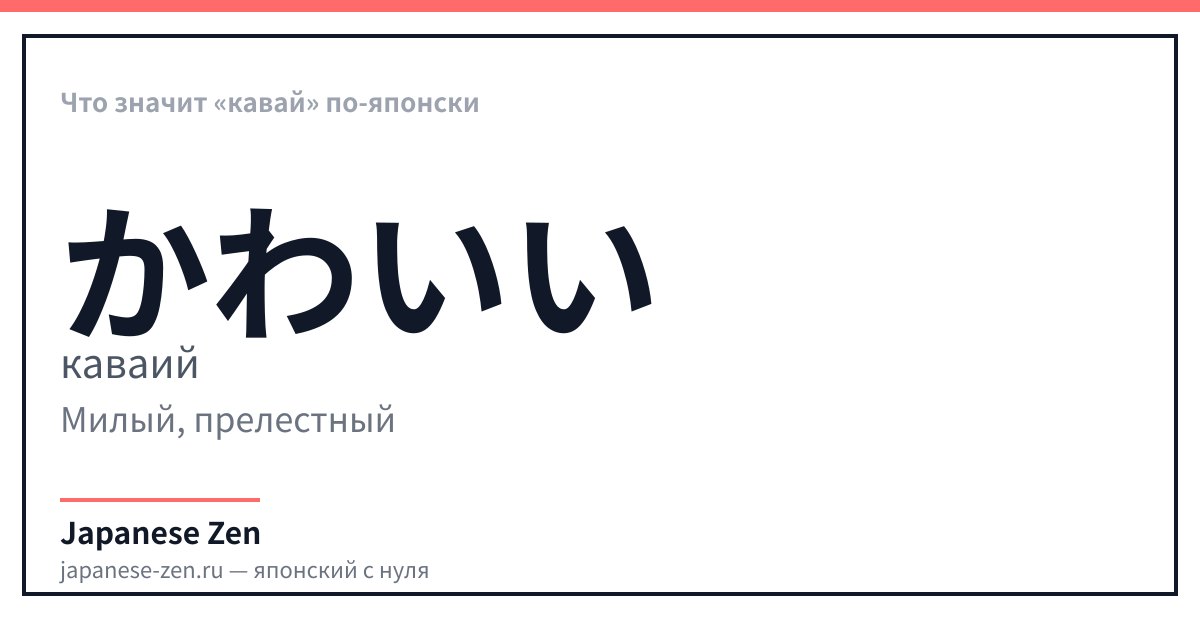
Perhaps the most recognizable Japanese word after “sushi,” and almost always pronounced incorrectly: not “ka-VAI,” but “ka-wa-ii” with a long “i.” Let’s break down how it works, how it attaches to nouns, and when it’s better to use a different compliment.
What “kawaii” means and how to use it in speech
かわいい is a predicative adjective ending in -い. It is placed directly before a noun without any particles and can also function as the predicate itself.
| Japanese | Reading | Translation |
|---|---|---|
| かわいい | kawaii · kawaii | Cute, lovely |
| 可愛い猫 | kawaii neko · kawaii neko | Cute cat (adjective placed directly before the word) |
| かわいいですね | kawaii desu ne · kawaii desu ne | How lovely, isn't it? (polite compliment) |
| かわいくない | kawaikunai · kawaikunai | Not cute (negative: -い changes to -くない) |
| かわいかった | kawaikatta · kawaikatta | Was cute (past tense of the adjective) |
| かわいそう | kawaisō · kawaisō | Poor thing, I feel sorry for him (careful: this is not “cute” but sympathy) |
“Kawai” or “kawaii” — which is correct
In Japanese, the word ends with two “i”s: かわいい, and the second “i” is an obligatory part of the adjective. The Russian “kavay” cuts it off and turns the word into an exclamation that doesn’t exist in Japanese. More accurate is “kawaii” or “kawai,” and the form “kavayny” is already Russian slang, not Japanese.
愛 — значение: love, affection — онъёми: アイ — кунъёми: いと.しい、かな.しい、め.でる、お.しむ、まな — 13 штрих(ов). 愛 — the second character in 可愛い, 13 strokes. Click “Show stroke order”: the character is built from top to bottom.
Who you can call “kawaii” and who you’d better not
- For a child, animal, thing, dessert — always appropriate and pleasant.
- For a girl — a common compliment; slightly older sounds 綺麗 (kirei) — “beautiful, elegant.”
- For a man — only in a friendly context: “cute” sounds condescending to an adult Japanese man. Better 格好いい (kakkoii) — “cool, stylish.”
- For a boss or client — not said at all, it’s too personal a judgment.
- Don’t confuse with かわいそう (kawaisō) — “poor thing”: one extra mora turns a compliment into pity.
Four morae, not two
Four moras: “ka-wa-i-i.” Both “i”s are pronounced, so the word is about twice as long as the Russian “kavay.” There is no stress; the pitch rises slightly on “wa” and stays level to the end.
Say the words aloud — the app will check whether you hold both “i”s at the end.
FAQ
- What does “kawaii” mean in Japanese?
- 可愛い (かわいい) — “cute, lovely.” It is an adjective: 可愛い猫 — “cute cat.”
- Which is correct: “kawai” or “kawaii”?
- More accurately “kawaii”: in Japanese the word ends with two “i”s, and the second is an obligatory part of the adjective.
- Can you call a man “kawaii”?
- Only in a friendly setting. For an adult man, 格好いい (kakkoii) — “cool, stylish” — is more appropriate.
- How do you write “kawaii” in Japanese?
- In kana as かわいい or in kanji as 可愛い. In everyday texts, it’s more often written in kana.
Updated: 2026-07-25