What does "muda muda" mean in Japanese
"Muda muda" (無駄無駄) means "useless, in vain, all for nothing." 無駄 (muda) is a common Japanese word for wasted effort: 無駄な時間 — "wasted time." In "JoJo's Bizarre Adventure," it's Dio's battle cry during a flurry of punches, paired with Jotaro's オラオラ (ora ora). In manufacturing, the same word 無駄 refers to any waste — hence the term muda in lean production.
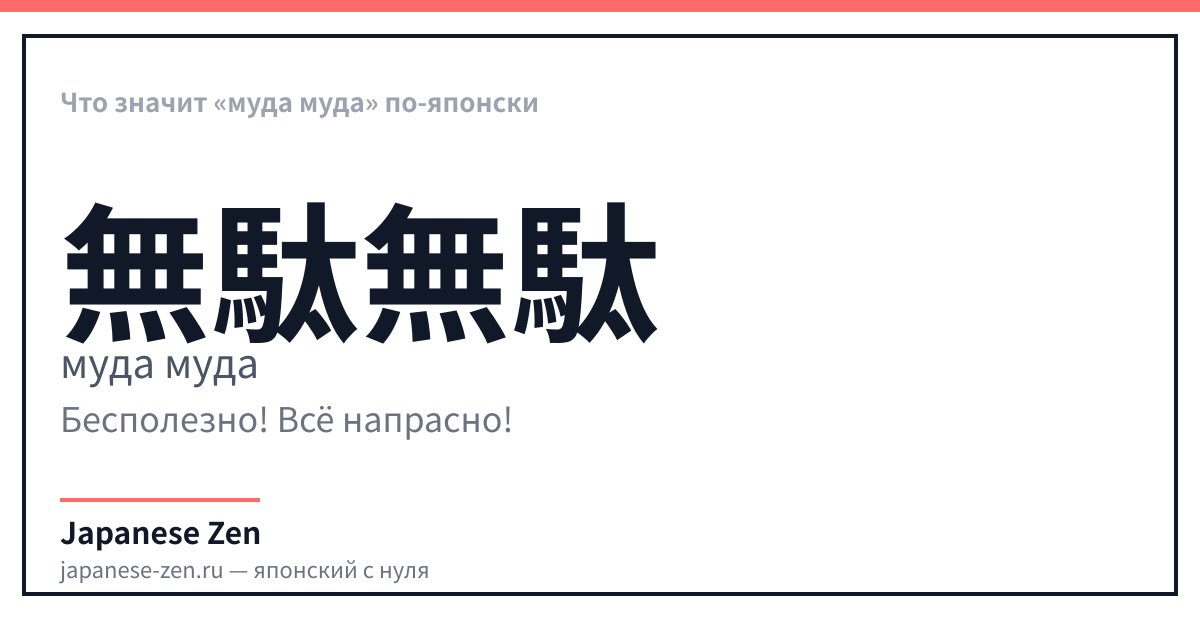
The same word is shouted by a vampire in manga and spoken by a Toyota engineer during process analysis. Let's break down what 無駄 literally means, why repetition turns it into a punch, and how to say "this is useless" in a way that sounds natural.
What does "muda muda" mean and where does the word come from
無 means "no, absence," 駄 means "packhorse load," and in compound words it conveys "worthless" (the same character appears in 駄目 — "no good, not allowed"). Together, they mean "that which yields no result." Repetition in Japanese intensifies: a single 無駄 states a fact, 無駄無駄 cuts off all hope.
| Japanese | Reading | Translation |
|---|---|---|
| 無駄無駄 | muda muda · muda muda | Useless! All in vain! |
| 無駄 | muda · muda | Vain, useless, in vain |
| 無駄な時間 | muda na jikan · muda na jikan | Wasted time (common everyday usage) |
| 無駄遣い | mudazukai · mudazukai | Waste of money (common word in budget discussions) |
| 無理 | muri · muri | Impossible, unrealistic (don't confuse: muda means "in vain," muri means "won't work") |
| オラオラ | ora ora · ora ora | Come on! Hey! (paired battle cry of the opponent) |
Muda, muri, mura — the three wastes of Japanese manufacturing
In the Toyota system, they distinguish 無駄 (muda — useless work), 無理 (muri — overburden), and 斑 (mura — unevenness). These three words have entered the global lexicon of lean production as-is, without translation. So "muda" from anime and "muda" from an efficiency report are the same word.
無 — значение: nothing, absence, without — онъёми: ム、ブ — кунъёми: な.い — 12 штрих(ов). 無 — "none, absence," N3 level. Click "Show stroke order": at the bottom of the character are the same four dots 灬 as in fire.
How to say "this is useless" without being rude
- Neutral: 無駄です (muda desu) — "this is useless," a calm statement.
- About yourself: 無駄にしました (muda ni shimashita) — "I wasted this," without blame.
- Softer: もったいない (mottainai) — "what a waste, a pity to waste." Japanese people say this about food, things, and time.
- Blunt: 無駄無駄 — only as a joke among friends; seriously, it sounds like "don't even try."
- What not to do: don't respond with 無駄 to someone's suggestion at work — it will be seen as rude. Say 難しいですね ("that's difficult") — the standard Japanese way to decline.
Japanese "u" without protruding lips
"Mu-da mu-da," four even short syllables. The Japanese "u" is pronounced without protruding the lips, closer to the Russian "ы" in a weak position — so when said quickly, it sounds almost like "mda-mda."
Say the shout aloud — four short syllables, no stretching at the end.
FAQ
- What does "muda muda" mean in Japanese?
- 無駄無駄 — "useless, all in vain." The single 無駄 (muda) means "vain, in vain."
- Why is "muda muda" associated with "ora ora"?
- They are paired battle cries in "JoJo's Bizarre Adventure": Dio shouts 無駄無駄, Jotaro shouts オラオラ.
- Is "muda" in lean production the same word?
- Yes, 無駄 — waste, useless work. The term entered global practice along with 無理 (muri) and 斑 (mura).
- How do you write "muda muda" in Japanese?
- 無駄無駄 in kanji, in kana — むだむだ. In manga, the cry is often written in katakana: ムダムダ.
Updated: 2026-07-25