Yandere — what it means and where the word came from
Yandere — what it means: a character (ヤンデレ) whose love turns into obsession and violence. The word is a blend of 病んでる (yan-deru, “sick, crazy”) and デレデレ (dere-dere, “melting with tenderness”): outwardly affectionate, inwardly ready to kill for the object of their affection. In Japan itself, this is fan jargon, not an everyday word.
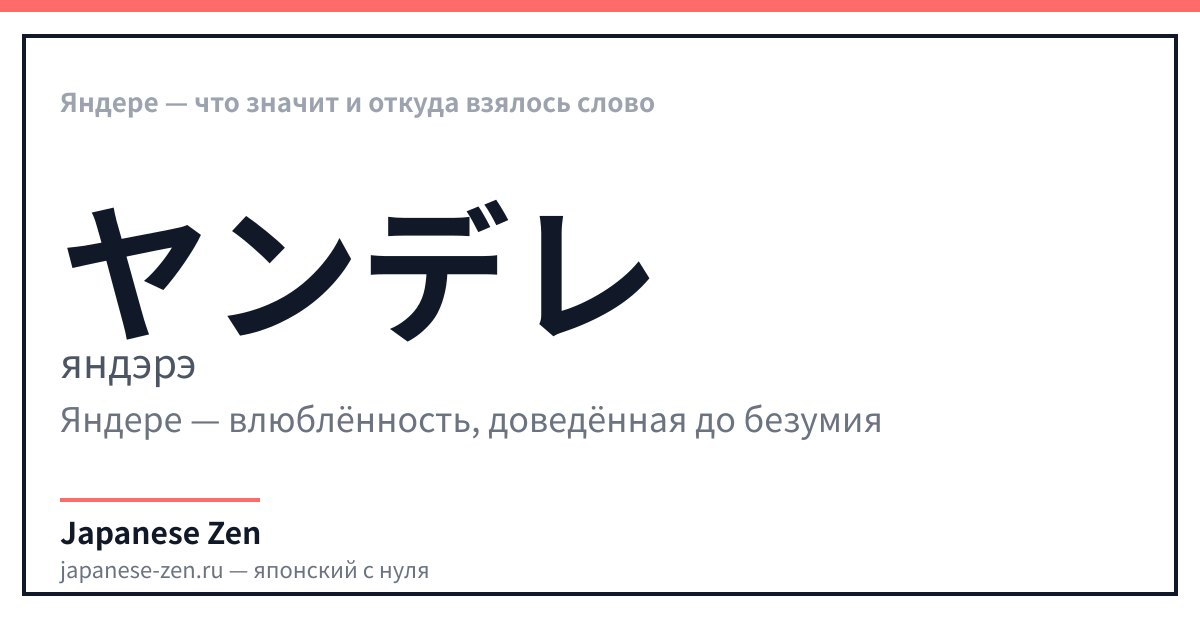
The archetype is recognizable in a single frame: a smile, sweet words — and a knife behind the back. Half the meaning is hidden in the word itself, so let's break it down syllable by syllable, and also separate yandere from neighboring “dere” types that beginners constantly confuse.
What “yandere” means literally
Japanese fans build such terms like a construction set: take two words, cut off the tail of each, and glue the beginnings together. ヤンデレ is exactly that case.
| Japanese | Reading | Translation |
|---|---|---|
| ヤンデレ | yandere · yandere | Yandere — love taken to the point of madness |
| 病んでいる | yandeiru · yande iru | To be sick, unhealthy (first root; in speech shortened to 病んでる) |
| デレデレ | deredere · deredere | To melt with tenderness, to cling (second root; onomatopoeia for being in love) |
| 病む | yamu · yamu | To fall ill, to become sick (original verb, hence 病んでる) |
Why “illness” and not “villainess”
The verb 病む describes not only the body but also the mind: 心を病む (kokoro o yamu) — “to lose one's mind.” The term deliberately gives a diagnosis rather than a verdict: a yandere does not consider herself evil; she is sure she is protecting love. Hence the signature combination of a gentle voice and a horrifying act.
愛 — значение: love, affection — онъёми: アイ — кунъёми: いと.しい、かな.しい、め.でる、お.しむ、まな — 13 штрих(ов). 愛 — the very character around which the whole archetype revolves. Click “Show stroke order” and see how it is written by hand.
Yandere, tsundere, and other “dere” types: how they differ
The common suffix ‑デレ means “to thaw, to show affection.” The first part distinguishes the types — how the character behaves before they thaw.
- ヤンデレ (yandere) — 病んでる “sick”: love turns into obsession, jealousy, and threat.
- ツンデレ (tsundere) — ツンツン “prickly, harsh”: acts rude and denies feelings, warms up in private.
- クーデレ (kuudere) — from English “cool”: cold and composed on the outside, rare flashes of warmth.
- ダンデレ (dandere) — 黙り (dammari) “silence”: stays silent out of shyness, comes alive only near their special person.
- 天然 (tennen) — not a “dere” but close: naive absent-mindedness without any mask.
How the word sounds in everyday speech
Japanese has no stress, but has pitch: ヤンデレ is pronounced evenly, with a slight rise on the first syllable — “yan-de-re,” without stretching the “e.” The Russian “yandere” with “e” comes from the English romanization yandere; closer to the original is “yandere” (with “e” as in “met”).
Say the word aloud — the app will compare your pronunciation with the reference.
FAQ
- Yandere — what does this word mean?
- ヤンデレ — a character whose love has grown into obsession. The word is a blend of 病んでる (“sick”) and デレデレ (“melt with tenderness”).
- How is yandere different from tsundere?
- Tsundere is rude to hide affection and at worst will hurt with words. Yandere is affectionate from the start, but jealousy drives her to threats and violence.
- Do Japanese people use the word “yandere” in everyday speech?
- Rarely, and only as jargon about characters or jokingly about acquaintances. It is a fan community term, not found in news or business speech.
- How do you write “yandere” in Japanese?
- In katakana: ヤンデレ. Katakana is used because it is a slang neologism, not an ordinary Japanese word.
Updated: 2026-07-25