How to say good evening in Japanese: こんばんは
“Good evening” in Japanese is こんばんは (konbanwa). As in こんにちは, the last character は is read as “wa” — it’s a frozen particle. It is used after dark; during the day you say こんにちは, in the morning おはようございます. Before going to bed, こんばんは is not used; instead you say おやすみなさい.
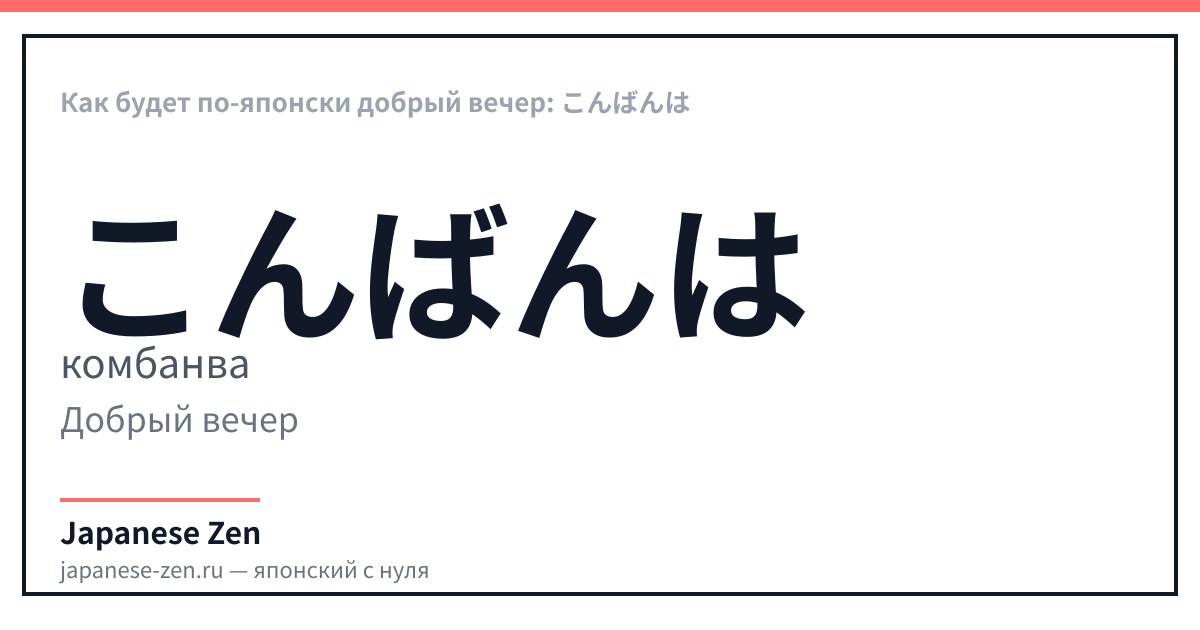
こんばんは is the evening twin of こんにちは, with the same history: both phrases were once the beginning of a longer sentence (“as for this evening…”), of which only the particle remains.
How to greet in the evening
| Japanese | Reading | Translation |
|---|---|---|
| こんばんは | konbanwa · kombanwa | Good evening |
| こんにちは | konnichiwa · konnichiwa | Good afternoon |
| おはようございます | ohayō gozaimasu · ohayō gozaimasu | Good morning |
| おやすみなさい | oyasumi nasai · oyasumi nasai | Good night |
| お疲れ様です | o-tsukaresama desu · o-tsukaresama desu | Hello (to a colleague at any time) |
| 今晩 | konban · konban | This evening |
Why は is read as “wa”
At the end of こんばんは, it’s not the syllable “ha” but the particle は, which is always read as “wa”. Previously, the phrase was longer — “as for this evening, how are you?” — and only the beginning with the particle remained. The same story applies to こんにちは.
From what time do people say “konbanwa”
- The guideline is darkness, not a specific hour: in summer it’s after 6–7 PM, in winter already from 5 PM.
- In evening correspondence, it’s a common greeting; often just the person’s name is used instead.
- At work, colleagues will say お疲れ様です in the evening, not こんばんは.
- Before sleep, use おやすみなさい: こんばんは does not mean “goodbye” or “good night”.
Say the greeting aloud
“Konbanwa”: ん before “b” sounds like “m” — that’s normal, not a slip of the tongue.
FAQ
- How do you say “good evening” in Japanese?
- こんばんは (konbanwa). It is written with the particle は at the end, which is read as “wa”.
- From what time do people say “konbanwa”?
- It depends on darkness: in summer after 6–7 PM, in winter already from 5 PM. There is no strict boundary.
- Why is は read as “wa”?
- It’s the particle は, not the syllable “ha”. The phrase is a remnant of a longer sentence, and the particle’s reading has been preserved. Same in こんにちは.
- Can you say “konbanwa” before going to bed?
- No, it’s a greeting when meeting someone. Before sleep, you say おやすみなさい (oyasumi nasai) — “good night”.
Updated: 2026-07-25