Dzyubokko — who is it in Japanese mythology
Dzyubokko is a vampire tree, and Japanese mythology has given it one of its darkest stories. According to legend, it grows on the site of an old battlefield and absorbs so much spilled blood that it itself begins to thirst for it: it lures tired travelers with its shade, then drinks their blood through hollow, straw-like branches. This yokai is actually late — the image in its current form was assembled in the 20th century by artist Shigeru Mizuki.
Dzyubokko is a rare case where the myth's setting is more honest than the myth itself: the tree doesn't invent cruelty, it simply remembers the ground it grew on.
How a tree becomes dzyubokko
Dzyubokko is a tree that grew on the site of an ancient battle and absorbed so much human blood into the soil that it itself transformed into a bloodthirsty yokai. It looks like an ordinary large tree and lures tired travelers with the promise of shade and rest, then pierces them with hollow branch-'straws' and drinks their blood dry.
- Habitat: old battlefields and abandoned cemeteries.
- Appearance: indistinguishable from an ordinary large tree at first glance.
- Hunting method: lures with shade, sucks blood through hollow branches.
- Clue sign: from a broken branch of a dzyubokko, according to legend, blood oozes, not sap.
Can you somehow negotiate with it
In stories — absolutely yes, and without any possibility of negotiation: dzyubokko doesn't take revenge or punish for wrongdoing like an onryo, but simply feeds, because that's what the past of the place made it.
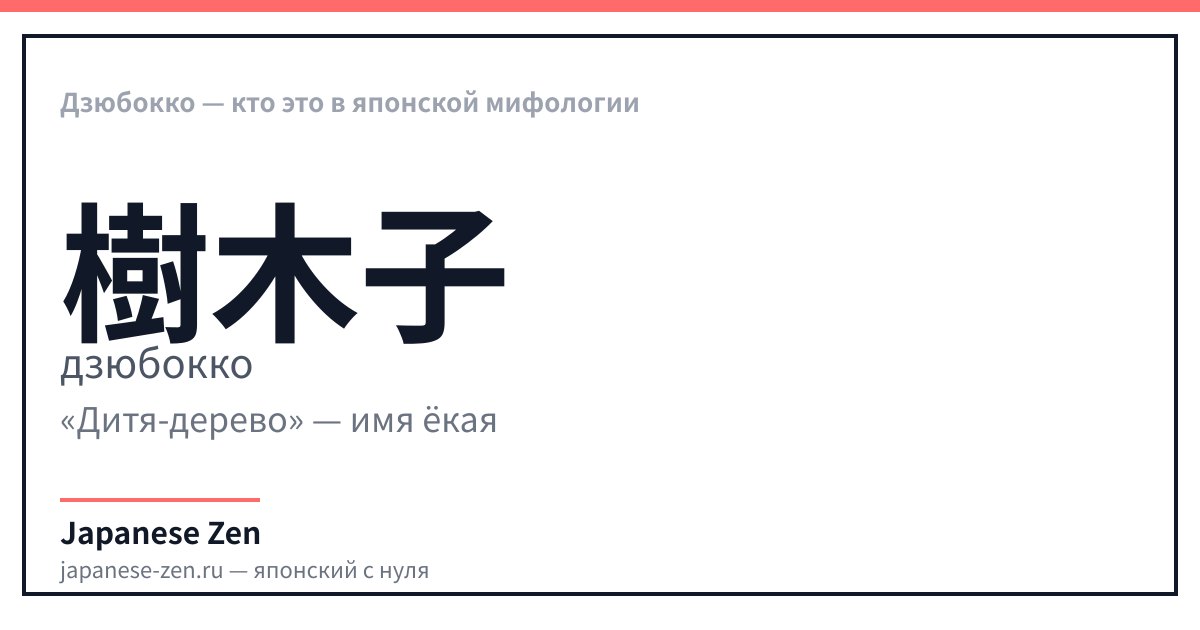
樹木子 — 'child-tree'
| Japanese | Reading | Translation |
|---|---|---|
| 樹木子 | jubokko · dzyubokko | 'Child-tree' — the yokai's name |
| 木 | ki · ki | Tree |
| 血 | chi · chi | Blood |
| 古戦場 | kosenjō · kosenjō | Old battlefield |
| 吸う | suu · suu | To suck |
Why does such a yokai have such a soft name
樹木子 is read じゅぼっこ: 樹木 'tree, plant' plus 子 'child' — literally 'child-tree'. Dzyubokko entered the standard bestiary relatively late: it was systematically described and drawn in the 20th century by manga artist Shigeru Mizuki, who continued the work of Toriyama Sekien for a new era.
木 — значение: tree, wood — онъёми: ボク、モク — кунъёми: き、こ- — 4 штрих(ов). 木 — 'tree': a pictogram of a trunk with branches and roots. The tripled sign 森 means 'forest'.
Write 木 along the guidelines — one of the first N5 level kanji.
Dzyubokko in Shigeru Mizuki and after him
- 'GeGeGe no Kitaro' — an adaptation of Shigeru Mizuki's encyclopedias, where dzyubokko and dozens of other late yokai first gained a mass audience.
- Horror games about abandoned forests and battlefields often use the idea of a predator tree without directly referencing the name.
- Some role-playing games introduce dzyubokko as a boss or trap in locations associated with past wars.
FAQ
- Is Dzyubokko a deity?
- No, it's a yokai: a vampire tree that grew on the site of an old battlefield and absorbed too much blood to remain an ordinary plant.
- What is Dzyubokko dangerous for?
- It lures tired travelers with shade and rest, then sucks blood through hollow branch-'straws'. It acts not out of revenge, but simply following its bloodthirsty nature.
- What characters make up 樹木子?
- 樹木子 (じゅぼっこ): 樹木 'tree' plus 子 'child' — 'child-tree'. One of the most recently documented yokai, systematized only in the 20th century.
- Through which anime did dzyubokko become famous?
- Through adaptations of Shigeru Mizuki's bestiary, primarily 'GeGeGe no Kitaro', where dzyubokko and other late yokai first appeared on the mass screen.
- Are there real places associated with Dzyubokko?
- There is no specific cult site — the legend is tied not to a particular point, but to the type of location itself: any old battlefield could theoretically, according to legend, give rise to such a tree.
- Is Dzyubokko a spirit or a creature?
- It's a yokai — a supernatural creature born from ground soaked in blood, not a deity and not the disembodied spirit of a specific deceased person.
Sources
Updated: 2026-08-29