Mountain Gods — Who They Are in Japanese Mythology
Japanese mythology does not know a single 'Mountain God' — the question usually arises from a truncated search query. Mountain gods here are collectively called yama-no-kami (山の神): these are guardian spirits of specific peaks, on whom the harvest in the valley below depended. Not one deity, but a whole class of local gods, each with their own mountain and their own rituals.
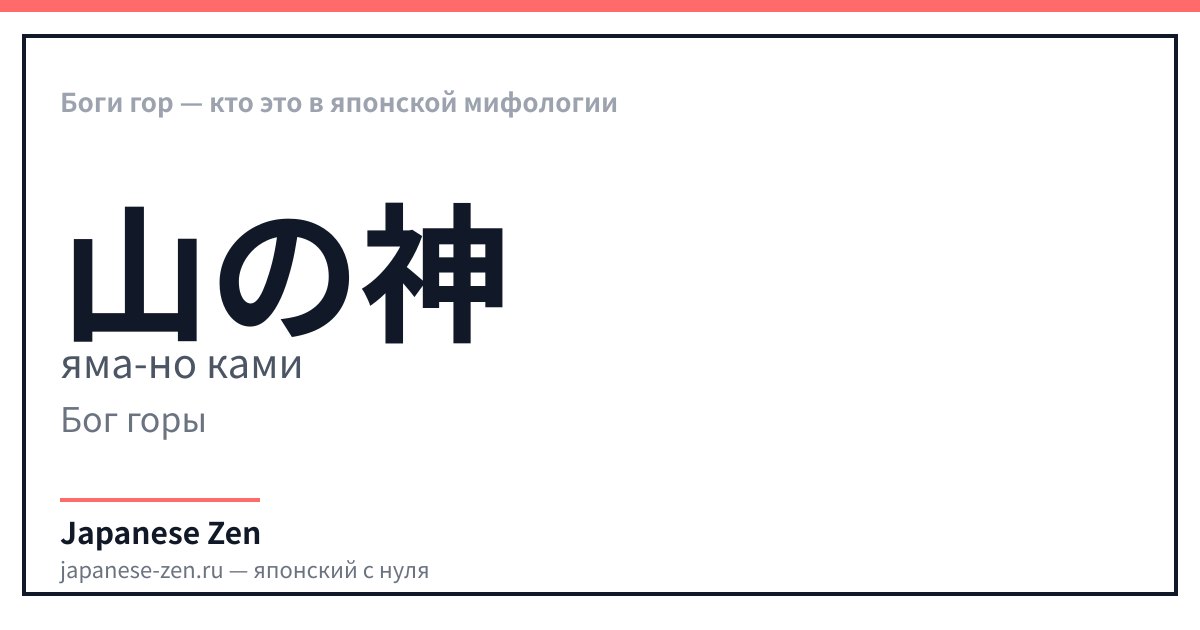
Japanese mountains have no single ruler — each peak is its own kingdom with its own god, often nameless to the rest of the world.
Who Are Yama-no-Kami and What Are They Responsible For
Yama-no-kami is a collective name for guardian spirits of specific mountains, not a single deity: almost every significant peak in Japan has its own patron god, often nameless outside the region. According to a widespread belief, in spring such a god descends from the mountain into the valley and becomes ta-no-kami, the god of rice fields, and in autumn after the harvest returns to the mountains.
- Status: not a single deity, but a class of local guardian spirits of mountains.
- Seasonal cycle: descends into the valley as the god of fields in spring, returns to the mountains in autumn.
- Connection to folklore: mountains are the traditional habitat of yamamba and other mountain yōkai.
- Practice: mountain ascetics yamabushi have for centuries worshiped the spirits of specific peaks.
Why They Are Almost Absent from Chronicles
Chronicles record individual mountain deities sporadically — for example, the god of Mount Ōyama — but the vast majority of yama-no-kami never made it into state texts: this is a local, oral tradition of specific villages and mountain communities.
山の神 — 'Mountain God' and 'My Wife'
| Japanese | Reading | Translation |
|---|---|---|
| 山の神 | yama no kami · yama no kami | Mountain God |
| 田の神 | ta no kami · ta no kami | God of Rice Fields (the same entity in the valley) |
| 山伏 | yamabushi · yamabushi | Mountain Ascetic-Pilgrim |
| 山岳信仰 | sangaku shinkō · sangaku shinkō | Cult of Sacred Mountains |
| 峰 | mine · mine | Mountain Peak |
How to Read 山の神 and What Else This Combination Means
山の神 is read やまのかみ: 山 'mountain' plus の (possessive particle) plus 神 'god'. The same combination of characters is sometimes also read as 山神 (sanjin), without the particle — a more bookish, formal variant of the same concept.
山 — значение: mountain — онъёми: サン、セン — кунъёми: やま — 3 штрих(ов). 山 — 'mountain': a pictogram of three peaks. One of the first kanji learned in Japanese.
Write 山 along the guides — a simple and frequent character at the N5 level.
Mountain Gods in 'Princess Mononoke' and Beyond
- 'Princess Mononoke' — the entire plot revolves around the conflict between humans and the spirits of a specific mountain and its forests.
- 'Naruto' and similar shōnen often introduce guardian spirits of individual mountain regions as secondary characters.
- Games about yamabushi and mountain pilgrimages use the image of a nameless mountain god as a source of power for the hero.
- Yamamba, the mountain ogress, is traditionally associated precisely with the territory of yama-no-kami.
FAQ
- Is there a single mountain god in Japanese mythology?
- There is no single god with that name — the query usually refers to the guardian spirits of mountains, yama-no-kami: a class of local deities, each significant peak having its own, often nameless outside the region.
- What are yama-no-kami responsible for?
- For the mountain itself and, according to the seasonal cycle, for the harvest in the valley: in spring the mountain spirit descends and becomes the god of the fields, and in autumn after the harvest returns to the mountains.
- How is 'mountain god' written?
- 山の神 (やまのかみ): 山 'mountain' plus 神 'god'. A more formal variant of the same concept is 山神, read sanjin, without the possessive particle.
- Which anime shows mountain gods?
- Most vividly in 'Princess Mononoke', where the conflict between humans and the spirits of a specific mountain and its forest constitutes the entire plot of the film.
- Where in Japan are mountain gods worshiped?
- At the foot of almost every significant peak there is a shrine to the local yama-no-kami. Mountain ascetics yamabushi have for centuries practiced a separate cult of worshiping the spirits of specific mountains.
Sources
Updated: 2026-08-29