Kami — Who They Are in Japanese Mythology
Kami in Japanese mythology are not 'gods' in the usual sense, but anything that inspires awe or reverence: Mount Fuji, a waterfall, a fox, an unusual stone, an outstanding person after death. The classic of Japanese philology Motoori Norinaga in the 18th century defined kami precisely this way — through the observer's emotion, not through a list of divine powers.
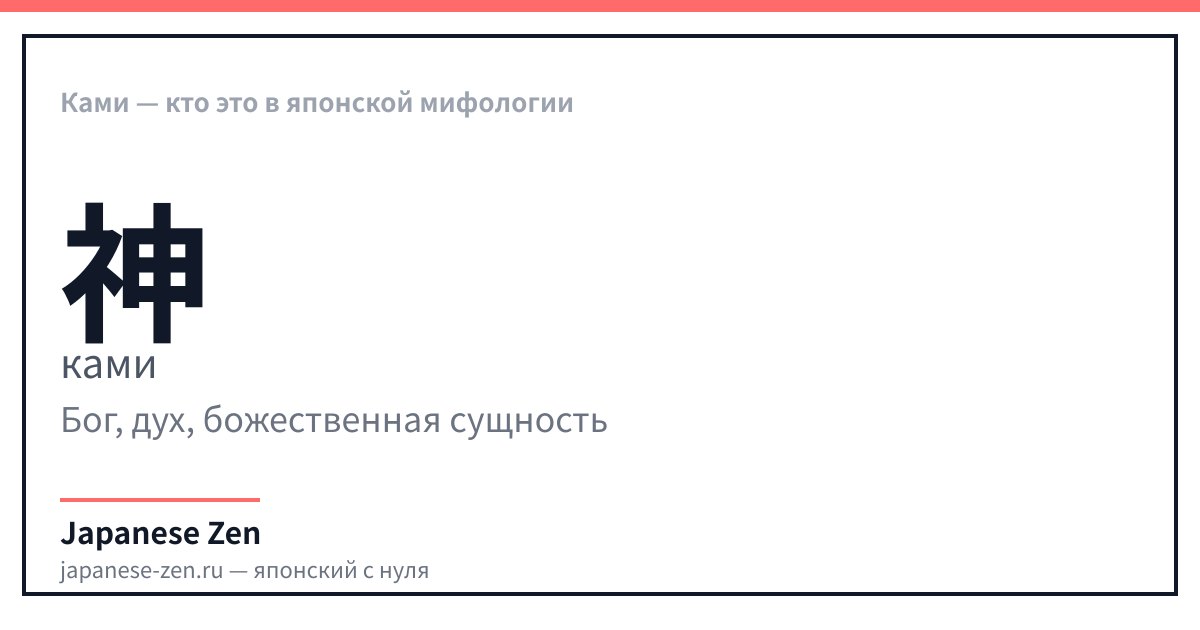
The translation 'god' is the shortest and most deceptive thing you can do with the word 'kami'. This word encompasses both Amaterasu and a roadside boulder that someone once put a sign on.
Who Are Kami and Why Can't They Simply Be Called Gods
Kami is the central concept of Shinto, which is awkward to translate with a single word. There is no formal list of criteria for what counts as a kami. The closest to a definition came from the philologist Motoori Norinaga: kami is everything that evokes a sense of extraordinariness, whether majestic, beautiful, or frightening. Not only Amaterasu, but also a fox, a mountain, a waterfall, or an exceptionally powerful person.
- Heavenly kami (amatsukami) — gods like Amaterasu and Susanoo from the upper tier of the pantheon.
- Earthly kami (kunitsukami) — spirits of specific places: mountains, rivers, trees, stones.
- Ancestral kami (ujigami) — deified founders of clans and distinguished deceased.
- Kami-objects — sacred items (shintai) in which, according to belief, the spirit of a deity temporarily resides.
Which Kami Were Actually Recorded in the Chronicles
The chronicles record only named, 'state' kami — those needed for the genealogy of the imperial house. The concept of kami itself is much broader than written sources: it continues to work today, when Japanese people hang a plaque on an unusual tree or rock.
Do Kami Have Their Own Myth
There is no direct myth 'about kami' as a single character — the concept describes not a hero but a category. The closest illustration of how something becomes a kami is the story of Sugawara no Michizane: an ordinary courtier, after dying in disgrace, became such a powerful source of awe (in his case, terror of revenge) that he was officially recognized as a kami and given a shrine.
So Is It a God or Not
In translated culture, 'kami' is almost always presented as a synonym for 'god' with superpowers. In reality, the status of kami can be obtained posthumously, or through a simple collective feeling that 'there is something in this place' — without any feats or miracles.
神 — A Character with Two Readings
| Japanese | Reading | Translation |
|---|---|---|
| 神 | kami · kami | God, spirit, divine essence |
| 神様 | kamisama · kamisama | God (polite form) |
| 御神体 | goshintai · goshintai | Sacred object-vehicle of kami |
| 神々しい | kōgōshii · ko:go:shi: | Divine, awe-inspiring |
| 畏れ | osore · osore | Awe, reverent fear |
Kami and Shin: When to Use Which Reading
神 is read in two ways: kun'yomi かみ (kami) when the word stands alone, and on'yomi シン (shin) in compound words like 神道 (Shinto) or 神話 (shinwa). The same character freely shifts from 'a specific spirit with a name' to abstract 'divinity' — the boundary between these meanings is not drawn in the language itself.
神 — значение: gods, mind, soul — онъёми: シン、ジン — кунъёми: かみ、かん-、こう- — 9 штрих(ов). 神 — 'god, spirit': on the left is the altar sign 示, on the right is lightning 申 descending from the sky.
Write 神 along the guides — the character that no Japanese legend can do without.
Kami in 'Spirited Away' and in Games
- 'Spirited Away' — a bathhouse for kami, where spirits come to rest from people: perhaps the most complete visualization of the concept in all of pop culture.
- 'Noragami' — a plot directly about what the life of a small, little-known kami without its own permanent shrine looks like.
- 'Your Name' — the theme of shintai and the connection between people and kami runs through the entire plot of the film.
- Ōkami — the entire game is built on the idea of a kami embodied in the form of an animal.
How the Vagueness of the Concept Is Convenient for Authors
The vagueness of the concept of kami is a gift for a screenwriter: almost any supernatural entity can be fitted under it without breaking canon, since the category has no formal boundaries even in the original.
Where Kami Live: Shrines and Beyond
- Any Shinto shrine (神社) — by definition the home of a specific kami.
- Home altar kamidana — a miniature shrine in an apartment or office.
- Sacred trees and stones with a shimenawa rope — a sign that a kami is recognized in them.
- Mount Fuji and other natural objects to which individual shrines at the foot are dedicated.
FAQ
- What does Shinto call the word 'kami'?
- Not 'god' in the usual sense, but everything that evokes awe or reverence: from the great heavenly gods to a mountain, a tree, or an outstanding deceased person. There is no single list of criteria.
- What are kami responsible for?
- It depends on the specific kami: some have a clear sphere like thunder or harvest, others have only the status of 'spirit of this place' without specific functions.
- How is the character 神 read?
- 神 is read かみ (kami) on its own and シン (shin) in compound words like 神道 or 神話. The same character covers both abstract divinity and a specific god with a name.
- Which anime best explains who kami are?
- Visually and in detail — in 'Spirited Away', where the bathhouse is entirely filled with kami coming to rest. The theme is also central to 'Noragami' and the film 'Your Name'.
- Where in Japan are kami worshipped?
- In any Shinto shrine — there are tens of thousands of them in the country, and each is dedicated to a specific kami. At home, a miniature kamidana altar is kept for this purpose.
- Is a kami a god or a spirit?
- Both at once: the Japanese tradition does not separate these concepts as strictly as the European one. The same word covers both a great deity and a humble spirit of a river or tree.
Sources
Updated: 2026-08-29