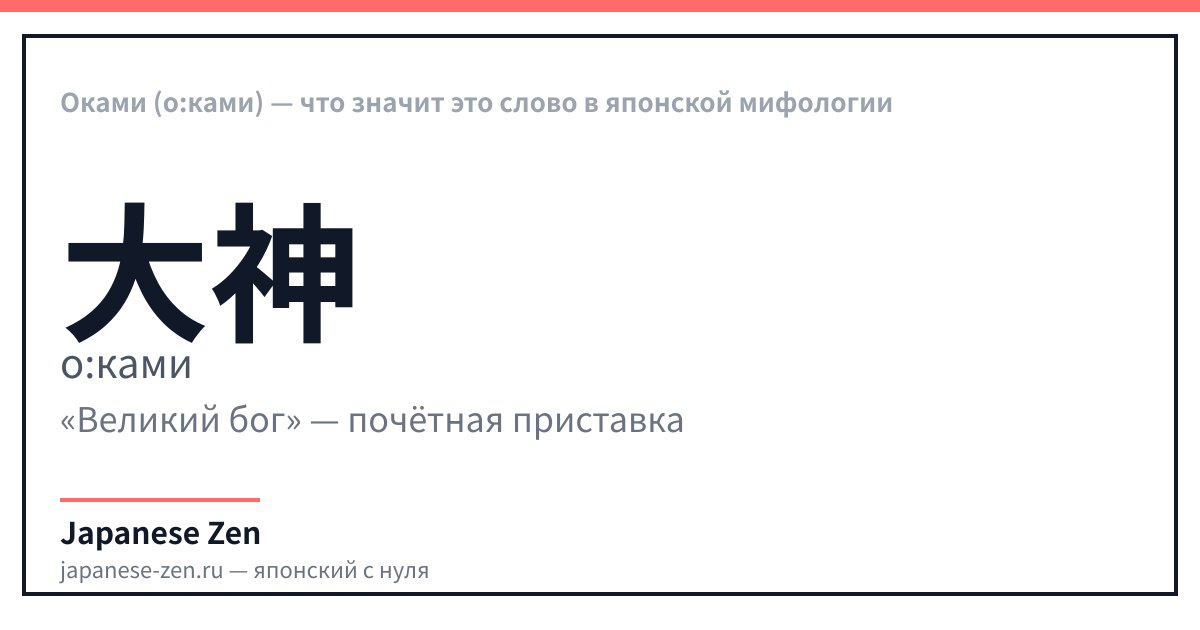
Okami (ōkami) — what this word means in Japanese mythology
In Japanese mythology, "okami" is not a separate deity, but the word 大神 (ōkami), "great god": an honorific prefix that chronicles add to the names of the most significant kami — for example, in the full title of Amaterasu-Ōmikami. Exactly the same reading, おおかみ, is also used for the word "wolf" (狼): the coincidence is accidental, but telling.
It is convenient to confuse "okami" with three different things at once — an honorary title, a wolf, and a video game — and all three are connected by the same sound not without reason.
What does "okami" mean and where did it come from
大神 (ōkami, "great god") is an honorific prefix that Japanese chronicles add to the names of the most significant kami: the full title of Amaterasu sounds like Amaterasu-Ōmikami, literally "great deity illuminating the heavens." This is not the name of a separate god, but a formula of respect applicable to different deities depending on the context.
- What it is: an honorific prefix "great god," not the name of a specific deity.
- Example: Amaterasu-Ōmikami — the full, respectful title of the sun goddess.
- Homonym: the same reading おおかみ is also used for the word "wolf" (狼) — a rare phonetic coincidence.
- Pop culture: the video game Ōkami plays on both meanings at once — Amaterasu in the form of a she-wolf.
How the prefix works in the chronicles
The prefix 大神 regularly appears in both chronicles in reference to the most high-status figures of the pantheon — Amaterasu, Susanoo, and other children of Izanagi. This is part of the courtly language of respect, not a separate mythological lineage.
大神 and 狼 — same reading, different meanings
| Japanese | Reading | Translation |
|---|---|---|
| 大神 | ōkami · ōkami | "Great god" — honorific prefix |
| 狼 | ōkami · ōkami | Wolf — homonym of "great god" |
| 天照大神 | Amaterasu Ōmikami · Amaterasu-Ōmikami | Full, respectful title of the sun goddess |
| 大 | ō · ō | Great, big |
| 尊敬 | sonkei · sonkei | Respect, reverence |
Why wolf and "great god" sound the same
大神 and 狼 are both read おおかみ — a coincidence that researchers consider one of the reasons why the wolf was revered in Japan as a sacred messenger animal: one who is called the same as "great god" seems to receive part of its status for free.
大 — значение: big — онъёми: ダイ、タイ — кунъёми: おお-、おお.きい、-おお.いに — 3 штрих(ов). 大 — "great, big": a pictograph of a person with arms spread wide. One of the most frequent characters in the Japanese language.
Write 大 along the guides — a basic N5-level kanji.
Okami: game, wolf, and title all at once
- Ōkami (2006) — the game's title immediately plays on both meanings of the word: the heroine is Amaterasu in the form of a she-wolf, that is, literally "great god" and "wolf" at the same time.
- The full title Amaterasu-Ōmikami often appears in historical anime and games as a formal address to the goddess.
- Fate/Grand Order uses honorific prefixes like "Ōmikami" to emphasize the status of Japanese divine servants.
FAQ
- Is there a god named Okami in Shinto?
- Not a separate deity, but an honorific prefix 大神 ("great god") added to the names of the most significant kami — for example, in the full title of Amaterasu-Ōmikami.
- What is Okami responsible for?
- Nothing specific — it is not an independent function, but a formula of honor. The functions remain with the god to whose name the prefix is added.
- How is 大神 written?
- 大神 (おおかみ): 大 "great" plus 神 "god." The same reading おおかみ separately also means "wolf" (狼) — a rare and, apparently, significant phonetic coincidence.
- What does the game Ōkami play on?
- The video game Ōkami plays on both meanings of the word at once: the heroine is Amaterasu herself in the form of a she-wolf, combining "great god" and "wolf" in one character.
- In whose names does the prefix "okami" appear?
- In the official names of the most high-status kami in Shinto texts and on shrine plaques — for example, in the full title of Amaterasu-Ōmikami at Ise Jingu.
- Is Okami a separate deity?
- It is not a separate entity, but an honorary title for already existing gods of the highest rank — a kind of superlative within the pantheon, not a new character.
Sources
Updated: 2026-08-29