Hanafuda — what it is and what it is for
Hanafuda is a deck of 48 cards without numbers or familiar suits: instead, there are twelve months, each with its own flower or plant and four cards. The games played with it are older than the Japanese gaming giant Nintendo, which in 1889 started out by producing these cards, not video games.
Hanafuda is not fortune-telling cards or tarot, although they look similar. It is a card game for a group, organized not by numbers but by seasons.
What is hanafuda and what is it for
Hanafuda is a deck of 48 cards divided into 12 months, with four cards for each month: each month has a symbolic plant, not a number or suit. The goal of most games is to collect yaku combinations from cards of different months, similar to how poker players collect combinations from suits. The cards are thick, lacquered, and about half the size of a standard playing card.
- Hikari — 'bright' cards, the most valuable: there are only five, each with a moon, crane, curtain, or other vivid motif.
- Tane — cards with animals and objects, medium value.
- Tanzaku — cards with a poem ribbon, value depends on the ribbon color.
- Kasu — plain cards with no special significance, the most common in the deck.
Koi-Koi: how to play
The most famous hanafuda game is Koi-Koi: players take turns laying down cards, collecting pairs by month, and forming yaku combinations that earn points. A round is short, five to ten minutes, so players play multiple rounds until a pre-agreed score is reached.
Name and kanji: 花札
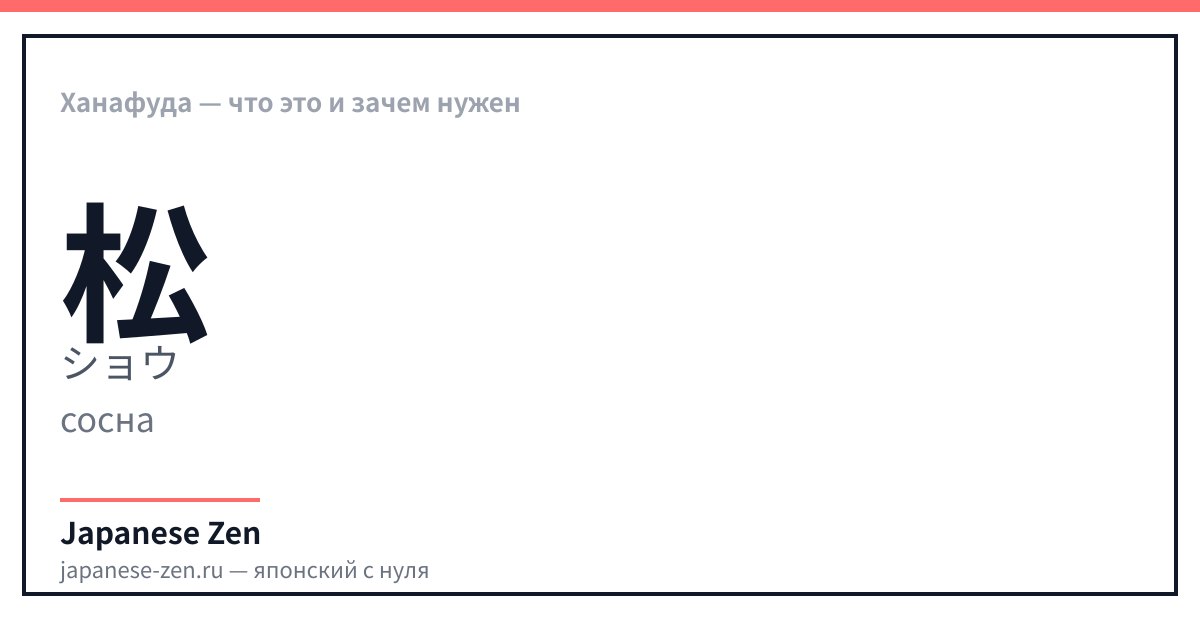
松 — значение: pine — онъёми: ショウ — кунъёми: まつ — 8 штрих(ов). 松 — 'pine': the card 'pine and crane' (松に鶴) is one of the five hikari, the most valuable cards in the deck, symbolizing the first month, January.
| Japanese | Reading | Translation |
|---|---|---|
| 花札 | hanafuda · hanafuda | Hanafuda, flower cards |
| 松 | matsu · matsu | Pine |
| 役 | yaku · yaku | Card combination |
| 光 | hikari · hikari | Light; the most valuable cards |
| 遊ぶ | asobu · asobu | To play |
花札 — flower cards
花札 means 'flower cards': 花 'flower' and 札 'card, tag'. The breakdown of the character 花 is on a separate page about the kanji 'flower', which often appears in other words on this topic. There are no labels on the cards: the design without numbers arose partly because the authorities of the Edo period repeatedly banned card games with numbers as gambling, and the new design each time circumvented the old ban.
Practice the stroke order of the character 松 in the trainer — the symbol of the first month in hanafuda.
Hanafuda in anime and games
- Tanjiro's earrings in 'Demon Slayer' are stylized after the hanafuda motif — a red circle with rays, like on the 'hikari' card.
- Nintendo started in 1889 by producing hanafuda cards and only decades later moved to video games.
- Koi-Koi and other hanafuda games occasionally appear as a mini-game within larger video games with a Japanese setting.
- The card patterns — pine, plum, cherry blossom, iris, peony, moon with susuki grass, chrysanthemum, maple, willow — are recognizable even without knowing the rules, simply as a 'Japanese floral ornament'.
Hanafuda is not tarot
Hanafuda is often confused with tarot cards because of the bright miniature artwork, but it is purely a game deck with no divination purpose. The meaning of a card is the month and points, not a prophecy.
Where to buy and what does Nintendo have to do with it
Hanafuda is sold in any large toy and stationery store, and the Nintendo Museum in Uji devotes a separate part of its exhibition to this production, with an interactive game. In everyday life, people still play it with friends and family on New Year's and on vacation — it is more of a family game than a museum exhibit.
The deck as a souvenir
As a gift, hanafuda is chosen as a souvenir with simple rules — a compact deck that can be explained in five minutes. Collector's lacquered versions are two to three times more expensive than regular ones and are suitable as a more prestigious gift, rather than a game set for an actual match.
FAQ
- What do hanafuda earrings mean?
- 'Hanafuda earrings' are usually searched for because of Tanjiro from 'Demon Slayer': his earrings are stylized after the 'hikari' card from the deck. A detailed breakdown is on a separate page about Tanjiro's earrings.
- What is hanafuda?
- A deck of 48 cards without numbers, divided into 12 months with four cards each, featuring a symbolic plant for each month. You play for yaku combinations, not suits, as in regular cards.
- What is hanafuda for?
- To play Koi-Koi and other card games with a group — the goal is to collect a combination of cards of the same month or a special set. A round is short, five to ten minutes.
- How do you write 'hanafuda' in Japanese?
- It is written 花札, read 'hanafuda': 花 'flower' plus 札 'card'. Literally — 'flower cards', from the floral design on each of them, without numbers or suits.
- What does hanafuda mean?
- There is no single meaning: each card represents a month and a plant, and its value depends on the type — hikari, tane, tanzaku, or kasu.
- Where is hanafuda found in Japan?
- In toy and stationery stores throughout the country, and the Nintendo Museum in Uji devotes a separate part of its exhibition to the history of the cards. At home, people play it with friends and family on New Year's.
Sources
Updated: 2026-08-24