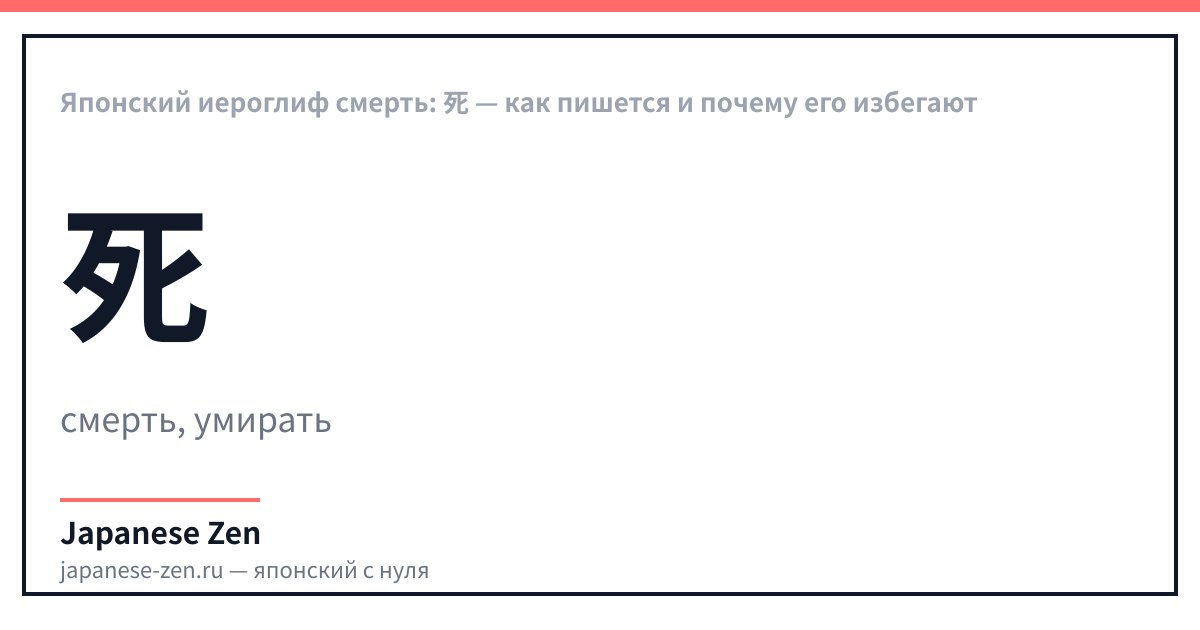
Japanese death kanji: 死 — how to write it and why it is avoided
The Japanese death kanji is 死, 6 strokes, N4 level. It is read as "shi" (on'yomi シ) and "shinu" (kun'yomi し.ぬ, "to die"). Because 死 sounds like the number "four" (四, also "shi"), in Japan they avoid fours: hospitals have no room No. 4, and gifts are not given in sets of four.
In Japanese homes there are floors without the number 4, and in dinnerware sets there are five items instead of four. The reason is one syllable: 四 "four" and 死 "death" are read the same — "shi". Here, language turned out to be more superstitious than people.
How to write the Japanese death kanji
死 — значение: death, to die — онъёми: シ — кунъёми: し.ぬ、し.に- — 6 штрих(ов). N4 level, 6 strokes. Click "Show order" — the strokes will go as in handwriting.
What the sign consists of
On the left is 歹, an ancient element meaning "remains", on the right is 匕, a bowed figure of a person. Together it turns out to be a living person next to the departed: the sign depicts not death itself, but the one who bowed over it.
Why the number four is unlucky in Japan
四 (four) is read as "shi" — like 死. Therefore, in everyday counting, the number four is often replaced with "yon": not "shi-hon", but "yon-hon". In hospitals, the number 4 is skipped, in hotels sometimes the 4th floor too, and dishes are sold in sets of five.
Words with the death kanji
| Japanese | Reading | Translation |
|---|---|---|
| 死 | shi · shi | Death |
| 死ぬ | shinu · shinu | To die |
| 必死 | hisshi · hisshi | Desperately, with all one's might (literally "certain death" — i.e., at the limit) |
| 死活 | shikatsu · shikatsu | Life and death, critical |
| 亡くなる | nakunaru · nakunaru | To pass away (polite replacement for 死ぬ when talking about people) |
| 四 | shi · shi | Four (that very homophone; in counting, "yon" is more common) |
How to speak about death politely
死ぬ is a direct and somewhat rude "to die", like the Russian "sdohnut" in reference to a person. About people they say 亡くなる (nakunaru) — "to leave", or 逝去 (seikyo) in official speech. In news about a person, they will never say 死んだ, only 亡くなった.
Is it worth taking 死 for a tattoo
- For a Japanese person, this is not "dark aesthetics", but a word from a medical record and crime chronicle — the effect will not be what is expected.
- If you need the theme of accepting the end, Japanese culture uses other images: 無常 (mujō) "impermanence of all things", 桜 (sakura) as a symbol of short-lived beauty.
- The combination 死神 (shishin) — "god of death", the very one from "Death Note"; it is read unambiguously and is understandable in the anime context.
- Stroke order: first the left element 歹 from top to bottom, then the right 匕 — it is written last.
Write 死 yourself
Trace the sign along the guides — the system will evaluate each stroke.
FAQ
- What Japanese kanji means death?
- 死 — 6 strokes, N4 level. It is read as "shi" (on'yomi) and "shinu" in the verb 死ぬ "to die".
- Why do Japanese people dislike the number 4?
- 四 "four" is read as "shi" — the same as 死 "death". Because of the homophone, the number four is replaced with "yon" in counting, room numbers are skipped, and sets of four are not given as gifts.
- What does "shinigami" mean?
- 死神 (shishin/shinigami) — "god of death", a guide of the dead in Japanese tradition. The word is familiar from "Death Note" and "Bleach"; it consists of 死 "death" and 神 "god".
- How to say "died" politely in Japanese?
- 亡くなりました (nakunarimashita) — "passed away". The direct 死んだ about a person sounds rude; it is used only when talking about animals or in harsh speech.
Updated: 2026-07-25