Japanese luck kanji: 運 and 福 — which one to choose
The Japanese kanji for luck is 運 (un), 12 strokes: it means both 'luck' and 'fate'. The second character also translated as luck is 福 (fuku), 'happiness, well-being': it appears on New Year's amulets and maneki-neko figurines. 'Luck' as a standalone word is more often written with two characters: 幸運 (kōun).
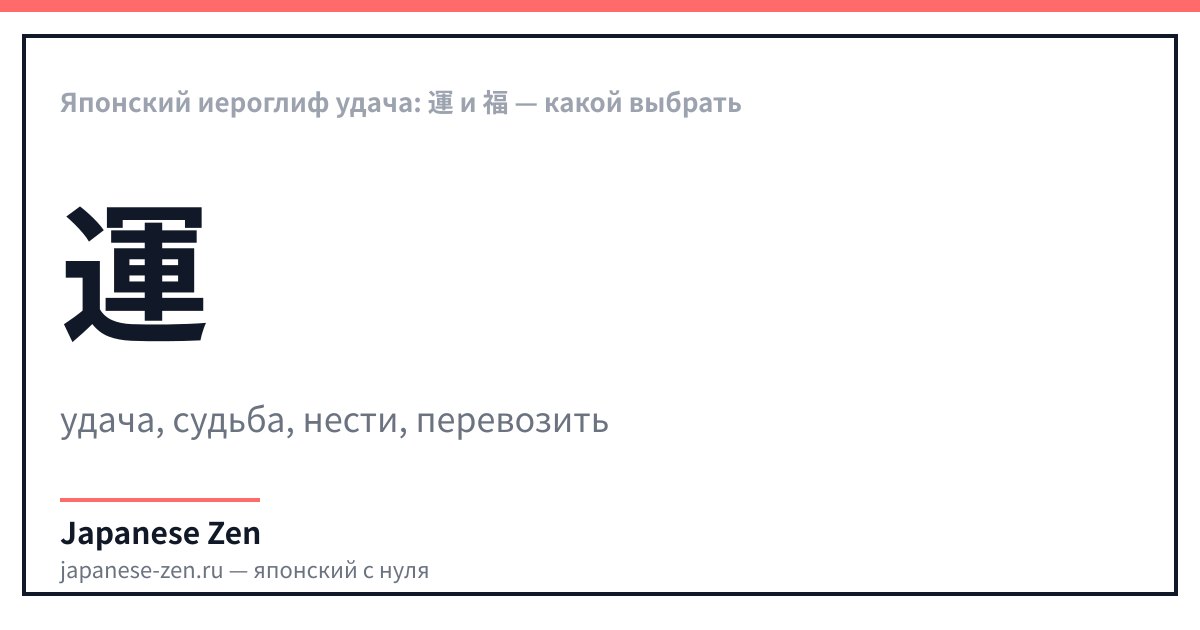
Japanese luck has no wheel of fortune. 運 literally means 'to carry' — that which carries you along the current. Therefore 運がいい ('luck is good') sounds not like 'I got lucky' but like 'the road turned out well': not chance, but direction.
How to write the Japanese luck kanji
運 — значение: luck, fate, to carry, to transport — онъёми: ウン — кунъёми: はこ.ぶ — 12 штрих(ов). Level N4, 12 strokes. Click 'Show stroke order' — the strokes will appear in the order they are written by hand.
What the character consists of
At the bottom left is 'road' ⻌ (the same element as in 道 'path' and 送 'to send'), at the top right is 軍 'army'. The character was formed from the image of a moving convoy: something large moving along a road. Hence the two modern meanings — 'to transport' and 'fate' that carries you.
運 or 福 — which is drawn on amulets
On New Year's talismans, money envelopes, and ceramic maneki-neko cats, 福 (fuku) — 'well-being, prosperity' — is more common. 運 is about the course of events, 福 is about a full cup. If you need a 'good luck' sign as a gift, a Japanese person would choose 福; if it's about luck in a specific matter, 運.
Words with the luck kanji
| Japanese | Reading | Translation |
|---|---|---|
| 運 | un · un | Luck, fate, lot |
| 幸運 | kōun · kōun | Luck, fortunate turn of events (the most accurate 'luck' as a noun) |
| 運命 | unmei · unmei | Fate, destiny (that very 'unmei' from anime and songs) |
| 幸 | sachi · sachi | Happiness, luck (the same character is read 'shiawase' in 幸せ 'happiness') |
| 福 | fuku · fuku | Happiness, well-being, prosperity (the character from amulets and maneki-neko) |
| 縁起 | engi · engi | Omen, sign of fate (縁起がいい — 'a good omen') |
| 開運 | kaiun · kaiun | Turning fate for the better (inscription on talismans from temples) |
Luck kanji for tattoos and talismans
- A lone 運 would be read by a Japanese person more as 'fate' than 'luck' — the meaning is neutral, it can also mean a bad lot.
- 'Good luck' is 幸運 (kōun) or 開運 (kaiun); these are what is written on temple amulets.
- The character 福 looks friendlier and more unambiguous: 'well-being'. It is also used by the Chinese, so it is read there too.
- The stroke order of 運 is visible in a finished work: first the right part 軍, then the 'road' at the bottom left — it is written last.
Write 運 yourself
Trace the kanji along the guides — the system will evaluate each stroke.
FAQ
- Which Japanese kanji means luck?
- 運 (un) — luck and fate at the same time, 12 strokes, level N4. 福 (fuku) is used for 'happiness and well-being'. The word 'luck' in full is 幸運 (kōun).
- How is the kanji 運 read?
- On'yomi — ウン (un), in words like 運命 (unmei) and 幸運 (kōun). Kun'yomi — はこ.ぶ (hakobu), 'to carry, to transport': this is the original meaning of the character.
- How is 運 different from 福?
- 運 — the course of events, fate, can also be unlucky. 福 — well-being and prosperity, always positive. On amulets and New Year's decorations, 福 is more common.
- Is this a Chinese or Japanese kanji?
- The character came from China and is used in both languages with a similar meaning. The Japanese writing 運 coincides with the traditional Chinese; in mainland China it is written simplified — 运.
- How do you say 'fate' in Japanese?
- 運命 (unmei) — fate, destiny. There is also 宿命 (shukumei) — predestination, and 縁 (en) — the bond between people, which is also considered a manifestation of fate.
Updated: 2026-07-25