Kamidana — what it is and why you need it
Kamidana is a home Shinto shelf-altar for an ofuda amulet: miniature torii gates and a shrine scaled to a room, where people bow every day and offer rice, salt, and water. It is kept above eye level, usually on a separate shelf in a clean part of the house, facing south or east.
Kamidana is not a decoration or a souvenir from a shelf. It is a working altar scaled to a room, approached every day, not once a year for a festival.
What is kamidana and why is it needed
Kamidana is a home Shinto altar the size of a small shelf: a miniature shrine with tiny torii gates, where an ofuda amulet from a temple is placed. People bow before it, clap their hands, and leave simple offerings — rice, salt, water, sometimes sake. It is not a decoration but a working point of connection with kami, the guardian deity of the home or locality.
- Ofuda — the main amulet, usually from the Ise Shrine and the local guardian temple.
- Miniature torii — symbolic gates in front of the shrine.
- Offerings — rice, salt, water; changed regularly, sometimes every day.
- Place — above eye level, on a clean wall, facing south or east.
Two bows, two claps, one bow
Before the kamidana, people bow twice, clap their hands twice, and bow once more — the same ritual as at the entrance to a real shrine, only scaled to a room. Offerings are changed on a schedule: water and rice frequently, more elaborate ones on festivals.
Name and characters: 神棚
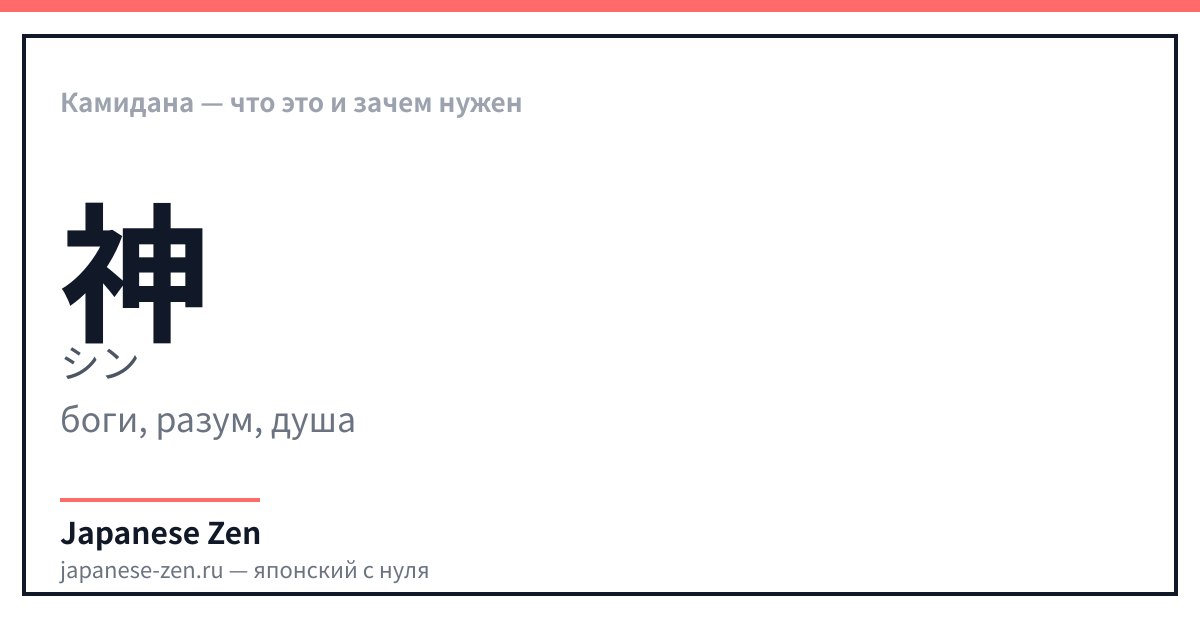
神 — значение: gods, mind, soul — онъёми: シン、ジン — кунъёми: かみ、かん-、こう- — 9 штрих(ов). 神 — 'kami, deity, spirit': on the left is the altar sign 示, on the right is the phonetic element. One of the key kanji of Shinto: without it, no word about shrines and spirits can be read.
| Japanese | Reading | Translation |
|---|---|---|
| 神棚 | kamidana · kamidana | Kamidana |
| 神 | kami · kami | Deity, spirit |
| 神社 | jinja · jinja | Shinto shrine |
| 祀る | matsuru · matsuru | To worship, to honor a deity |
| 拝む | ogamu · ogamu | To pray, to bow |
神棚 — shelf for kami
神棚 is read 'kamidana' and is composed of 神 'kami' and 棚 'shelf' — 'shelf for kami', literally and without metaphors. The inscription on the ofuda amulet itself is the name of the guardian deity, but the kamidana itself is usually not labeled: it simply holds the amulet at the proper height.
Repeat the stroke order of the character 神 in the trainer — the key kanji of the Shinto theme.
Not only at home: shops and offices
Kamidana is found in private homes, but it is more often seen in shops, offices, and small businesses. A Tokyo shop or restaurant almost always keeps such a shelf at the entrance or behind the counter — with offerings and an amulet for good luck in business. In modern apartments, it is sometimes replaced with a compact wall-mounted version due to lack of space.
You can give a shelf, but not an ofuda
The kamidana itself as an empty shelf can be bought and given as a gift — it is just a piece of furniture without consecration. But the ofuda amulet is only received at a Shinto shrine, usually once a year, and is not bought like an ordinary souvenir at a market.
FAQ
- What is kamidana?
- A home Shinto altar the size of a small shelf: a miniature shrine with an ofuda amulet, where people bow every day and offer simple offerings — rice, salt, water.
- Why is kamidana needed?
- To keep the ofuda amulet at the proper height and have a point for daily communication with kami, the guardian deity of the home. Without a kamidana, the amulet would simply lie in a drawer.
- How do you write 'kamidana' in Japanese?
- It is written 神棚, read 'kamidana': 神 'kami' plus 棚 'shelf' — literally 'shelf for kami', without metaphors or hidden meaning.
- What does kamidana mean?
- Literally — 'shelf for kami': a place where the ofuda amulet is placed and where people come to bow to the guardian deity of the home or business, not just an interior item.
- Where is kamidana found in Japan?
- In private homes, but more noticeably in shops, offices, and small businesses: a shelf at the entrance or behind the counter with an amulet for good luck in business.
- Where in anime can you notice kamidana?
- Home or shop scenes with a kamidana in the background are often found in anime about everyday life — an interior detail, not a plot accent.
Sources
Updated: 2026-08-24