Kasha — who is it in Japanese mythology
Kasha (火車) is a vulture demon in cat form, and Japanese mythology gave it a grim role: to appear at the funeral of a sinner and drag the body right out of the coffin, often in a fiery cart. Kasha is directly connected to the cat monsters bake-neko and nekomata — in some legends it is their particularly old and evil variety.
Kasha is a rare character whose specialization begins exactly where life ends: it does not scare the living, but works at funerals.
Who is kasha and why does it need the dead
Kasha is a demon that steals the bodies of deceased sinners right during the funeral rite, often in the midst of a thunderstorm. According to legend, it descends from the heavens in a fiery cart or appears as a giant cat monster that snatches the corpse from the coffin in front of the mourners. In some sources, it is directly linked to bake-neko and nekomata as their particularly old and dangerous form.
- Specialization: steals the bodies of sinners at funerals.
- Appearance: a giant cat demon or a rider of a fiery cart.
- Relation: considered related to or a particularly old form of bake-neko and nekomata.
- Protection: monks recited sutras and burned incense during the wake to scare off kasha.
Who is it actually dangerous to
For the living — practically safe; for deceased sinners — yes, and specifically: the theft of the body was considered a final spiritual catastrophe, depriving the deceased of any chance for a dignified afterlife.
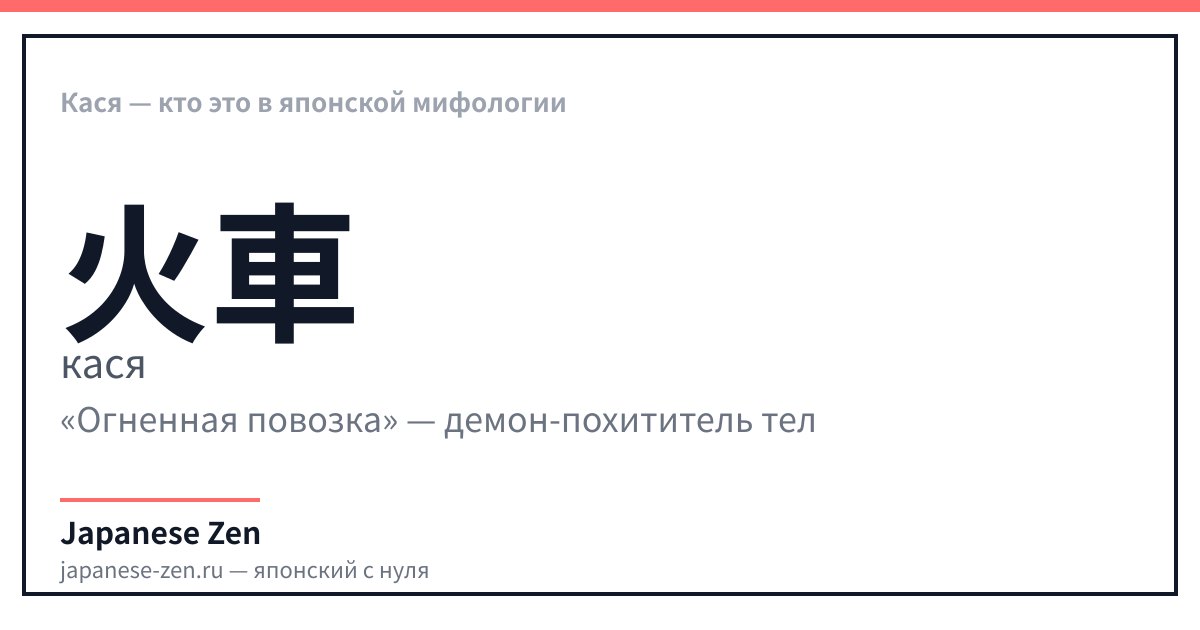
火車 — “fiery cart”
| Japanese | Reading | Translation |
|---|---|---|
| 火車 | kasha · kasha | “Fiery cart” — demon that steals bodies |
| 葬式 | sōshiki · so:shiki | Funeral |
| 棺 | hitsugi · hitsugi | Coffin |
| 猫又 | nekomata · nekomata | Related cat yokai |
| 雷雨 | raiu · raiu: | Thunderstorm |
The same term in Buddhist texts
火車 is read かしゃ (kasha): 火 “fire” plus 車 “cart, wheel” — literally “fiery cart.” The same term in Buddhist cosmology also denotes a hellish chariot that carries away sinful souls — the image of the demon that steals bodies grew precisely from this broader Buddhist concept.
火 — значение: fire — онъёми: カ — кунъёми: ひ、-び、ほ- — 4 штрих(ов). 火 — “fire”: a pictogram of flames. The same character appears in 火曜日 (Tuesday) and dozens of words related to fire.
Write 火 along the guides — a simple and frequent character at N5 level.
Kasha in yokai encyclopedias and anime
- Yokai encyclopedias and series like “Natsume's Book of Friends” periodically introduce cat demons that steal bodies as individual episode characters.
- In horror games, the image of a demonic fiery cart is often used for bosses associated with the afterlife.
- The motif of a “cat at a funeral” as a bad omen has survived in certain superstitions and indirectly echoes the legend of kasha.
FAQ
- Is kasha a Shinto creature or a Buddhist one?
- It is not a Shinto deity, but a demon of Buddhist origin that steals the bodies of sinners at funerals. It has no relation to the kami pantheon.
- What is kasha dangerous for?
- It steals the bodies of deceased sinners right during the funeral rite, often in the midst of a thunderstorm, depriving the deceased of any chance for a dignified afterlife.
- What do the characters 火車 mean?
- 火車 (かしゃ): 火 “fire” plus 車 “cart.” Literally “fiery cart” — the term also appears in Buddhist cosmology referring to a hellish chariot.
- Where does kasha appear in anime?
- Periodically in yokai series like “Natsume's Book of Friends,” where cat demons appear as individual episode characters related to funeral themes.
- How did people in Japan protect themselves from kasha?
- Monks recited sutras and burned incense during the wake — it was believed that this would scare off the demon and prevent it from stealing the body of the deceased.
- Is kasha a demon or a werecat?
- It is a demon-yokai of Buddhist origin, closely related to the werecats bake-neko and nekomata — not a deity and not the spirit of a deceased person in the pure sense.
Sources
Updated: 2026-08-29