Obon — what is this tradition and how it goes
Obon (お盆) is a Buddhist festival of ancestor remembrance in midsummer: spirits of the dead, according to belief, return home for a few days, and relatives greet them with fire, clean graves, and dance bon odori in the square. In most regions it takes place in mid-August, in some — in July. Many Japanese travel to their hometowns to be with family, like for the main holidays of the year.
From the outside, Obon can easily be mistaken for a summer festival with lanterns and dances. In essence, it is a family memorial service, just stretched over several days and without a mournful tone.
What is Obon and when is it held
Obon is a Buddhist rite of ancestor remembrance: it is believed that for a few days spirits return to the family home, and the family prepares for their reception — from cleaning the grave to setting up an altar with offerings. At the same time, Obon is not mournful: the tone is rather warm, a meeting with relatives, albeit invisible ones.
- When: mid-August in most regions, mid-July in Tokyo and part of Kanto.
- Who: the whole family, often gathering from different cities specifically for these days.
- Where: the home with the family altar butsudan and the cemetery, where the grave is cleaned before the festival.
- What they do: light bonfires, prepare special offerings, dance bon odori in the square.
The Ullambana Sutra and the monk Mokuren
The tradition is traced back to the Buddhist Ullambana Sutra and the legend of the monk Mokuren, who saved his mother's soul through offerings to monks. Over time, the rite merged with local Shinto practices of ancestor veneration, resulting in a festival where Buddhist and Shinto logic work together without displacing each other.
Three days of Obon in order
- A few days before the festival, the family grave is cleaned and the headstone is washed.
- The butsudan altar at home is prepared: special offerings are placed, often figurines of animals made from cucumber and eggplant — transport for the spirits.
- On the first day, mukaebi, the welcoming fire, is lit — the fire shows the spirits the way home.
- During the festival days, the grave is visited, a family meal is held, and in many cities people go to bon odori.
- On the last day, okuribi, the send-off fire, is lit, or lanterns are set afloat on water — symbolically seeing the spirits off.
How to offend the memory of ancestors
- Forgetting to clean the grave before the festival is considered a serious neglect of the ancestors' memory.
- Holding a noisy non-family celebration during these days without respect for the essence of the festival.
- Skipping the lighting of the send-off fire if the family has started the rite — the cycle of meeting and seeing off should be completed.
- Confusing Obon with mourning: crying and grieving is not necessary, the tone of the festival is rather bright.
Words and characters: お盆
| Japanese | Reading | Translation |
|---|---|---|
| お盆 | obon · obon | Obon |
| 盆 | bon · bon | Tray (also a shortened name of the festival) |
| 先祖 | senzo · senzo | Ancestors |
| ろうそく | rōsoku · roosoku | Candle |
| 盆踊り | bon odori · bon odori | Obon dance |
お盆 — tray for offerings
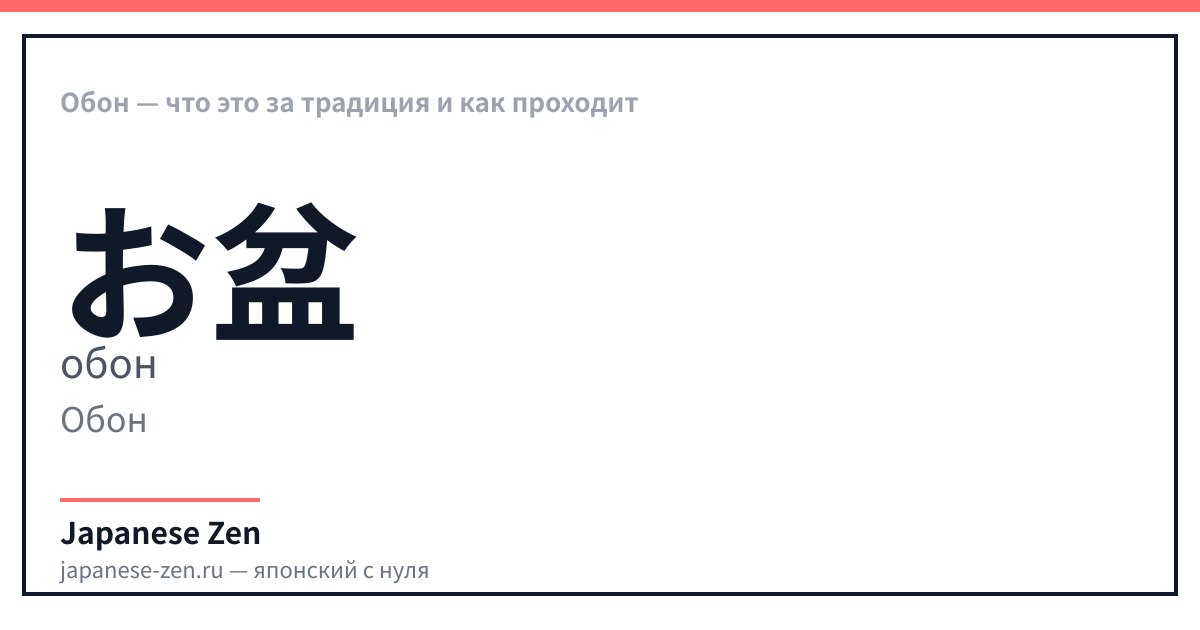
お盆 literally means 'tray' — the prefix お is polite, and the character 盆 historically indicated a vessel for offerings in the Buddhist Ullambana rite. Over time, the name of the vessel became the name of the whole festival.
盆 — значение: basin, lantern festival, tray — онъёми: ボン — 9 штрих(ов). 盆 — 'tray, basin': the same character in 盆栽 'bonsai', literally 'grown on a tray', a miniature tree in a shallow container.
Listen to the words of Obon and repeat — the app will evaluate your pronunciation.
Obon in anime
Obon often serves as a backdrop for summer stories about home and family — not only a festival, but also a reason to show a character's trip to their native places.
- A crowd in yukata around the yagura platform in the square with bon odori — a recognizable summer scene of group fun.
- Lanterns set afloat on water at the end of an episode — a visual image of farewell, often with emotional undertones.
- A character returning to their hometown for a few summer days — a plot device for a family storyline.
- A conversation at the family grave or butsudan altar — a rare but recognizable detail specific to this festival.
What emphasizes the summer atmosphere
Obon in anime almost always goes hand in hand with the sound of cicadas and evening heat — this is how creators indicate the season without naming the festival directly.
FAQ
- What is Obon?
- A Buddhist festival of ancestor remembrance: according to belief, the spirits of the dead return home for a few days. The family cleans the grave, prepares the butsudan altar, and greets the spirits with a ritual welcoming fire.
- When is Obon held?
- In mid-August in most regions of Japan, and in mid-July in Tokyo and part of the Kanto region. The difference in dates remains from the calendar reform of the 19th century.
- How does Obon go?
- They clean the grave, light the welcoming fire, have a family meal, and often go to the bon odori dance. On the last day, they light the send-off fire or set lanterns afloat on water.
- How is 'obon' written in Japanese?
- お盆, in kana おぼん. The prefix お is polite, the character 盆 means 'tray': historically a vessel for offerings in a Buddhist rite, which over time gave its name to a whole summer festival.
- Can a guest dance bon odori?
- Yes, anyone can participate in the bon odori dance in the city square: the movements are simple and repeat in a circle. However, you should not approach the family altar without an invitation.
- How does Obon appear in summer episodes?
- Often as a backdrop for a summer story about home: a crowd in yukata near the bon odori platform, lanterns on the water, a character's trip to their hometown. The festival is indicated by atmosphere, not always named directly.
Sources
Updated: 2026-08-24