"Omae wa mou shindeiru" — translation and breakdown of the phrase
"Omae wa mou shindeiru" (お前はもう死んでいる) translates to "you are already dead." It's Kenshiro's line from "Fist of the North Star": he strikes pressure points, the opponent is still standing and doesn't realize he's doomed — and replies with a bewildered なに (nani), "what?" Grammatically, the phrase relies on the 〜ている construction, which denotes not an action but a state that has come about.
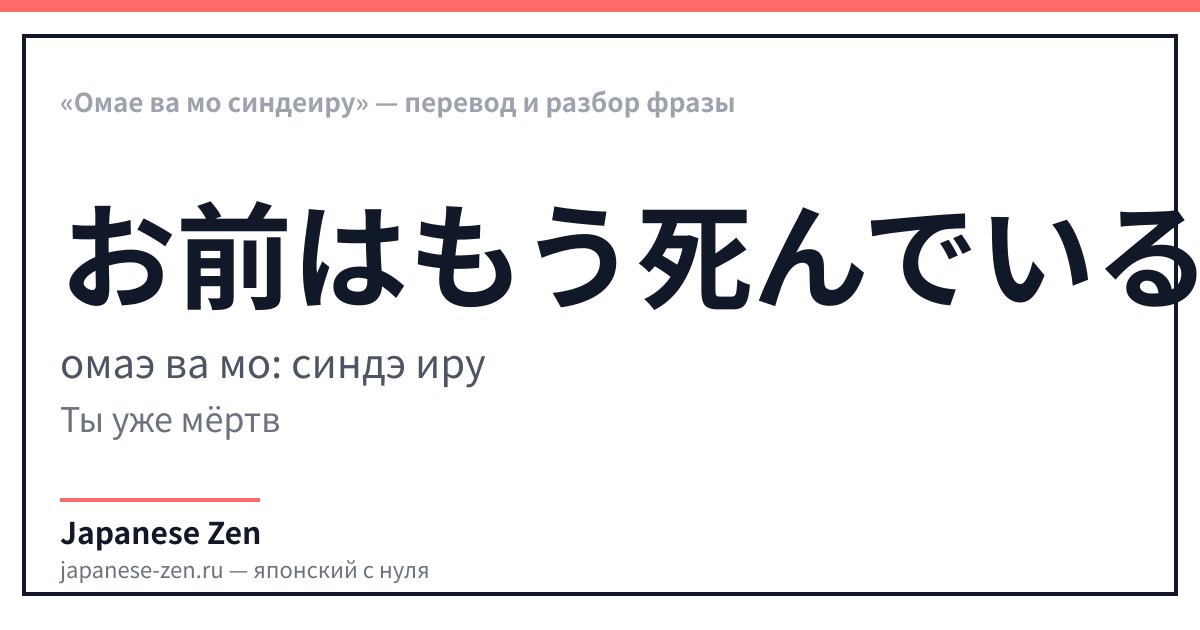
Even those who haven't watched the anime know the meme, but almost no one notices the main thing: in Japanese, the phrase is said in the present tense, meaning "you are dead right now," not "you will die." It's this grammar that makes it eerie.
What "omae wa mou shindeiru" means word by word
| Japanese | Reading | Translation |
|---|---|---|
| お前はもう死んでいる | omae wa mou shindeiru · omae wa mou shinde iru | You are already dead |
| お前 | omae · omae | You (rude masculine "you," from superior to inferior) |
| もう | mou · mou | Already (long "o", don't confuse with もっと) |
| 死んでいる | shindeiru · shinde iru | Dead (state after death) (from 死ぬ "to die" in the 〜ている form) |
| なに | nani · nani | What?! (the opponent's response, the second half of the meme) |
Why it's "dead," not "will die"
The 〜ている form with instantaneous verbs denotes not a process but a result: 死んでいる is not "dying" but "being in a state of death." The same mechanism is in 結婚している (married, not "getting married") and 知っている (know, not "come to know"). Russian translates this with the present or past tense, which loses the grammatical horror of the phrase.
死 — значение: death, to die — онъёми: シ — кунъёми: し.ぬ、し.に- — 6 штрих(ов). 死 — the key kanji of the phrase, N4 level. Click "Show stroke order" to see how to write it by hand.
Careful with "omae": it's not a neutral "you"
お前 is a pronoun from superior to inferior. It's appropriate in a fight, among close male friends, or for a character demonstrating superiority. To a stranger, such a "you" sounds like a challenge.
- Neutral "you" — あなた (anata), but more often Japanese people omit the pronoun altogether or call the person by their surname with ‑さん.
- 貴様 (kisama) — even ruder than お前, although the characters literally mean "noble lord": the politeness has worn away over centuries.
- てめえ (temee) — a distorted 手前, a swear word "you" from fights and anime.
- What not to do: don't address an older Japanese person or a colleague with お前 — the meme phrase in a real conversation will sound aggressive.
How to pronounce it
"O-ma-e wa mo: shin-de i-ru." Two places where people most often make mistakes: もう is pronounced with a long "o" — "mo:", not "mo"; in 死んでいる, the "n" sound before "d" remains a separate syllable, so it becomes "shin-de", not "shinde". In casual speech, いる is shortened to 死んでる (shinderu).
Say the phrase aloud — the app will compare your pronunciation with the reference.
FAQ
- "Omae wa mou shindeiru" — what is the translation?
- "You are already dead." Kenshiro's line from "Fist of the North Star": the opponent is still standing, but the strike to the pressure points is already fatal.
- How do you write "omae wa mou shindeiru" in Japanese?
- お前はもう死んでいる. In kana: おまえはもうしんでいる.
- What does the opponent reply?
- なに (nani) — "what?!". This line became the second half of the meme and sounds right after Kenshiro's phrase.
- Can I use "omae" in everyday speech?
- Better not. お前 is a rude "you" from superior to inferior; the neutral option is addressing by surname with the suffix ‑さん.
Updated: 2026-07-25